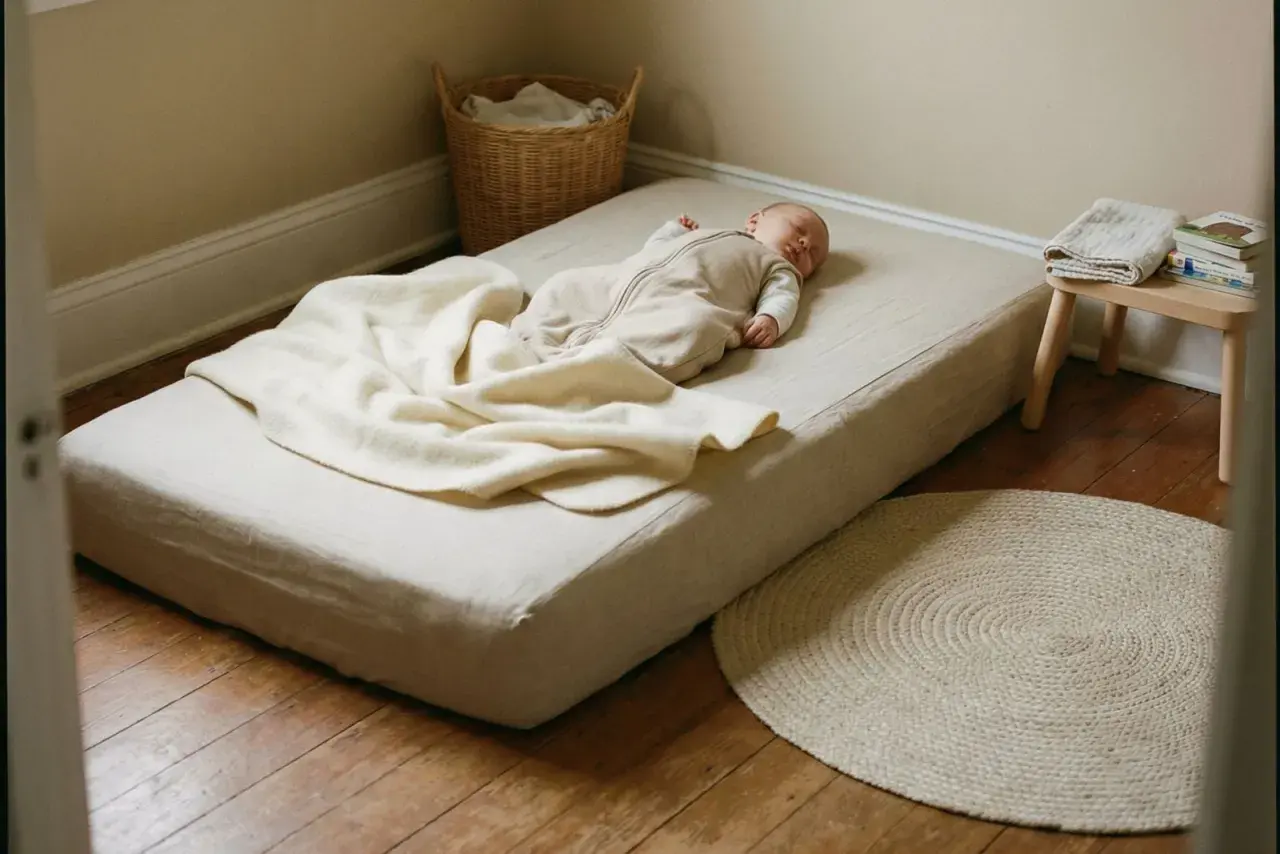
The short answer to what is a floor bed is simple: a mattress placed directly on the floor, or on a very low base, so a child can get in and out without a tall barrier. I use it most often in toddler rooms, where independence matters and the sleep space has to be calm, simple, and safe. In this article, I break down how it works, when it makes sense, how it compares with a crib, and the setup mistakes that can make it frustrating or unsafe.
Floor beds work best when the child and the room are ready
- A floor bed is usually a mattress on the floor or on a very low frame.
- It is most useful for toddlers and older children, not infants.
- Room safety matters more than the mattress style, so childproofing comes first.
- The transition often goes smoother when the child can already settle, wake, and move safely.
- A crib still makes more sense for many babies and for families who need more containment.
What a floor bed actually is
I think of a floor bed as a sleep setup built at the child’s level rather than the adult’s. It can be as simple as a mattress placed on the floor, or it can sit on a very low platform that keeps the profile close to the ground. The point is not luxury or style; the point is access. The child can climb in, climb out, and settle without needing a ladder, tall rail, or adult lift every time.
That idea also fits the broader child-led bedroom approach I see in Montessori-inspired homes, where the room is arranged so the child can move independently. In practice, that means the bed is only one piece of the setup. The rest of the room has to support the same goal, which is why I treat this less like a furniture choice and more like a whole-environment decision. Once that is clear, the more useful question becomes why families choose it in the first place.
Why many parents choose one
Parents usually choose a floor bed for the same reason toddlers love it: it gives them a little more control. A child can get up to look at books, come to the door, or settle back down without turning bedtime into a negotiation over crib rails. That can reduce some of the friction that shows up when a child is ready for more autonomy but still needs a defined sleep routine.
I also see floor beds work well when families want the bedroom to feel less restrictive. Instead of a sleep space that exists only for containment, the room becomes a calm place for rest, dressing, and quiet routines. That said, I would not oversell the benefit. A floor bed does not magically fix sleep. It simply removes one barrier, and that only helps when the rest of the setup is solid.
- More independence. Children can get in and out without asking for help every time.
- Less climbing drama. Toddlers who try to escape a crib may do better with a lower sleep surface.
- Easier routines. A child can settle with a book, a song, and a clear routine instead of treating the crib like a wall.
- Better room use. The bedroom starts to function like a child-friendly space instead of a containment zone.
Those benefits are real, but they depend on timing. That leads to the part I would not skip: when a floor bed makes sense and when it does not.
When it makes sense and when it does not
For infants, I would not use a floor bed as a substitute for safe sleep. The AAP still recommends that babies sleep on their backs in a crib, bassinet, or portable play yard with a firm, flat mattress and a fitted sheet. In other words, this is a toddler-and-up decision, not a casual replacement for infant sleep guidance.
| Situation | Floor bed usually fits | Better to wait or use a crib |
|---|---|---|
| Age and mobility | Toddler or older child who can move safely and steady themselves | Baby under 12 months or a child who still needs containment |
| Room safety | Furniture anchored, cords hidden, outlets covered | The room still has climbable, sharp, or unstable hazards |
| Sleep pattern | Child already settles with a predictable routine | Child needs stronger boundaries and still wakes into unsafe wandering |
| Family preference | Independence matters more than enclosure | Parents need a more bounded sleep space for now |
My rule is simple: choose the sleep space that matches the child’s current development, not the one that sounds most elegant online. If the room is not ready, I would keep the crib longer. If the child is ready and the room is safe, the transition can be refreshingly straightforward. That is why the setup itself matters so much.

How to set one up safely
I treat the room as the crib once the bed is on the floor. That means the mattress is only one part of the safety plan, and the child’s reach level becomes the real design standard. If I would not leave it in a crib, I would not leave it in the room.
- Choose a firm mattress that keeps its shape and does not sink easily.
- Keep bedding minimal: a fitted sheet and only age-appropriate, lightweight bedding for older toddlers.
- Anchor dressers, bookcases, and any tall furniture that could tip.
- Move cords, curtain pulls, lamps, and charging cables out of reach.
- Cover outlets and remove small objects, loose décor, and anything the child could swallow.
- Leave room for airflow. In humid rooms, a low slatted base can help, or you can lift and air the mattress regularly.
- Walk the room at child height before bedtime so you catch hazards you miss standing up.
I also like to keep the immediate floor area very clear. Toys, stuffed animals, and extra pillows look harmless, but they create clutter fast and make the room harder to read at night. When the room is clean and simple, the child has fewer distractions and you have fewer hidden hazards. That naturally raises the next question: how does this compare with the other bed options parents usually consider?
Floor bed, crib, and toddler bed compared
Families often compare a floor bed with a crib and a toddler bed because those are the three most common stages in a nursery. The differences are not subtle. Each one gives a different balance of freedom, containment, and parent control, so the best choice depends on what problem you are actually trying to solve.
| Feature | Crib | Floor bed | Toddler bed |
|---|---|---|---|
| Containment | Highest | Lowest | Medium |
| Independence | Lowest | Highest | Medium to high |
| Room safety demand | Lower inside the sleep space, higher overall as the child grows | Highest | Moderate |
| Best use case | Infant safe sleep and families who need a contained setup | Toddlers and older children in a fully childproofed room | Children who are ready for some freedom but still benefit from rails |
I see the crib as the most controlled option, the toddler bed as the middle ground, and the floor bed as the most open. That framing helps because it makes the trade-off obvious: more freedom usually means more responsibility for the room and the routine. Once you accept that, the common mistakes become much easier to spot.
Common mistakes that cause trouble
The biggest mistake I see is people focusing on the mattress and ignoring the room. That is backwards. A floor bed only works well when the surrounding space is prepared for a child who can move freely, reach more things, and make more decisions on their own.
- Moving too early. A child who still needs the security of a crib may sleep worse, not better.
- Leaving the room half-finished. Dressers, cords, blinds, and shelves matter more once the bed is open.
- Using soft bedding. Pillows, thick quilts, and too many stuffed toys make the setup messier and less clear.
- Ignoring airflow and moisture. A mattress pressed directly against the floor can be an issue in humid rooms.
- Expecting instant improvement. Sleep still depends on routine, temperament, and timing, not just bed height.
I also think parents sometimes expect the bed to solve bedtime resistance by itself. It rarely does. What usually changes the experience is the combination of a child-ready room, a predictable routine, and a setup that does not create extra friction every night. That is why my final check is always a practical one.
What I would check before making the switch
If I were choosing between a crib, a toddler bed, and a floor bed in a real nursery, I would start with one question: can the child move freely in this room without getting into trouble? If the answer is no, I would keep the crib longer. If the answer is yes, then the next check is simpler: the child should be developmentally ready, the room should be childproofed, and bedtime should already have some structure.
When those pieces line up, a floor bed can be a practical, low-fuss way to support independence without turning the bedroom into a battle. That is the version of the idea that actually holds up in everyday family life, and it is the one I would trust most in a well-planned nursery.
