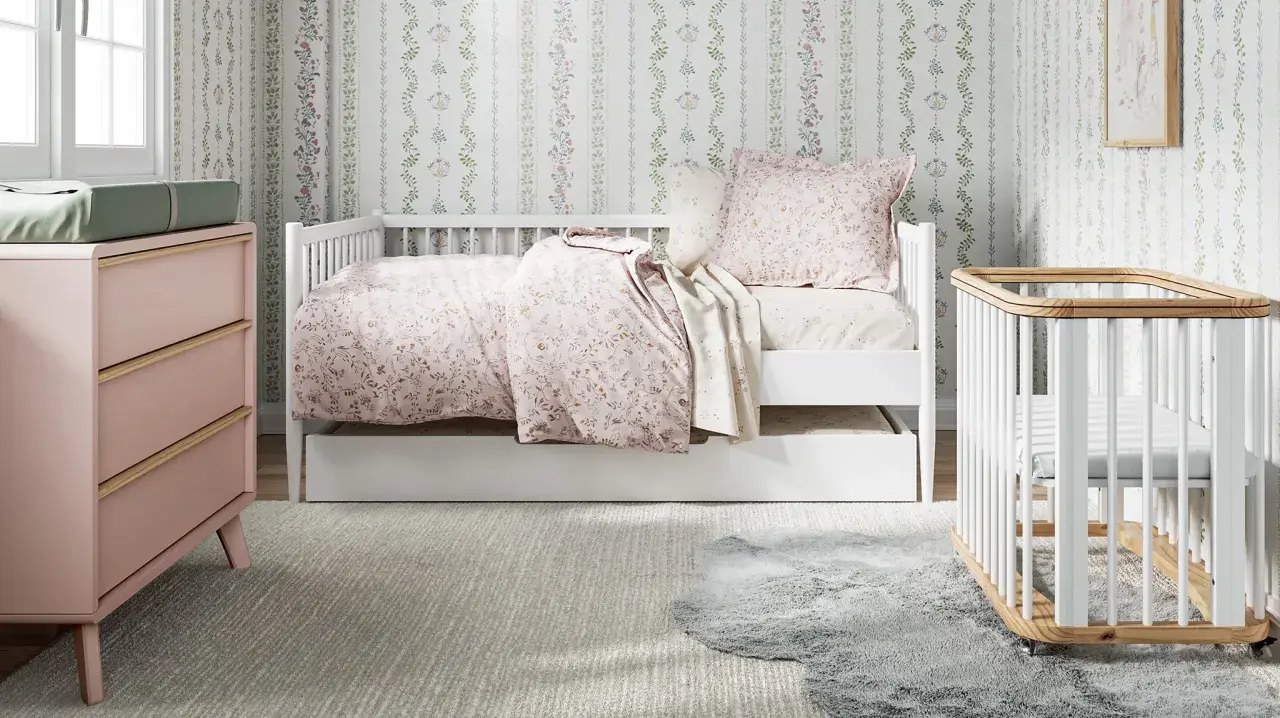
A compact nursery works best when every large piece earns its footprint. A daybed can solve three problems at once: it gives parents a place to sit or nap, creates a future guest spot, and keeps the room from feeling like a one-purpose box. The trick is choosing the right scale, placing it where it helps the flow, and keeping the rest of the room light enough to breathe.
The best compact nursery setups make the daybed work as seating, backup sleep space, and storage-friendly furniture
- A twin daybed is usually the safest starting point because it keeps the footprint close to a standard twin mattress.
- Storage matters as much as style in a small room, so drawers, baskets, and wall shelves do more work than extra décor.
- The room feels bigger when the daybed sits on the longest wall and the center stays open.
- For baby sleep, keep the crib separate and follow current safe-sleep guidance: firm mattress, fitted sheet, no loose bedding.
- If the daybed sits near a window, cordless coverings are the cleaner child-safe choice.
Why a daybed works so well in a compact nursery
I like daybeds in nurseries because they earn their place more reliably than a bulky lounge chair. During the newborn phase, they give you a place to feed, read, settle in for a contact nap, or lie down for a few minutes without dragging a second bed into the room. Later, the same piece can become a reading nook or a quiet spot for a parent during bedtime routines.
The real advantage is flexibility. A rocker or glider is useful, but it only solves one job. A daybed can act as seating, resting space, and a future guest bed, which matters in a room that already has to make room for a crib, a dresser, and storage. In a nursery that may later become a playroom, that extra adaptability is often the difference between a room that feels crowded and one that still has room to grow.
That said, a daybed is not automatically the right answer. If the room is extremely narrow, if the closet is tiny, or if you already need a lot of open floor for twins, toys, or mobility equipment, the bed can take up more visual and physical space than you want. Once the job it needs to do is clear, choosing the right frame becomes much easier.
How to choose the right daybed size and build
The most practical starting point is usually a twin daybed. A standard twin mattress measures 38 by 75 inches, which is much easier to fit beside a crib and dresser than a full-size mattress at 54 by 75 inches. That 16-inch width difference sounds small on paper, but in a nursery it can change how comfortably you move around the room.
For budget planning, I usually think in rough US retail ranges like these:
| Daybed type | Best for | Typical planning budget | Tradeoff |
|---|---|---|---|
| Simple twin frame | Smallest rooms and the cleanest layout | $250-$500 | Less built-in storage |
| Upholstered daybed | Soft, nursery-friendly look | $500-$1,200 | Looks fuller and can show wear faster |
| Storage daybed | Rooms with little closet space | $600-$1,500 | Heavier frame and usually less airy visually |
| Trundle daybed | Occasional overnight guests or siblings | $700-$1,500+ | Needs extra floor clearance to use well |
My rule is simple: if the room is tight, keep the frame visually quiet. Thin rails, low arms, and a light finish usually work better than oversized upholstered sides or ornate silhouettes. I would choose a trundle only if you genuinely expect to pull it out often; otherwise it becomes expensive dead weight. If you want the room to age well, keep the frame neutral and bring personality through bedding, artwork, and a rug instead.
Once the frame is settled, the layout is what decides whether the room feels calm or cramped.

Room layouts that keep the nursery open
The easiest layout is usually the one that gives the daybed the longest uninterrupted wall. That keeps the middle of the room open, which helps more than people expect once you are carrying laundry, a sleeping baby, or a diaper caddy back and forth. I also like to keep the daybed on the side of the room that gets the least traffic, so it reads as a resting zone instead of an obstacle.
| Layout | When it works best | Why it works | What to watch |
|---|---|---|---|
| Long-wall daybed | Narrow rectangular nursery | Keeps the center clear and gives the room a calm spine | Do not block the closet or the main window |
| Corner daybed nook | Square room with one open corner | Creates a reading or feeding corner without splitting the room in half | Keep side tables small so the corner does not feel crowded |
| Opposite-wall balance | Room that needs a strong visual grid | One major piece on each side keeps the room from feeling lopsided | Leave enough walkway between crib, dresser, and bed |
| Guest-room hybrid | Nursery that also hosts overnight adults | Lets the room double as a sleep space without folding furniture | Keep bedding simple so the room does not become visually heavy |
If I am designing the room from scratch, I usually place the crib first, then position the daybed where it supports the best sightlines and the easiest movement. A clear view from the door to the crib helps the room feel less crowded, and it also makes quick checks easier at night. If you have a window in the room, I would avoid putting the crib directly under it; that wall is often better reserved for the daybed or storage.
The layout only works if the room still has space for the things that collect around a baby, which is where storage becomes part of the design rather than an afterthought.
Storage and styling that keep the room calm
Small nurseries fail when every surface becomes a landing zone. The daybed itself can help if you choose a frame with drawers or if you leave just enough clearance beneath it for low bins, but the bigger win usually comes from controlling the vertical space. Wall shelves, narrow bookcases, and a few well-sized baskets do more than a crowded dresser top ever will.
- Use one tall storage piece instead of several short ones whenever possible.
- Keep blankets, burp cloths, and sleep sacks in closed baskets so they do not turn into visual clutter.
- Use the dresser top for a changing pad and the current essentials only, not for backup gear.
- Choose one toy bin or soft basket for the nursery so play items do not spread into every corner.
- Pick a rug that is large enough to define the room, not a small one that floats in the center and makes the floor look chopped up.
Styling should support the layout, not fight it. I prefer a quieter palette in compact rooms because the daybed already adds a strong horizontal line. Soft linen, light wood, or matte painted metal keeps the room from feeling heavy. If you want warmth, bring it in through texture rather than more furniture: a woven basket, a washable throw on the daybed, a cotton rug, or one framed print can do the job without adding bulk.
Once those surfaces are controlled, the remaining question is safety and how the room works in daily life.
Safety rules and finishing details I would not skip
Here I get stricter than I do with styling. The AAP recommends room-sharing without bed-sharing for at least the first six months, and that is one reason I always keep the baby’s actual sleep surface separate from the daybed. The crib or bassinet should stay firm, flat, and bare except for a fitted sheet; pillows, loose blankets, bumpers, and stuffed toys do not belong in that sleep space.
Window safety matters too. The CPSC recommends cordless window coverings in homes with young children, and that advice becomes especially relevant when a bed sits near a window. If you cannot replace the coverings right away, keep cords out of reach and move climbable furniture away from the window wall. A daybed under a window can look lovely, but only if the cords, curtains, and nearby surfaces are handled with the same care you would give the crib area.I also make a point of anchoring tall furniture to the wall and checking that the daybed does not block access to the door, the crib, or the closet. In a small room, a few inches matter. The goal is not just to make the nursery look finished; it is to make it easy to use at 2 a.m. without bumping into anything you do not need to bump into.
When those practical rules are in place, the room can stay soft and welcoming instead of feeling like a packed storage unit.
The setup I would choose for most small nurseries
If I were furnishing a compact nursery today, I would start with a twin daybed on the longest wall, a crib on the opposite side, and a narrow dresser that doubles as changing storage. That combination usually gives you the best balance of adult comfort, baby safety, and open floor space. I would skip the oversized upholstered frame unless the room is unusually wide, and I would only add a trundle if I truly expected overnight guests to use it.
- Choose a twin frame unless the room is clearly large enough to absorb a full-size mattress.
- Prioritize storage drawers or nearby baskets before adding decorative extras.
- Keep the crib visually separate so the room still reads as a nursery first, not a guest room first.
- Use one soft accent fabric, not a pile of pillows, to make the daybed feel inviting.
- Spend remaining budget on blackout shades, cordless coverings, and a rug that anchors the whole room.
That is the version I trust most often because it solves the daily work without asking the room to do too much. The best small nursery with a daybed is not the one with the most furniture; it is the one where every piece has a clear job and the room still feels easy to move through.
