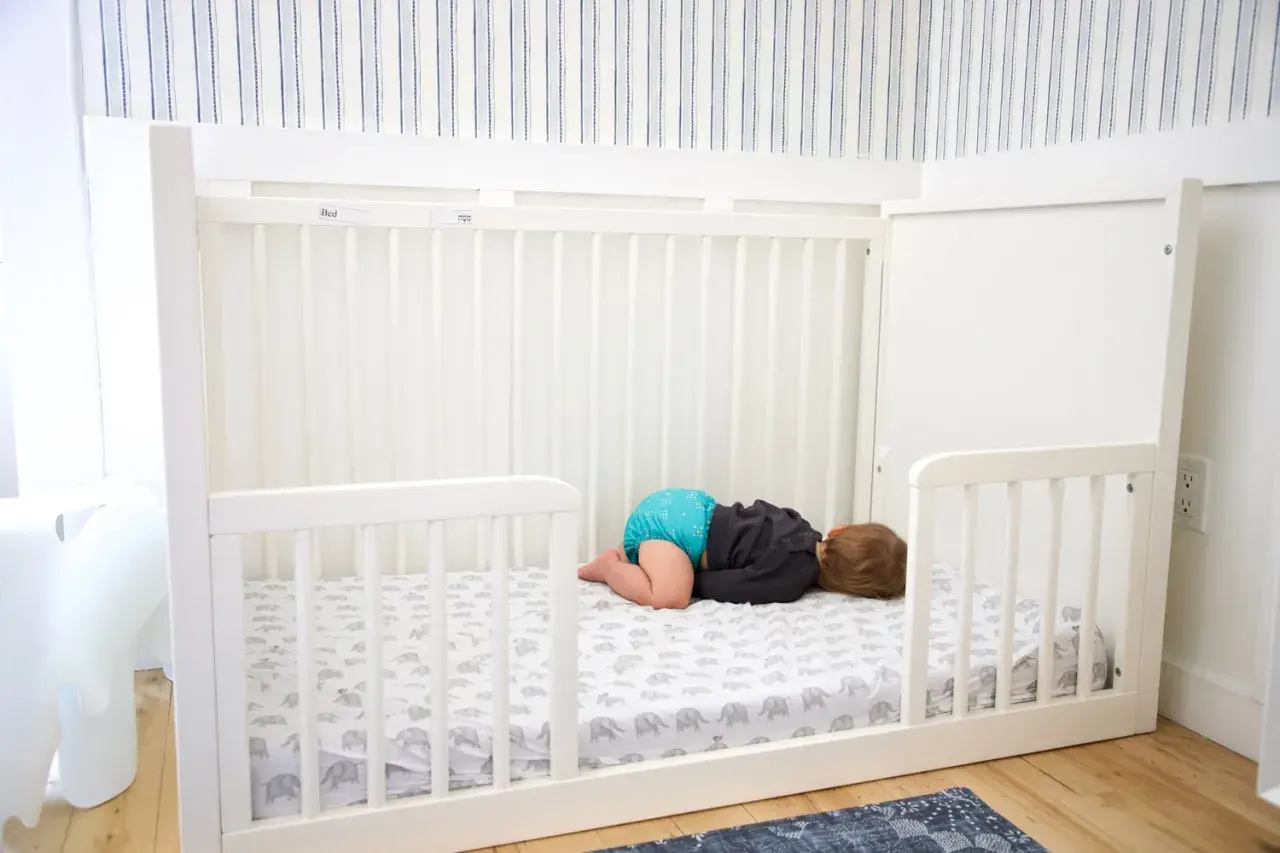
Floor beds can look calm and practical, but infant sleep is one place where style should take a back seat to safety. Are floor beds safe for babies? For babies under 12 months, my answer is no as a default sleep setup: current U.S. guidance still centers on a firm, flat crib, bassinet, or play yard with only a fitted sheet. In this article, I break down the risks, explain what a safe infant sleep space actually requires, and show when a low bed starts to make more sense later on.
The short answer for infant sleep
- For babies under 12 months, I would not choose a floor bed as the default sleep setup.
- The safest infant sleep space is still a firm, flat crib, bassinet, or play yard with a fitted sheet only.
- A mattress on the floor removes the fall from height, but it does not remove suffocation, entrapment, or room-hazard risks.
- If an adult sleeps there too, it is still bed-sharing, and the floor does not make that safer.
- After infancy, a low bed can make sense, but only in a fully babyproofed room.

Why a floor bed is not the same as a safe infant sleep surface
A floor bed is usually just a mattress on the floor or a very low frame. That sounds safer than a high bed because the fall is gone, but infant sleep hazards are usually not about falling. They are about breathing obstruction, entrapment, and exposure to loose bedding or nearby objects.
If an adult lies there too, it is still bed-sharing. Moving the mattress down does not make bed-sharing safer, and it does not turn an adult mattress into a tested infant sleep surface.
| Sleep setup | Best use | My safety take for babies |
|---|---|---|
| Crib, bassinet, or play yard | Infant sleep | My default choice for babies because it matches safe-sleep guidance. |
| Floor bed or mattress on the floor | Toddler independence | Useful later, but not my first choice for an infant. |
| Adult bed | Awake contact, not routine infant sleep | Not a safe infant sleep surface, even if the mattress sits low. |
So the floor removes one problem and leaves the others on the table. That is why I treat it as a toddler design choice, not an infant sleep solution. Once you separate style from safety, the next question is what a safe infant sleep setup actually needs.
What a safe sleep space for a baby actually needs
The AAP’s current safe-sleep guidance is straightforward: back to sleep, firm and flat, and bare. CDC guidance supports the same core rules. Those three ideas do most of the heavy lifting, and they matter more than the visual style of the nursery.
Read Also: Crib Height: When to Lower the Mattress for Baby Safety
The non-negotiables
- Back: place the baby on the back for every sleep, including naps.
- Firm and flat: use a non-inclined surface that stays level and resists sinking.
- Own sleep space: keep the baby in a crib, bassinet, or play yard rather than in an adult bed.
- Bare sleep area: use only a fitted sheet, with no pillows, blankets, bumpers, or soft toys.
- Room sharing: keep the sleep space in your room for at least the first 6 months if possible.
If warmth is the concern, I would reach for a sleep sack instead of adding blankets. That keeps the sleep space simple without sacrificing comfort. It also avoids the common trap of thinking that a soft, cozy setup is somehow more protective for a baby, when the opposite is usually true. That is why age matters so much, which brings me to when a floor bed starts to become more realistic.
When a floor bed starts to make more sense
There is no official green light I would give for infants. My practical cutoff is after 12 months, and many families wait closer to 18 to 24 months depending on mobility, temperament, and how well the room can be controlled. That is an expert judgment, not a medical rule, but it aligns with how infant safe-sleep guidance is written: the first year is the period where the sleep surface matters most.
| Signs a floor bed may be reasonable later | Reasons to wait |
|---|---|
| The child can get in and out of bed deliberately and calmly. | The child is still an infant or is too young to move away from hazards reliably. |
| The room is fully babyproofed, including furniture anchoring and cord control. | There are cords, blinds, unanchored furniture, small objects, or other hazards within reach. |
| The child does not need extra bedding to stay warm. | The setup depends on blankets, pillows, bumpers, or a very soft mattress. |
The important shift is this: once you move to a floor bed, the room becomes part of the sleep product. A crib contains risk; a floor bed pushes more responsibility onto the entire nursery. That is manageable for an older child, but it is a bad trade for a baby. If you are not ready to switch yet, you can still get the look without changing the sleep rulebook.
How to keep the nursery low and calm without using a floor bed
I see a lot of parents assume they have to choose between a clean Montessori style and safe infant sleep. You do not. You can keep the nursery quiet, low, and uncluttered while still using a crib or bassinet that meets infant sleep standards.
- Choose a low-profile crib or mini crib if you want a lighter visual footprint.
- Use a fitted sheet in a muted color and keep the sleep space visually bare.
- Store toys, diapers, and loose items in closed bins or low drawers outside the sleep zone.
- Use a sleep sack for warmth instead of blankets.
- Keep wall art, cords, and lamps away from the crib so the area stays clean and low-risk.
- Put the cozy elements where they belong: rug, rocker, books, and lighting outside the sleep surface.
This approach gives you the calm nursery feel many parents want without blurring the line between a styled room and a safe sleep environment. The baby gets a proper sleep space, and you still get a room that feels intentional rather than clinical. From there, my line is simple.
My line in the sand for a baby nursery
For a baby under 12 months, I would stick with a crib, bassinet, or play yard that meets infant sleep standards. If you want the gentle, low-to-the-ground look, build it around the room rather than around the mattress.
Once a child is older, mobile, and sleeping in a fully babyproofed space, a floor bed can be a reasonable choice. Until then, the safest answer is the boring one: firm, flat, bare, and approved for infant sleep.
