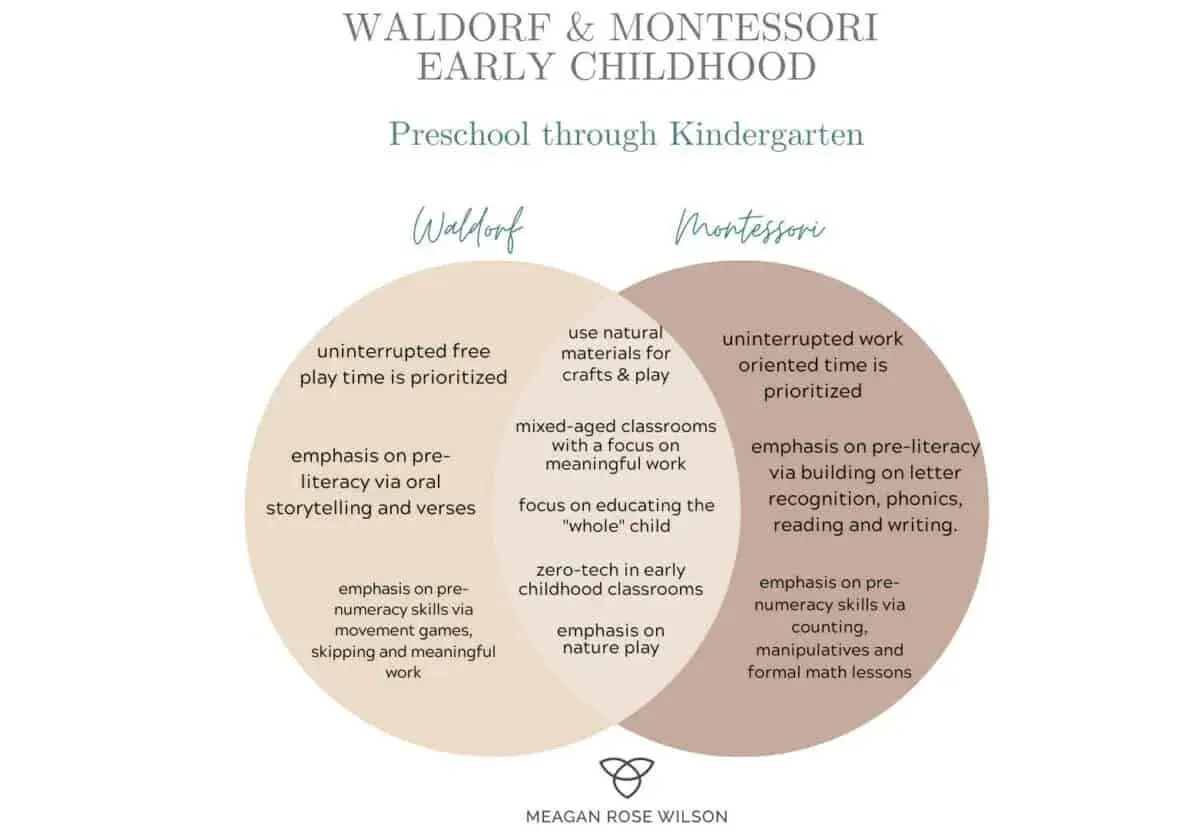
Choosing between Montessori and Waldorf is really a choice between two different ideas of childhood. One puts a strong emphasis on independence, hands-on work, and a carefully prepared environment; the other leans into rhythm, imagination, art, and story. In this article, I break down how each approach works in practice, where the biggest differences show up in preschool and early elementary years, and how to decide which one fits your child, your home, and your expectations.
The real tradeoff is independence versus rhythm
- Montessori gives children more self-directed choice, structured materials, and longer uninterrupted work periods.
- Waldorf centers on imaginative play, daily rhythm, artistic activity, and a slower introduction to formal academics.
- Both are child-centered, but they define “child-centered” very differently.
- In the U.S., the quality of the actual school matters more than the philosophy name on the brochure.
- For toys and nursery setups, Montessori tends to favor practical, open-and-close, do-it-myself items, while Waldorf leans natural, tactile, and imaginative.
What each philosophy is trying to develop
When I strip away the marketing language, Montessori is trying to build independence, concentration, and practical competence. Children work with real, carefully designed materials, often at their own pace, and the adult steps in more like a guide than a lecturer. The American Montessori Society describes the model as child-directed and built around uninterrupted work periods, which is exactly why Montessori classrooms often feel calm, orderly, and very intentional.
Waldorf, by contrast, is trying to build a child who learns through imagination, imitation, rhythm, and lived experience. AWSNA describes Waldorf education as developmentally appropriate and arts-integrated, and that shows up in classrooms that use story, movement, music, and handwork to shape the day. In early childhood especially, the goal is not to rush academics; it is to protect the texture of childhood while the child develops readiness for later learning.
That difference sounds subtle until you watch a real classroom. Then it becomes obvious very quickly, which is why the next step is looking at the day-to-day experience, not just the philosophy statement.

How the classrooms feel day to day
| Aspect | Montessori | Waldorf |
|---|---|---|
| Teacher role | Guide, observer, and lesson giver | Warm authority figure who leads the flow of the day |
| Child activity | Individual choice, repetition, and hands-on work | Group rhythm, imaginative play, story, movement, and art |
| Materials | Specialized learning tools, often self-correcting | Natural materials, open-ended toys, handwork, and craft |
| Early academics | Introduced earlier through concrete materials | Usually delayed in favor of play and developmentally paced learning |
| Class atmosphere | Ordered, quiet, focused | Warm, rhythmic, artistic, and story-rich |
| Technology | Not central to the method | Usually minimal, especially in early years |
That table is useful, but it can still flatten the real difference. What parents usually feel in practice is this: Montessori gives a child more visible autonomy, while Waldorf gives a child more visible structure in the day itself. The first pushes choice into the child’s hands; the second uses rhythm and imitation to shape readiness. From there, the age of the child starts to matter a lot.
Where the differences show up most in early childhood
In the preschool years, Montessori often introduces practical life work, sensorial exploration, and early literacy or math in a very concrete way. Children pour, sort, match, trace, count, and repeat. That repetition is not filler; it is how the method builds coordination and confidence. The classroom may look simple, but it is highly engineered.Waldorf early childhood looks different. The day is usually built around story, outdoor time, movement, baking, painting, singing, and pretend play. Children may not be asked to sit for worksheet-style work very early, because the method assumes that deep imaginative play and bodily rhythm lay the groundwork for later academic readiness. In many Waldorf settings, the pace feels slower on purpose.
That does not mean Montessori is always “more academic” and Waldorf is always “less academic.” Real schools vary, and some blur the line. But if a family wants early, concrete skill-building, Montessori usually delivers that more directly. If a family wants a childhood with more space for fantasy, seasonal rhythm, and a gentler academic runway, Waldorf usually feels closer to the mark. Once that becomes clear, the next question is temperament.
Which child tends to do well in each setting
I would not reduce this to a personality test, but some children clearly settle into one model more naturally than the other.
- Montessori often suits children who like order, repetition, and doing things for themselves. They usually enjoy selecting work, finishing a task, and moving on without a lot of adult interruption.
- Waldorf often suits children who love pretend play, stories, art, and a predictable daily rhythm. These children usually relax when the day feels warm, guided, and emotionally coherent.
- Montessori can be a strong match for children who want quiet concentration. The environment rewards focus and fine-grained attention.
- Waldorf can be a strong match for children who need more movement, imitation, and social flow. The method tends to meet them through doing, not just talking.
- Some children do well in both. In that case, the deciding factor is often the quality of the teacher and the authenticity of the school.
I also think parents sometimes mistake “child fit” for “parent preference.” Those are not the same thing. A parent may love the look of a Waldorf classroom but have a child who thrives on the precision of Montessori work. Or the reverse: a parent may prefer structure but have a child who needs more imaginative breathing room. The cleanest way to avoid regret is to observe the child in the room, not just to admire the room from outside.
What to look for in toys and nursery essentials
This is where the topic becomes practical for a site like Mon-Octopus.com, because the same principles that shape classrooms also shape toy choices and nursery setups. If you are building a Montessori-friendly space at home, I would look for simple, child-sized, real-world tools: a small broom, a low shelf, a pourable water pitcher, stacking and sorting toys, puzzles with clear purpose, and practical life items a child can actually use. The point is not to fill the room. The point is to make independence easy.
If you lean Waldorf, the home environment usually works better with natural textures and open-ended materials: wooden blocks, simple dolls, play silks, crayons or beeswax sticks, baskets, and toys that invite a child to invent the story instead of consuming one. The best Waldorf-leaning toys are often quiet, tactile, and unfinished enough to become many things.
My rule of thumb is simple: Montessori toys tend to answer, “How can I do this myself?” Waldorf toys tend to answer, “What can I imagine with this?” Neither approach requires a crowded playroom. In fact, both work better when the space is edited down to what actually supports play, concentration, and calm. That practical lens also helps when it is time to choose a school.
How I would choose between them in the U.S.
In the U.S. in 2026, I would not choose based on the label alone. I would choose based on how the school actually operates, because two schools can share a philosophy and still feel completely different in daily life. If you are deciding between Montessori and Waldorf, I would start with three questions:
- Does my child need more independence or more guided rhythm right now?
- Do I want early academic exposure, or do I want academics introduced more gradually?
- Does the school have trained teachers, a stable classroom culture, and a schedule that feels consistent?
If your answer leans toward self-direction, visible skill-building, and a strong sense of order, Montessori is usually the safer bet. If your answer leans toward imaginative play, artistic living, and a slower academic pace, Waldorf will probably feel more natural. But here is the part I would not skip: visit the classroom, ask about teacher training, and watch how children move through the day. A strong school can make a philosophy come alive; a weak one can make even a good philosophy feel flat.
The questions that reveal the real fit
When I tour a school, I care less about the marketing copy and more about the mechanics. These questions tell you a lot fast:
- How long does the lead teacher stay with the same class?
- How much uninterrupted work or play time do children get each day?
- What does the school do with early reading, writing, and math?
- How are conflict, transitions, and behavior handled?
- What materials are used, and why were they chosen?
- How much screen time, if any, is part of the program?
If you ask those questions, the difference between the two approaches stops being abstract. You can see whether the school is genuinely Montessori, genuinely Waldorf, or simply borrowing a few surface details from one of them. That is usually the point where parents make a clear, confident choice.
If I had to reduce the whole decision to one sentence, I would say this: Montessori is usually the better fit for families who want independence and concrete skill-building early, while Waldorf is usually the better fit for families who value rhythm, imagination, and a slower academic start. The strongest choice is the one that matches your child’s temperament and is delivered by a school that is consistent, well-trained, and honest about what it actually does each day.
