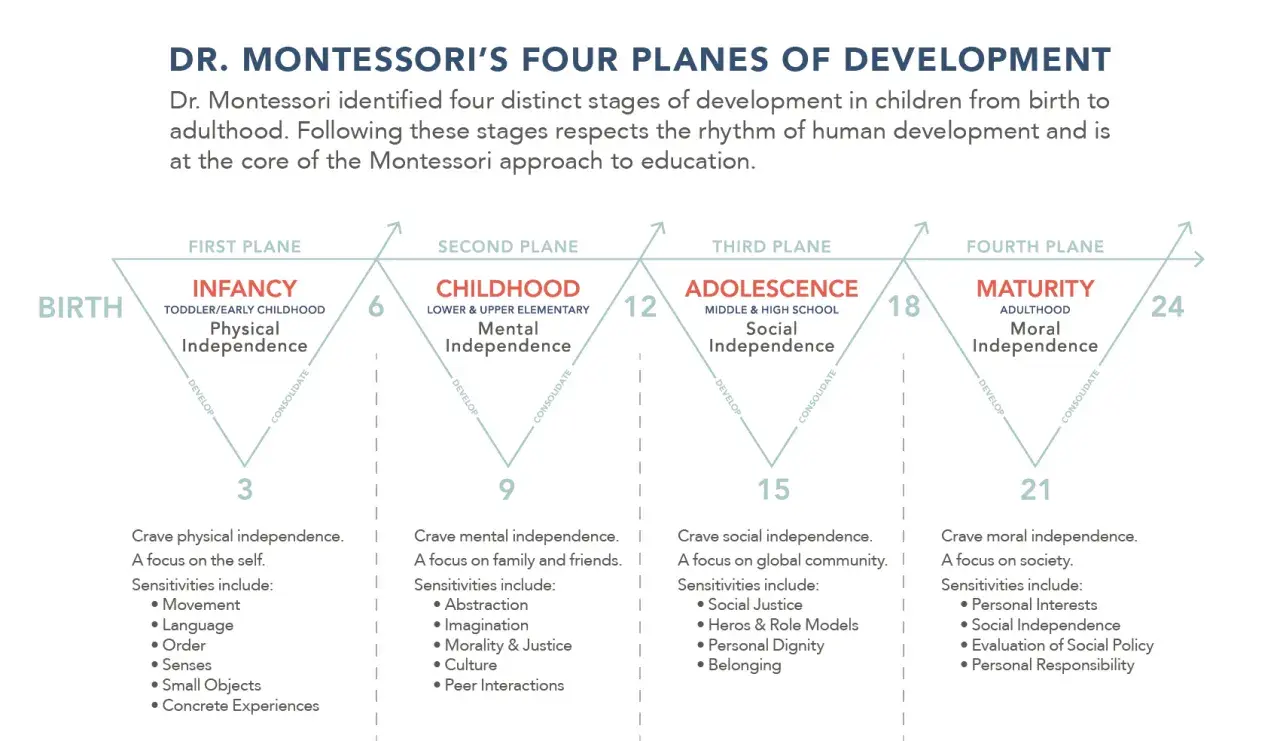
The Montessori planes of development explain why a toddler thrives on repetition and movement, why a nine-year-old wants reasons and patterns, and why a teenager suddenly needs real responsibility. I’m breaking down the four stages in plain English, with the classroom logic behind them and the home choices that make the most sense when you are buying toys, nursery essentials, or practical learning materials. The short version is simple: match the environment to the child’s current developmental work, not just to age.
What to keep in mind before choosing materials or expectations
- The Montessori model divides childhood and young adulthood into four broad planes: 0-6, 6-12, 12-18, and 18-24.
- Early childhood is shaped by movement, language, order, sensory exploration, and independence.
- Elementary children are ready for reasoning, imagination, classification, and big-picture thinking.
- Adolescents need belonging, dignity, purposeful work, and room to become emotionally independent.
- The best home materials are the ones that fit the child’s current stage of development, not the loudest or most expensive option.
- Montessori classrooms use multi-age groupings because the environment is designed around development, not a single birth year.

What the four planes actually describe
Maria Montessori did not divide childhood into neat school grades for convenience. She observed that human development moves through distinct periods, each with its own dominant needs, sensitivities, and social patterns. In U.S. Montessori settings, that is one reason you often see three-year classroom cycles and mixed-age groups: the setting is built to fit the stage, not the calendar.
| Plane | Typical age span | Main developmental focus | What tends to work best |
|---|---|---|---|
| First plane | 0-6 years | The absorbent mind, movement, language, order, independence | Practical life work, sensory materials, repetition, clear routines |
| Second plane | 6-12 years | Reasoning, imagination, fairness, collaboration, abstraction | Research, timelines, maps, experiments, group projects, classification |
| Third plane | 12-18 years | Identity, emotional independence, social belonging, purposeful work | Real responsibility, community work, hands-on projects, mentorship |
| Fourth plane | 18-24 years | Self-understanding, vocation, place in the world, adult identity | Advanced study, apprenticeships, internships, practical independence |
The first and third planes are the most change-heavy, while the second is relatively stable and the fourth is a transition into adult life. I find that this rhythm matters more than people expect, because it tells you whether a child needs simplification, expansion, independence, or mentorship. That becomes especially clear in the first plane, where the environment does a lot of the teaching before formal academics ever begin.
Why the first plane depends on the absorbent mind
From birth to about age six, Montessori describes the child as having an absorbent mind. In plain language, children at this stage take in language, movement, social habits, and sensory impressions almost continuously. They are not just learning facts; they are building the foundations for how they will move, speak, concentrate, and act in the world.
This is why the prepared environment matters so much. A calm room with low shelves, child-sized furniture, and materials that invite repetition will usually do more for a young child than a room full of noisy gadgets. At this stage, practical life work is not a side activity. Pouring, spooning, wiping, dressing, folding, and carrying are the work. They build coordination, concentration, independence, and the sense that “I can do this myself.”
For families choosing nursery essentials or early toys, I would lean toward materials that isolate one skill at a time. Stacking cups, nesting objects, simple puzzles, shape sorters, realistic books, and tactile materials all fit better than screens or toys that do everything at once. A single well-chosen tray of materials often has more educational value than a basket of flashing plastic that asks the child to watch instead of act.
- Good fits for this plane: child-sized brooms, pitchers, step stools, dressing frames, simple puzzles, blocks, nesting cups, realistic animal figures, and books with clear images.
- What to limit: overcrowded toy bins, battery-heavy toys, and anything that overstimulates without giving the child a clear action to repeat.
- What to watch for: repetition, order-seeking, vocabulary growth, and a strong desire to help with real tasks.
That early work creates the habits that support later learning, which is exactly why the next plane looks so different once the child is ready to reason, imagine, and question the world.
Why the second plane is built around reasoning and big ideas
From about six to twelve, children become hungry for explanation. They do not only want to know what something is; they want to know why it works, how it connects to other things, and where it fits in the larger story of the world. Montessori responds to that shift with big lessons, timelines, maps, experiments, and what the tradition calls cosmic education, a broad curriculum that connects history, science, geography, language, and culture instead of isolating them into unrelated facts.
This is also the stage where fairness, logic, and peer collaboration become much more important. A child in this plane may become deeply interested in systems, rules, comparisons, and categories. That is not a random personality change. It is the developmental work of the stage. The classroom should support that hunger with materials that let children investigate, classify, measure, and build understanding step by step.
In practical terms, the best toys and learning tools for this age often look more like instruments than entertainment. Atlases, timelines, science kits, card sets for classification, board games with rules, craft materials, journals, microscopes, and nature collections all fit well here. If a child is collecting rocks, shells, coins, insects, or animal cards, that can be real intellectual work when the child is sorting, comparing, labeling, and telling the story of what they see.
- Good fits for this plane: maps, globes, timelines, research notebooks, experiment kits, logic games, building sets, and carefully organized collections.
- What works best in teaching: stories that connect ideas, hands-on demonstrations, and room for collaboration.
- What to avoid: treating this age as if it still needs early-childhood materials or endless memorization without context.
By adolescence, the center of gravity shifts again. The child is no longer trying to understand the world only as a system; they are trying to understand themselves inside it.
What changes in adolescence and the young-adult years
The third plane, roughly ages 12 to 18, is where Montessori becomes especially interesting. Adolescents are not just older children. They are reorganizing around identity, social belonging, emotional independence, and moral judgment. A teenager is often asking, sometimes quietly and sometimes not so quietly, “Where do I fit?” and “Does what I do actually matter?”
That is why the Montessori adolescent vision, often associated with Erdkinder or “child of the earth,” leans toward real work, community life, and practical responsibility. A teen usually needs less artificial polish and more authenticity. They benefit from meaningful projects, visible consequences, and adults who trust them to contribute. A kitchen, workshop, garden, studio, or service project can do more for this age than another round of detached worksheets.
- Good fits for adolescents: cooking, gardening, repair work, budgeting, journalism, volunteering, carpentry, design, coding, and other projects with real outcomes.
- What matters socially: belonging, dignity, peer collaboration, and adults who respect the teen’s growing need for independence.
- Common mistake: interpreting normal adolescent resistance as laziness when it is often a sign that the environment no longer matches the developmental stage.
The fourth plane, ages 18 to 24, is less visible in everyday Montessori schooling, but it is part of the model. Young adults are still constructing identity, direction, and a sense of place in the world. They usually need mentorship more than micromanagement, and they often learn best through apprenticeships, internships, advanced study, and real responsibility that is not performed for show.
If you want the simplest translation, it is this: early childhood needs formation, elementary needs explanation, adolescence needs purpose, and young adulthood needs direction.
How I would choose toys and nursery essentials with this model
This is where the theory becomes practical for families, especially on a site that talks about toys and nursery essentials. I would not ask first, “Is this trendy?” I would ask, “What plane is this child in, and what kind of work should the material support?” That one question clears up a lot of clutter.
For the youngest children, I would favor a few high-quality objects with clear purpose: open shelves, low baskets, realistic books, simple manipulatives, and practical-life tools that let the child pour, scoop, carry, wash, and dress. For elementary children, I would choose materials that invite investigation and categorization. For adolescents, I would choose tools that help them do something real with their hands, time, money, or ideas.
Collectibles can fit beautifully when they support observation and classification. A child who lines up shells, fossils, postcards, trading cards, or animal figures is often practicing comparison, naming, and order. The key is whether the collection helps the child think more clearly, not whether it looks impressive on a shelf.
- Birth to 6: blocks, nesting toys, realistic figures, simple puzzles, practical-life sets, child-sized furniture, and sensory materials with one clear purpose.
- 6 to 12: maps, science kits, math manipulatives, board games, journals, reference books, and collections that can be sorted and explained.
- 12 to 24: cooking tools, repair kits, sewing supplies, planners, cameras, gardening tools, budgets, and project-based materials that lead to independence.
My rule of thumb is blunt but useful: if a material only entertains, it has limited Montessori value; if it invites the child to act, repeat, compare, or build something real, it is usually a much better fit.
The mistakes that blur the picture
The model is simple enough to explain, but it is easy to misuse. I see the same errors again and again, and most of them come from treating the planes as rigid labels instead of broad developmental patterns.
- Taking the age bands as hard cutoffs. Real children overlap. Development is not a switch that flips on a birthday.
- Pushing academics too early. Early childhood is not the place to rush abstract worksheets when the child still needs movement, order, and sensory work.
- Buying too many materials. A crowded shelf usually weakens concentration instead of improving it.
- Using “Montessori” as a preschool-only idea. The method explains elementary, adolescent, and young-adult needs too.
- Ignoring the social side of later planes. Older children need peer interaction, responsibility, and moral growth, not just more content.
The broader limitation is worth saying plainly: Montessori is a strong developmental guide, but it is not a magic formula. It works best when adults observe carefully, keep expectations realistic, and choose materials that match the child’s actual stage rather than the one they wish the child were in.
The shelf test I use before buying the next toy or tool
When I want to keep the model useful, I use a short check before adding anything new to a child’s environment.
- Watch what the child repeats naturally.
- Ask what developmental need is hiding inside that behavior.
- Choose the simplest material that supports that need without adding noise.
That approach keeps Montessori grounded in observation instead of trend-chasing. It also makes home life easier: fewer useless purchases, calmer shelves, and a clearer sense of which toys, nursery essentials, and learning tools are actually doing real developmental work.
