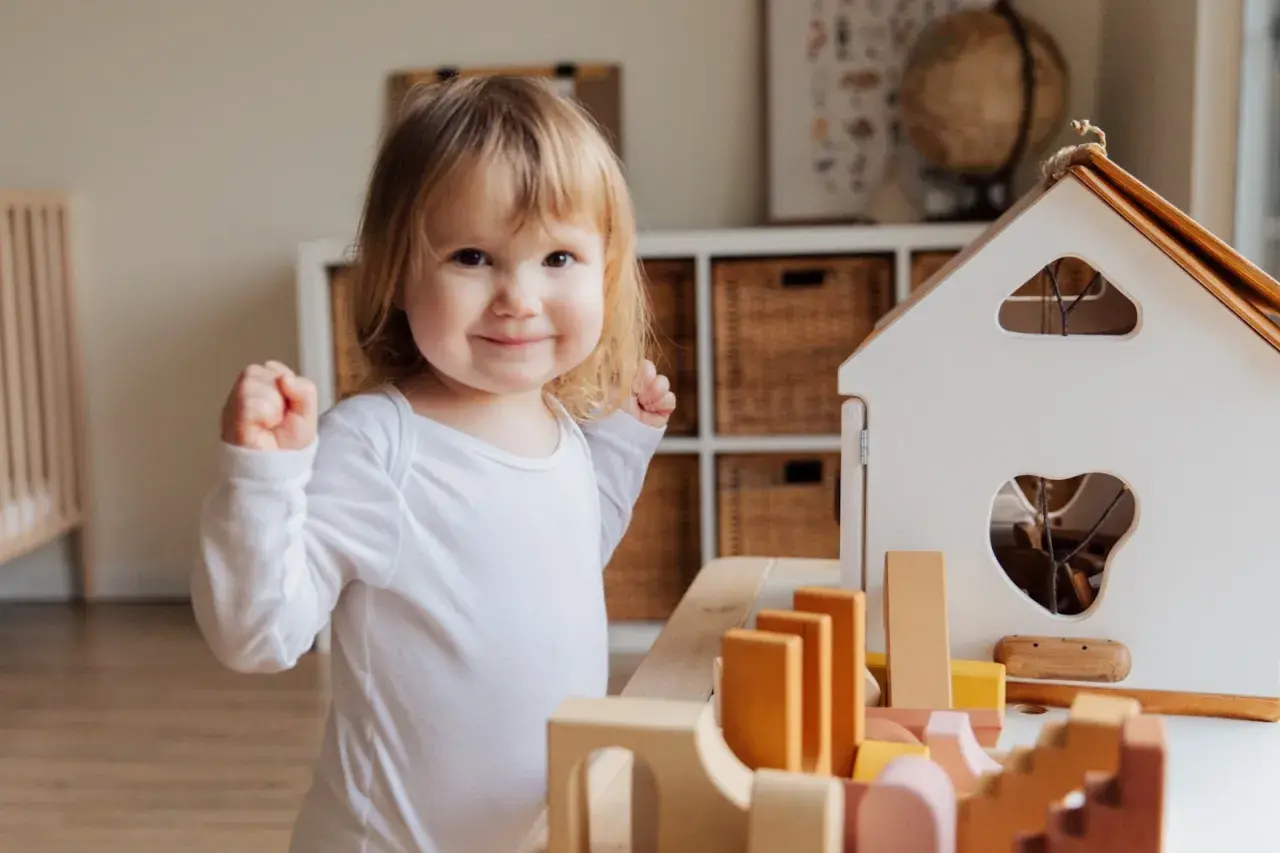
Learning for 1-year-olds works best when it feels like play: short, repeated moments of talking, moving, stacking, pointing, and copying. At this age, children are building language, coordination, attention, and early problem-solving at the same time, so the right activities matter more than any formal lesson plan. I focus on practical, low-pressure methods that fit real homes, real budgets, and short attention spans.
The fastest way to support a 1-year-old’s learning
- Keep it short and interactive. A few minutes of back-and-forth play beats a long, passive session.
- Use simple objects. Cups, blocks, books, balls, and household items do a lot of developmental work.
- Repeat on purpose. Repetition helps one-year-olds lock in words, movements, and cause-and-effect ideas.
- Build learning into routines. Meals, baths, dressing, and walks are full of teachable moments.
- Limit screen-based learning. Live human interaction does more for this age than apps or videos.
- Watch communication closely. If gestures, eye contact, or responses to sound seem off, bring it up early.
What a 1-year-old is really learning
At 12 months, the goal is not academic instruction. The real work is much more basic and much more important: building a brain that can connect words to objects, actions to results, and people to predictable routines. The CDC’s 12-month milestone guidance points to skills like copying gestures, searching for hidden objects, and using objects in simple ways, which tells me the best learning environment is still physical, social, and hands-on.
| Developmental area | What you may notice | Best support |
|---|---|---|
| Language | Babbling, copying sounds, reacting to familiar words | Talking, singing, labeling, reading aloud, pausing for a response |
| Motor skills | Crawling, cruising, standing, early walking, grasping small objects | Floor play, push toys, stacking, carrying, sorting, climbing with supervision |
| Problem-solving | Dropping objects, repeating actions, opening containers, looking for hidden items | Cause-and-effect toys, nesting cups, shape sorters, simple puzzles, container play |
| Social-emotional | Clinging, copying, smiling back, testing reactions | Face-to-face play, predictable routines, gentle turn-taking, comfort plus boundaries |
That mix matters because a one-year-old learns best when the body and the brain are working together. Once you see that, the next question becomes less about “What should I teach?” and more about “What kind of interaction will make this stick?”
The methods that work best at this age
I usually think in terms of methods, not “lessons,” because the method decides whether a child stays engaged long enough to learn anything. For one-year-olds, the best methods are simple, responsive, and repetitive.
- Follow the child’s attention. If they are fascinated by a spoon, a sock, or a red block, start there. Attention is the entry point.
- Repeat the same idea in different forms. A ball can roll, bounce, hide, or be thrown into a basket. The child is learning the concept, not the toy.
- Use real words with real objects. “Ball,” “big,” “up,” “more,” and “finished” become useful when they are attached to something the child can see and touch.
- Pair movement with language. Saying “up” while lifting a child, or “in” while placing a cup inside a bowl, creates stronger memory than speech alone.
- Offer tiny choices. Two options are enough: “Book or blocks?” Choice-making supports attention and early independence without overwhelming them.
- Scaffold instead of testing. I would rather show a child how to place a block than ask them to figure out the whole sequence alone.
This is also where I keep screen-based learning in perspective. The American Academy of Pediatrics advises against making screens the main learning tool for children under 18 months, and that matches what I see in practice: live interaction, not passive viewing, does the heavy lifting at this age.

Toys and activities that build real skills
The best toys for this stage are usually the simplest ones. They invite repetition, have a clear action-reaction pattern, and do not do all the work for the child. If a toy flashes, sings, and talks constantly, it often teaches less than a plain object the child can manipulate on their own.
| Toy or activity | What it builds | Why I like it |
|---|---|---|
| Board books | Language, attention, picture recognition, shared focus | They are short, durable, and easy to repeat every day |
| Stacking cups or blocks | Fine motor control, size awareness, problem-solving | The child can stack, nest, knock down, and rebuild without pressure |
| Soft balls | Hand-eye coordination, rolling, throwing, chasing | Movement turns into a game, and the feedback is immediate |
| Shape sorters | Matching, persistence, spatial reasoning | One clear challenge is enough for a one-year-old; they do not need more complexity |
| Musical toys or simple instruments | Cause and effect, rhythm, imitation | Sound motivates repetition, which is exactly what learning needs here |
| Everyday household items | Container play, grasping, sorting, emptying, filling | They often hold more learning value than expensive novelty toys |
If I were building a starter toy basket, I would choose a board book, stacking cups, a ball, a simple shape sorter, and one open-ended object like nesting bowls or soft blocks. That is enough variety to support language, movement, and problem-solving without creating clutter or overstimulation.
Turn everyday routines into small lessons
One of the most practical things about this age is that learning does not need a special setup. Meals, diaper changes, bath time, and walks already contain repetition, vocabulary, and cause-and-effect. I use those moments because they happen every day and they are naturally tied to the child’s attention.
| Routine | What to do | What it teaches |
|---|---|---|
| Mealtimes | Name foods, offer a spoon, talk about hot/cold, more/all done | Language, sequencing, self-feeding, choice-making |
| Bath time | Pour, fill, empty, splash, name body parts | Cause and effect, sensory play, vocabulary, motor planning |
| Getting dressed | Pause for an arm, let them push a foot through, sing the same song | Body awareness, cooperation, routine memory |
| Walks and errands | Point out dogs, cars, trees, people, and colors | Labeling, attention shifting, curiosity about the world |
| Cleanup | Put toys in a basket, hand items one by one, say in/out | Sorting, motor control, following a simple direction |
I like these routine-based moments because they do not depend on a perfect schedule. A five-minute repetition after lunch is often more effective than a carefully planned activity that happens once a week. When learning is tied to daily life, it feels normal instead of forced.
What I would avoid or keep limited
There is a lot of noise around “early learning,” and some of it sells the wrong idea. One-year-olds do not need formal drills, long instructional videos, or a constant stream of novelty. They need room to explore, repeat, and interact with a person who notices what they are trying to do.
- Too many toys at once. A cluttered floor can make attention scatter instead of deepen.
- Flashcards and worksheets. These are poor matches for a child whose learning is still physical and sensory.
- Passive screen use. Videos can distract, but they do not replace real conversation or shared play.
- Overly complicated toys. If a toy is doing most of the work, the child is often just watching.
- Long sessions. Most one-year-olds learn better in short bursts than in extended “sit still” periods.
My rule of thumb is simple: if an activity makes the adult feel smarter but the child less involved, it is probably not the best use of time. The strongest learning tools at this age are usually ordinary, tactile, and easy to repeat.
When learning needs a closer look
Most one-year-olds develop unevenly, and that is normal. Still, I think it is smart to notice communication patterns early rather than waiting for a bigger concern to appear. If something consistently feels “off,” it is worth bringing up with a pediatrician sooner instead of later.
- Rarely using gestures such as pointing, waving, or showing objects
- Not responding to name or familiar sounds often enough
- Very limited eye contact or shared attention during play
- Not imitating simple actions, sounds, or facial expressions
- Losing skills they already had, even briefly
I am careful not to over-interpret one isolated behavior, because toddlers have off days and uneven phases. What matters is the pattern. Early support is useful even when the issue turns out to be minor, and it is much easier to adjust a routine early than to unwind months of vague worry later.
A simple rhythm that keeps progress steady
If I were helping a family build a daily learning rhythm for a one-year-old, I would keep it almost boring in structure and very rich in interaction. Three short touchpoints are enough: one book, one movement game, and one routine-based moment where the child gets to repeat the same action again and again.
- Connect for 2 minutes. Get face to face, name what the child is doing, and wait for a response.
- Repeat the same action 3 to 5 times. Stack, drop, roll, pour, or turn pages more than once.
- Add one small step. Introduce one new word, one new object, or one slightly harder version of the task.
That rhythm is enough for most families, and it scales well. The child gets consistency, the caregiver gets a practical structure, and learning stays tied to real life instead of becoming a performance. If you keep the play short, interactive, and familiar, the progress is usually obvious before the week is over.
