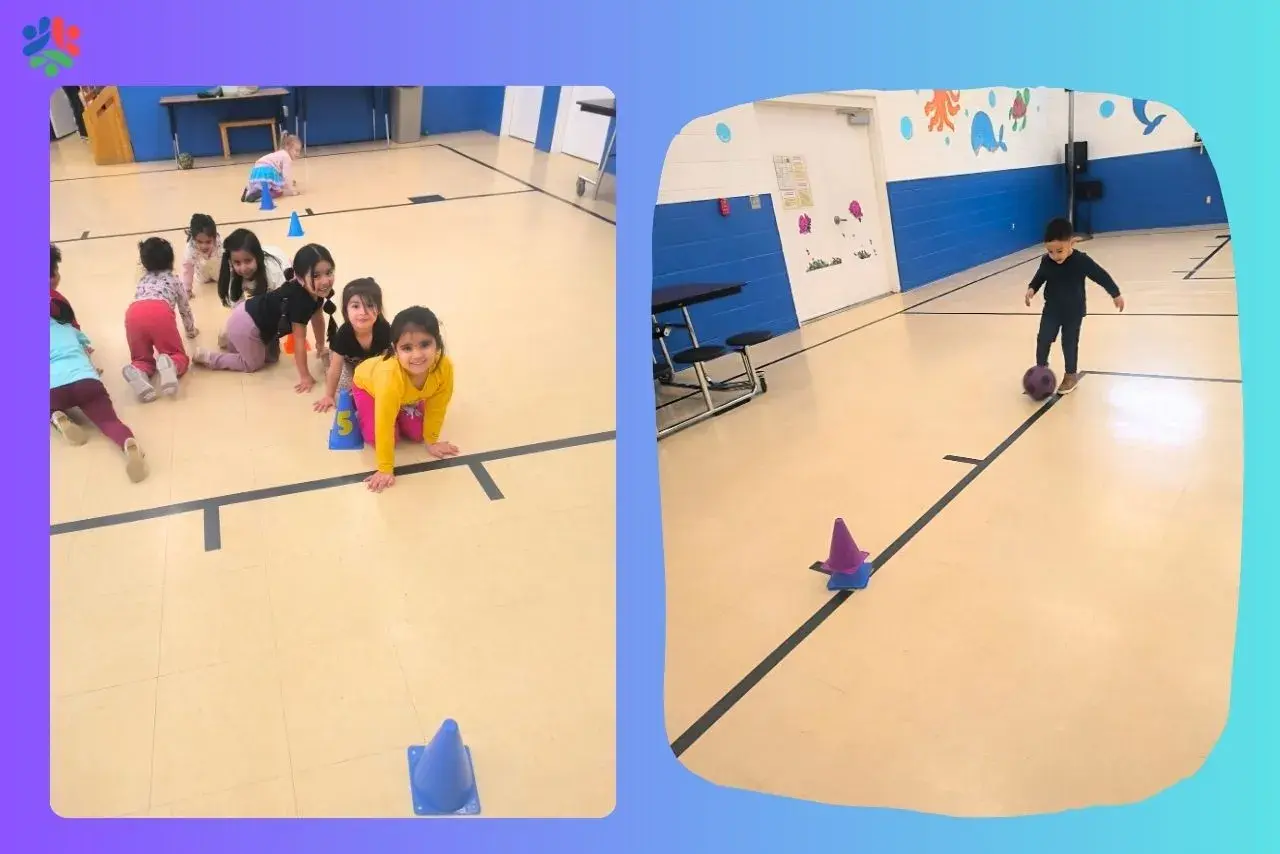
The most useful gross motor skills activities in school are the ones that feel like play but still give children repeated practice in running, balancing, jumping, throwing, catching, and changing direction. I look at this topic through a practical lens: what fits into a classroom, what belongs in recess or PE, and how to make movement age-appropriate without turning every lesson into a performance test. That matters because movement affects participation, confidence, and readiness to learn, not just physical fitness.
The school day works best when movement is built into it, not added on top
- Use a mix of classroom movement, recess play, and structured PE so children practice skills in different contexts.
- Focus on locomotor skills, balance, and object control together; that is where most school games pay off.
- Keep instructions short and repetitions high so children actually get enough practice to improve.
- Adjust the same activity by changing distance, speed, ball size, or support level instead of inventing a new game every time.
- Treat movement as part of learning and development, not only as a reward or energy release.
Why gross motor practice belongs in the school day
Gross motor skills use the large muscle groups that support whole-body movement. In school, that usually means locomotor skills like running, hopping, skipping, and jumping; stability skills like balancing, stopping, and landing; and object-control skills like throwing, catching, kicking, and striking. When those skills improve, children usually move with more control, join games more easily, and spend less time avoiding physical tasks that feel hard or awkward.
I think this is where many schools underestimate the value of movement. Gross motor work is not just “burn off energy” time. It gives children repeated chances to coordinate both body and attention at the same time, which is one reason movement often supports classroom readiness. The CDC recommends that children and adolescents ages 6 to 17 get 60 minutes or more of moderate-to-vigorous physical activity each day, and school is one of the only places where that can happen at scale.
There is also a simple developmental reason to take this seriously: younger children are still learning how to control speed, force, direction, and timing. If they only get occasional practice, they improve slowly. If they get frequent, low-pressure practice across the week, they usually become more confident and more willing to try harder tasks. That confidence matters just as much as the skill itself, because children who believe they can move well are more likely to stay active.
Once you treat movement as part of development rather than a side activity, the next question is which activities give the most improvement for the least setup.

Activities that build the biggest skills fastest
When I choose activities for school, I look for three things: repeated movement, a clear skill target, and a structure that still feels playful. The best options usually hit more than one motor area at once, which makes them efficient for busy classrooms, recess, or PE.| Activity | Skills it trains | Why it works | Easy school variation |
|---|---|---|---|
| Obstacle course | Jumping, crawling, stepping, balancing, turning | Children practice several movement patterns in one sequence | Use cones, tape lines, benches, hoops, or floor spots |
| Hopscotch and line jumps | Single-leg balance, jumping, landing control | Simple repetition helps children improve rhythm and force control | Draw with chalk or tape and change the pattern by grade level |
| Follow-the-leader | Locomotor skills, coordination, listening, imitation | Easy to run indoors or outdoors and easy to scale up or down | Add sideways steps, high knees, tiptoe walking, or backward walking |
| Ball toss and catch games | Hand-eye coordination, timing, bilateral control | Object control is one of the most useful school-age motor skills | Start with scarves or large soft balls before moving to smaller balls |
| Freeze dance | Stopping, starting, balance, rhythm, body awareness | Great for quick resets because the rules are easy to understand | Ask children to freeze on one foot, in a wide stance, or with arms overhead |
| Animal walks | Crawling, squatting, core strength, shoulder stability | Good for short bursts of whole-body work without much equipment | Use bear walk, crab walk, frog jumps, or duck waddle stations |
| Target kicking or tossing | Force control, aiming, weight shift, coordination | Helps children learn how to control the body while directing an object | Use soft balls, floor targets, laundry baskets, or taped squares |
If I had to choose only a few staples, I would keep an obstacle course, a ball game, and one balance-based activity in rotation. Those three cover a lot of motor ground without demanding much equipment. A roll of floor tape, a few cones, and some soft balls are often enough to turn an ordinary room into a useful movement space.
The main point is not novelty. It is repetition with enough variety to keep children engaged. That leads directly to where these activities fit best during the day.
How to fit movement into the school day without losing control
Schools do not need to choose between learning time and movement time. They need to place movement where it helps most. I usually divide school movement into four zones: classroom, recess, PE, and transitions. Each one has a different job.
| Setting | Best use | What it should feel like | Common mistake |
|---|---|---|---|
| Classroom | Short movement breaks, active lessons, quick resets | Brief, structured, and calm enough to return to work | Making the activity too long or too chaotic |
| Recess | Free play, chase games, climbing, ball play | Open, social, and student-led with light supervision | Over-structuring every minute of play |
| PE | Skill instruction, practice, feedback, small-sided games | Focused and progressive, with repeated attempts | Spending too much time explaining and too little time moving |
| Transitions | Hallway walks, stretch-and-go routines, quick movement cues | Purposeful and predictable | Using movement only when the class is already off task |
Classroom movement
In the classroom, I prefer short movement breaks that are easy to start and easy to stop. Think of actions like march in place, reach overhead, side steps, squats to stand, or balance holds. These do not need to be dramatic. Their job is to wake up the body, sharpen attention, and give children one more chance to practice control.
Classroom physical activity can also support academic behavior, which is why I like pairing movement with lesson content when it fits naturally. For example, children can hop the number of syllables in a word, act out story verbs, or move to show shapes and directions. The activity becomes more useful when it serves both the body and the lesson.
Recess
Recess is where many children get their most natural gross motor practice because the play is self-directed and social. A good recess environment does not have to be complicated. Chalk games, balls, jump ropes, cones, and open space can create a lot of movement without adults micromanaging every choice.
What matters most is access. If children spend recess waiting for a turn, arguing over equipment, or standing near the edge of the yard, the motor value drops fast. I like recess activities that invite movement from the start and let children stay active with minimal queue time.
PE
PE is where skill development should become more intentional. This is the place for teacher feedback, progression, and practice with better technique. National guidance from SHAPE America recommends 150 minutes per week of instructional PE for elementary students and 225 minutes per week for middle and high school students. Those targets matter because PE is not just “more activity”; it is the part of school where movement skills are supposed to become more competent and more durable.
In practice, that means using PE to teach the difference between throwing hard and throwing accurately, or between jumping for distance and landing with control. If the lesson only feels like free play, children may stay active but still miss the motor instruction they need.
Read Also: Parallel vs Associative Play - Understanding Your Child's Social Growth
Transitions
Transitions are underrated. A hallway walk, a line routine, or a two-minute cleanup sequence can be turned into skill practice if the structure is deliberate. I like simple cues such as “walk on the tape line,” “tiptoe to the door,” or “carry the stack of books with two hands.” These tiny tasks build balance, control, and spatial awareness without needing separate lesson time.
Once movement is spread across the day instead of trapped in one block, it becomes much easier to make the activities age-appropriate and inclusive.
How I adapt the same game for different ages and abilities
The best school movement games are flexible. The same idea can work for a kindergarten class and an upper elementary group if the task changes in the right places. I usually adjust five things: distance, speed, equipment size, rule complexity, and support level.
- For younger children: keep the pattern simple, the field small, and the demo very clear. A short hop path or a large-ball toss is usually better than a long rule-heavy game.
- For older children: add direction changes, team roles, scoring, or timed rounds so the activity stays challenging without becoming confusing.
- For children with lower confidence: build in success first. Use larger balls, slower pace, shorter distances, and partner support before increasing difficulty.
- For children with sensory or attention needs: predictable routines help more than surprise. A visual model, a start signal, and a finish signal can make the activity much easier to join.
- For mixed-ability groups: offer choices. One child can hop, another can step, and another can hold a balance pose at the same station.
I also think it is important to separate ability from willingness. A child who looks reluctant is not always unmotivated; sometimes the task is too fast, too noisy, or too hard to organize in the moment. When I lower the barrier to entry, participation usually improves quickly.
That flexibility matters because many of the most common mistakes are not about the activities themselves but about how they are delivered.
The mistakes that make movement less effective
I see the same problems over and over in school settings, and they are usually easy to fix once you notice them. The biggest one is too much waiting. If children stand in line longer than they move, the activity stops being a motor practice opportunity and becomes a management problem.
| Mistake | Why it hurts the activity | Better approach |
|---|---|---|
| Too much standing in line | Children lose momentum and get fewer practice attempts | Use stations, pairs, or simultaneous movement |
| Only using running games | Children miss balance, throwing, catching, and landing practice | Rotate locomotor, stability, and object-control tasks |
| Overly complex rules | Children spend energy remembering directions instead of moving | Teach one rule at a time and model it physically |
| No progression | The activity stays fun but does not get more skillful | Increase challenge through distance, accuracy, or speed |
| Using movement as punishment | Children begin to associate movement with shame or correction | Keep physical activity positive and neutral |
| Poor space planning | Collisions, confusion, and frustration rise quickly | Mark clear boundaries and keep pathways open |
If a game creates more chaos than practice, I simplify it immediately. Fewer rules, more repeats, and better spacing usually solve the problem. That is especially true in crowded classrooms where the environment itself can make even a simple activity feel messy.
The small rotation I would keep all year
If I had to build a lean movement plan for a school, I would keep five things in the rotation: one locomotor game, one balance task, one object-control activity, one cooperative chase or tag game, and one calm reset. That mix covers most of the core motor needs without forcing teachers to reinvent the system every week.
- Locomotor game: hopscotch, follow-the-leader, or a cone path.
- Balance task: line walking, one-foot freezes, or stepping stones.
- Object-control activity: tossing, catching, kicking, or rolling to a target.
- Chase or tag game: freeze tag, red light green light, or a simple relay.
- Calm reset: slow stretches, wall pushes, or breathing with gentle arm movements.
That is the version I trust most: simple enough to repeat, varied enough to stay useful, and flexible enough to work across ages and ability levels. If a school keeps that kind of rotation alive through the year, children get more than exercise. They get repeated, meaningful practice in the movements that support play, confidence, and everyday participation.
