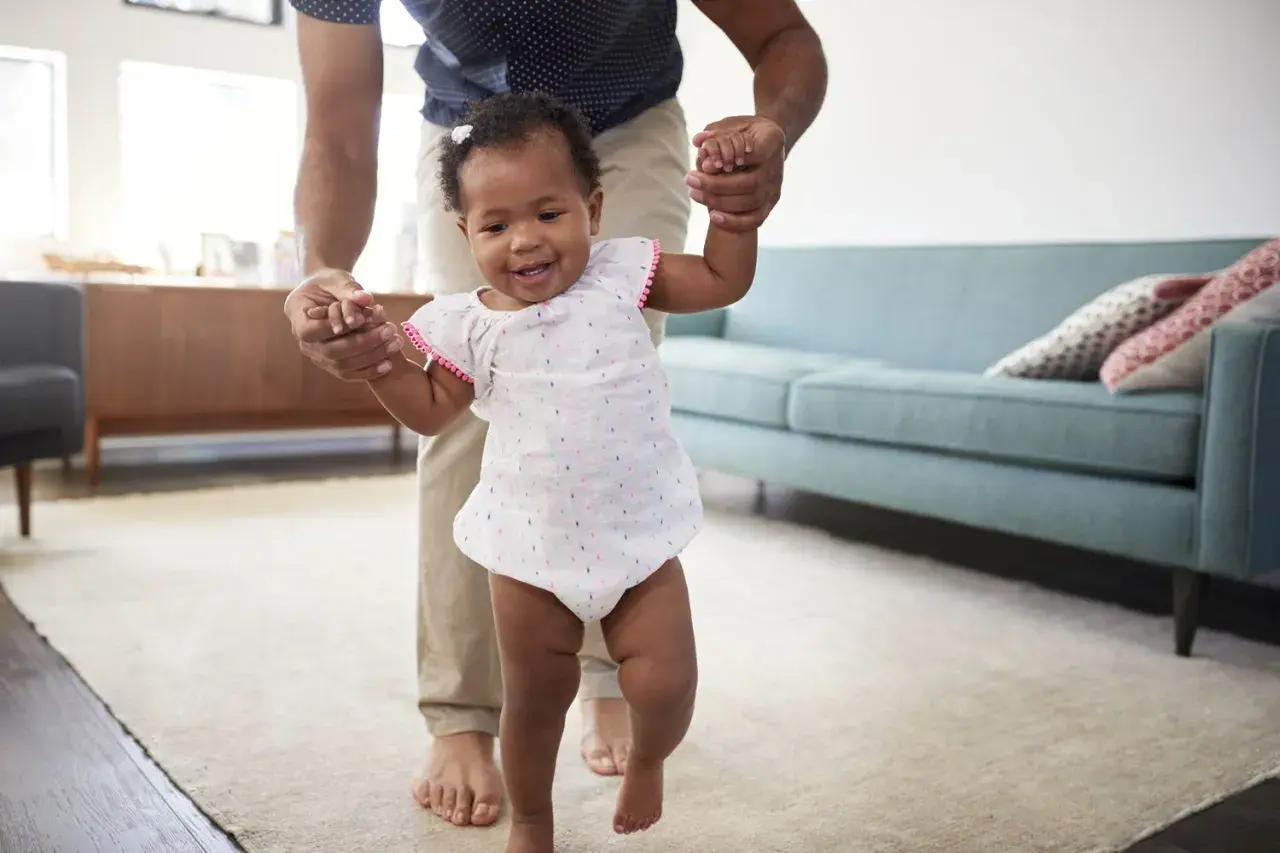
The fastest way to build movement skills is short, repeated play every day
- At this age, the big gains come from standing up, walking independently, squatting, climbing, and changing direction.
- Simple repeatable games beat complicated toys almost every time.
- Push toys, balls, low cushions, and sturdy furniture are often more useful than expensive gear.
- A safe floor space matters as much as the activity itself.
- Progress should look a little wobbly at first, then gradually steadier and more confident.
- If a child loses skills, looks unusually stiff or floppy, or is not meeting key movement milestones, it is worth checking in early.
What changes most between 12 and 18 months
In this window, babies move from “I can get there somehow” to “I can choose how I get there.” That sounds subtle, but it is a big deal. Around 12 months, many children are still cruising along furniture, lowering themselves awkwardly, and testing balance in short bursts. By 18 months, many are walking independently, climbing onto and off low furniture, and starting to handle more changes in level and direction.
The CDC milestone checklist for 18 months includes walking without holding on and climbing on and off a couch or chair without help. I like that benchmark because it keeps expectations realistic: this stage is not about polished athleticism, it is about building control, confidence, and body awareness.
What parents often miss is that falls and stumbles are part of the process. A toddler who can step forward but still needs several tries to squat, turn, or stop is not failing; that child is rehearsing balance. Once you understand that, the next step is choosing activities that give the right kind of practice instead of random chaos.

The activities that match each stage
I prefer to think in stages, not strict ages. A 12-month-old and an almost-18-month-old can both benefit from movement play, but the challenge should look different. The table below shows how I would match common gross motor activities to the child’s current skill level.| Stage | Good activities | What they strengthen | How to level up |
|---|---|---|---|
| 12 to 13 months | Cruising between furniture, standing to reach a toy, rolling a ball back and forth, low cushion climbing | Weight shifting, balance, standing endurance, transition skills | Place the toy a little farther away or add one more step between supports |
| 14 to 15 months | Push toy walks, bubble chasing, squat-and-stand games, short step-ups with help | Leg strength, start-stop control, coordination, early speed changes | Make turns sharper, add a second target, or use a slightly uneven surface |
| 16 to 18 months | Climbing on and off low furniture, kicking a soft ball, carrying toys while walking, simple obstacle paths | Controlled climbing, kicking, sequencing, trunk stability | Add a delivery task, a second obstacle, or a short pause before the next move |
My favorite part of this stage is that the “activity” is often just a normal movement dressed up as play. A child who walks to a basket, drops in a block, turns around, and comes back is doing a surprising amount of work: walking, bending, carrying, releasing, and starting again. That is exactly the kind of repetition that builds real movement skill.
- Pillow path - line up couch cushions or folded blankets for a low, stable obstacle course. This helps with climbing, stepping, and figuring out where the body fits in space.
- Ball chase - roll a soft ball a few feet away and let your child crawl after it, walk toward it, or kick it back. The appeal is simple, but the skill work is serious.
- Basket delivery - ask your child to carry one toy across the room and drop it into a bin. Carrying while walking builds trunk control and balance at the same time.
- Music and freeze - dance, bounce, and march together, then pause when the music stops. Start-stop control is one of the underrated skills in this age range.
If you only choose one pattern, I would choose walk, stop, squat, and repeat. It is simple, low pressure, and surprisingly effective. Once the movement menu is clear, the main job becomes making the room safe enough for a child to practice without constant interruptions.
How to set up a safe movement space at home
A good setup does half the work for you. I like open floor space, a few sturdy objects to pull up on, and one or two soft landing zones. That gives a child freedom to practice without turning the room into an obstacle course of hazards.
There are a few safety rules I do not bend on:
- Use a firm floor or low-pile rug, not a bed or couch, for climbing and walking practice.
- Keep stairs gated unless you are actively supervising practice.
- Clear away sharp corners, unstable furniture, and anything that can tip.
- Keep climbs low and supervised. A couch cushion is fine; a tall chair is not the place to get adventurous.
- Skip sit-in walkers. HealthyChildren is direct about this: they are not safe and they do not build walking skill the way families often hope they will.
One more practical detail: slippery socks can make a new walker less stable, especially on hardwood. Bare feet or grippy socks often work better indoors. Once the space is ready, the next question is what gear actually helps instead of just looking developmental on a shelf.
Toys and gear that actually help
For this age, I care less about “educational” labels and more about what the object makes the child do. The best movement tools invite repeated standing, pushing, carrying, climbing, or chasing. They do not trap the child in one position.
| Useful item | Why it helps | Best use |
|---|---|---|
| Push toy with a wide, stable base | Supports upright walking practice without locking the child in place | Short indoor laps on a flat surface |
| Soft ball | Encourages rolling, chasing, kicking, and turning | Hallway play, living-room games, outdoor use |
| Foam blocks or couch cushions | Great for climbing, stepping, and body awareness | Gentle obstacle courses and supervised transitions |
| Large bin or basket | Adds a carry-and-drop challenge, which strengthens balance | Pickup games and “deliver the toy” routines |
| Pop-up tunnel or play tunnel | Encourages crawling, reaching, and directional movement | Indoor play on rainy days or colder months |
| Low ride-on toy | Builds leg drive and steering if the child is ready for it | After walking is already fairly steady |
| Sit-in walker | It does not meaningfully build walking skill | Avoid |
In real homes, some of the best “gear” is not a toy at all. A laundry basket, a cardboard box, painter’s tape on the floor, or a few sofa cushions can be more useful than a flashy gadget. For families who are shopping, I would rather see one stable push toy and a ball than three overdesigned products that get used once and forgotten.
How to tell whether the challenge is right
The sweet spot is easy to recognize once you start paying attention. The activity should feel a little hard, but not so hard that your child shuts down. I usually look for three signs that the challenge is right:
- Your child returns to the activity on their own after a wobble or brief pause.
- The movement looks slightly messy, but the child is still coordinated enough to keep trying.
- There is effort, but not obvious fear or frustration after every turn.
Here are the signs I would scale back:
- Your child avoids the activity every time.
- There is repeated crying, stiffening, or freezing.
- The body always collapses the same way, or one side seems to do much more work than the other.
- The task is so hard that you need to rescue it at every step.
A simple progression rule helps: if a child can repeat an activity about 3 to 5 times with decent control, I usually make it a little more challenging by changing distance, angle, or surface. If the child cannot get through one clean attempt, I make it easier instead of pushing harder. That judgment call matters, because the goal is confidence, not exhaustion.
When movement needs a pediatrician's attention
Most variation in this age range is normal, but there are also moments when “let’s wait and see” is the wrong response. CDC guidance for 18 months includes walking without holding on and climbing on and off a couch or chair without help, and that is useful as a reality check rather than a strict pass-fail test. If a child is not meeting milestones, has lost skills, or you notice something that feels off, I would not brush it aside.
Watch for patterns like these:
- Not bearing weight or not walking independently by around 18 months.
- Muscles that seem unusually stiff or floppy.
- Frequent balance problems that do not improve with practice.
- Using one side of the body much more than the other.
- Loss of a skill the child already had.
That does not automatically mean something serious is wrong, but it does mean the child deserves an evaluation. In the U.S., early intervention can make a real difference, and the 18-month well-child visit is a good time to bring concerns into the open instead of waiting for them to “sort themselves out.”
A simple routine that fits real family life
If I had to build a practical weekly plan for this age, I would keep it boring in the best way. Repeat the same few movement patterns often enough that your child starts to predict them, then change one detail at a time.
- Daily - one walking game, one climbing or stepping game, and one ball game.
- Twice a week - add a low obstacle course with cushions, boxes, or a tunnel.
- On busy days - do 5 to 10 minutes of movement in two or three short bursts instead of trying to force one long session.
- When your child is tired - choose easy repetition, like rolling a ball or carrying a toy, rather than a harder climb.
The pattern I come back to most is stand, climb, chase, and carry. Rotate those four ideas through the week, keep them short, and let your child repeat what feels fun instead of pushing for a perfect milestone on command. That is usually enough to build stronger legs, steadier balance, and the kind of confidence that makes movement take off on its own.
