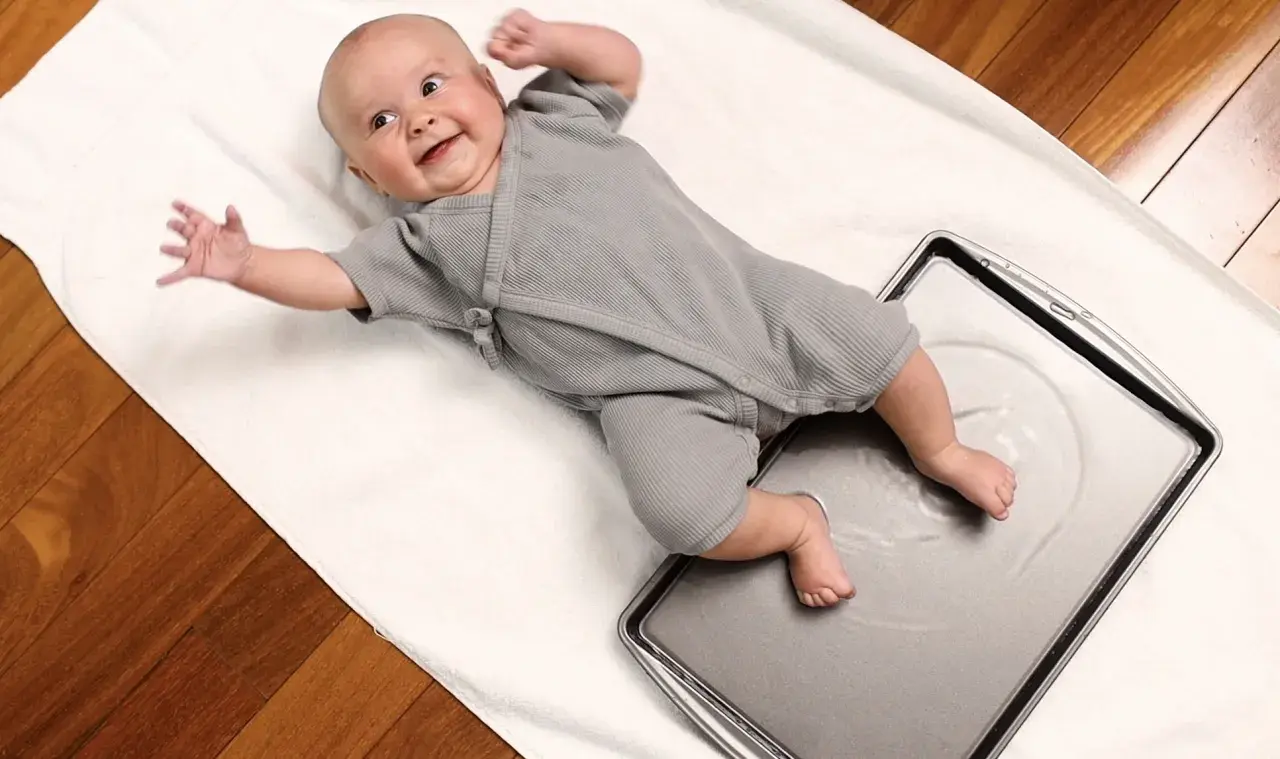
What matters most before the first splash
- Keep the water shallow, warm, and always within arm’s reach.
- Match the activity to your baby’s stage, not just their age.
- Use simple tools such as cups, sponges, and wide funnels instead of tiny toys.
- Short sessions usually work better than long ones.
- The best play is repetitive and predictable, not crowded with too many objects.
- Stop as soon as your baby looks cold, tense, or overstimulated.
Why water play supports early development
When I think about infant play, I look for activities that give the brain and body something real to work through. Water does that unusually well. It moves, drips, splashes, soaks, and changes shape in a way that invites a baby to notice cause and effect, which is one reason it is such a useful sensory tool.
ZERO TO THREE regularly uses cups, sponges, funnels, and bag-based water activities because they naturally build touch awareness and early problem-solving. That is the part many adults underestimate: the baby is not just being entertained. They are learning what happens when pressure changes, when a hand squeezes, when a cup tips, and when a floating object moves away.
Touch and sensory processing
Water gives babies a clean, immediate mix of texture, temperature, and motion. A cool splash on the hands, the slick feel of a sponge, and the sound of water pouring into a cup all help a baby compare sensations. For some infants, that is calming. For others, it is exciting at first and then quickly too much, which is why I keep the setup simple and the session short.
Motor control and coordination
Water play encourages reaching, grasping, transferring, and squeezing. Those are small movements, but they matter. A baby who lifts a cup, tips it, and watches the water move is practicing hand control, eye tracking, and timing at the same time. If two hands are involved, even better, because bilateral coordination is part of nearly every later self-care skill.Read Also: Beyond Parallel Play - Associative & Cooperative Stages
Early language and attention
Water play also gives you something concrete to talk about. I narrate what is happening in plain language: “pour,” “more,” “splash,” “wet,” “cold,” “empty.” That does more than fill the silence. It links words to actions, and that connection is what babies remember long before they can say anything back.
Once you see water as a development tool rather than a novelty, the next step is making the setup safe enough that the play can actually stay calm.

How to set up a safe play spot at home
I prefer a setup that looks almost boring. That is usually a shallow dishpan, a towel underneath it, and a small stack of sturdy tools. A kitchen floor, bathroom floor, or bath area can all work, but the priority is always the same: stable container, shallow water, and full supervision.
For infants, I keep the water depth very low - usually no more than 1 to 2 inches. The American Academy of Pediatrics is direct about this point: babies should never be left alone near water, and drowning can happen in very small amounts. That is why I treat every bucket, tub, sink, and basin as something that must be emptied immediately after use.
| Setup item | Why I use it | What to watch |
|---|---|---|
| Shallow dishpan or basin | Keeps the water low and contained | Choose one that will not tip easily |
| Towel or non-slip mat | Reduces slipping and damp mess | Replace it if it becomes soaked |
| Plastic cups and spoons | Help with scooping, pouring, and grasping | Pick larger pieces that are easy to clean |
| Large sponge | Great for squeezing and transferring water | Avoid anything that sheds pieces |
| Washcloths | Soft, simple, and useful for very young babies | Keep extras nearby so the baby stays comfortable |
I also watch the room itself. Bright, natural light helps the baby notice movement, a clean floor reduces stress for both of us, and having a dry towel within arm’s reach keeps me from stepping away mid-play. That setup matters because good infant water play is less about the objects and more about how controlled the environment feels.
With the space ready, the next question is what the baby can actually do with it at different stages.
Simple activities that fit different baby stages
I like to match the activity to what the baby can already do with their body. That keeps the experience satisfying instead of frustrating. Age ranges are approximate here; the real guide is head control, sitting balance, and how easily your baby tolerates new sensations.
| Stage | Good activity | What it supports | My note |
|---|---|---|---|
| Before sitting independently | Wet washcloths, gentle drips over hands during bath time, watching water move in a cup | Sensory exposure, visual tracking, early calmness around water | Keep the experience brief and fully supported |
| Sitting with support | Squeezing a sponge, patting the surface, moving water from one cup to another | Hand strength, cause and effect, two-handed coordination | This is where the play usually starts to feel more active |
| Sitting steadily | Pouring from a small cup, filling and emptying bowls, floating a larger toy | Timing, attention, hand-eye coordination | Use large objects that cannot fit fully in the mouth |
| Pulling to stand or cruising | Low water table play with a stable container on the floor, scooping with both hands | Reaching, balance awareness, bilateral movement | I avoid standing play if the floor is slippery or the baby is wobbly |
If I want the easiest win, I start with three moves: pour, squeeze, and scoop. Those are simple enough for babies to repeat, but interesting enough that they keep coming back to them. That repetition is what turns a splashy moment into real practice.
Once the activity matches the baby’s stage, the remaining challenge is not creativity. It is safety discipline.
Safety rules I never bend
This is the part I take seriously, even when the play looks harmless. The American Academy of Pediatrics is clear that infants should never be left alone near water, because drowning can happen in less than 2 inches of water. That includes bathtubs, buckets, sinks, and any open container that holds water, even if the session feels small.
- I stay within arm’s reach the entire time.
- I never rely on bath seats, rings, or other gear as a safety device.
- I empty every container immediately after use.
- I avoid breakable items, tiny parts, and anything that could become a choking hazard.
- I keep the water warm, not hot, and test it before the baby touches it.
- I stop if the baby starts shivering, arching away, rubbing their eyes, or getting upset.
There is also a practical limit that parents sometimes miss: more water is not more developmental value. A deeper basin does not make the activity better. It mostly makes it riskier and harder to supervise. If the baby is too small to sit steadily, I keep the water play in the bath or in a very low container with full physical support.
When the safety basics are in place, the last thing that determines whether this works is the quality of the tools you choose.
What to buy and what to skip
You do not need a shelf full of baby gear for this. In fact, too many toys usually get in the way. I would rather have four good items that dry quickly than ten pieces that trap water and collect grime.
Good buys are simple and sturdy: wide plastic cups, a soft sponge, a small funnel with a generous opening, a shallow basin, and a non-slip mat. These are easy to clean, inexpensive, and flexible enough to use in the bath, kitchen, or patio area.
What I skip is usually more important: glass, anything with sharp edges, small floating toys with hidden holes, and pieces so tiny they disappear under the waterline. Closed toys that hold water can become mold traps, which is a nuisance no parent needs.
If you are trying to keep the budget realistic, a functional setup often costs very little because kitchen items work just fine. That is one reason I like this kind of play for nursery essentials: it rewards smart basics, not flashy purchases. A baby does not need a “water station” to benefit from the experience; they need safe materials and an attentive adult.
That leaves the final layer, which is less about shopping and more about rhythm - how to keep the activity useful day after day without letting it become either chaotic or boring.
The small details that make it work day after day
The best infant water routine is usually short, predictable, and a little repetitive. I keep it to 5 to 10 minutes for most babies, because that is long enough for exploration and short enough to avoid fatigue. I also use one or two materials at a time. When I put out too much, the play gets scattered and the baby loses the thread.
Here is the pattern I trust most: set the water out, name what the baby is doing, let them repeat the same action several times, then end before the moment turns into frustration. That last part matters more than people think. A baby who stops while still interested is more likely to come back willingly tomorrow.
I also pay attention to what the baby seems to like. Some babies love splashing; others prefer quiet squeezing or watching the water move. There is no prize for making every child react the same way. The point is to give them a small sensory experience that feels safe, understandable, and worth repeating.
If I had to reduce the whole idea to one rule, it would be this: keep the water shallow, keep the choices few, and keep the supervision total. That is what turns a simple sensory moment into play that genuinely supports development.
