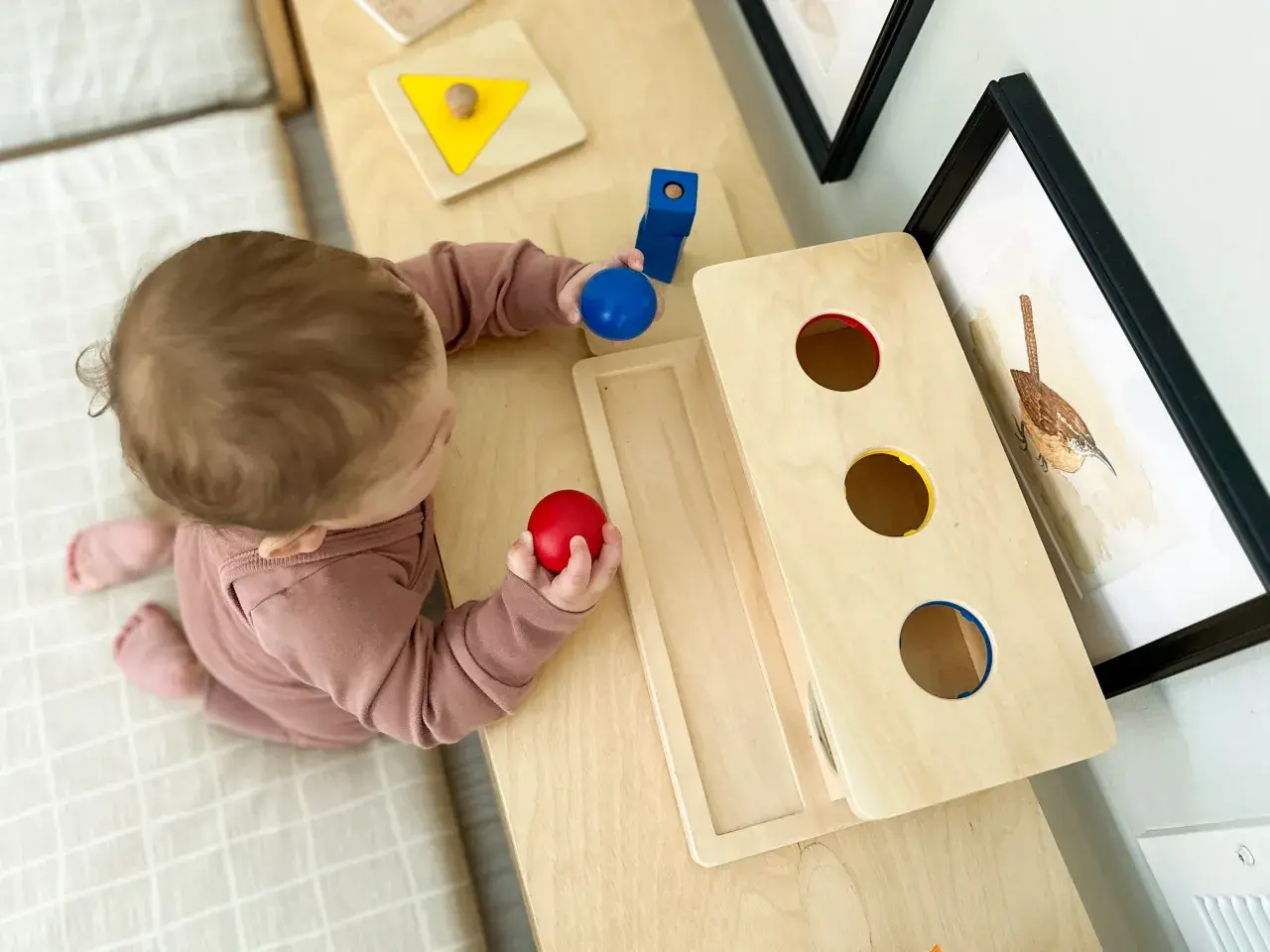
The best montessori activities for 10 month old baby are the ones that match what this age is already trying to master: crawling, grasping, dropping, transferring, and repeating the same movement until it makes sense. In practice, that means simple materials, low shelves, and very little clutter. This guide focuses on practical ideas you can use at home, how to set up the space, what to leave out for now, and how to keep the routine realistic.
What matters most at ten months
- Keep the environment calm, low, and easy to explore from the floor.
- Choose activities that build cause and effect, hand-eye coordination, and object permanence.
- Offer only a few materials at a time; repetition matters more than variety.
- Use safe household items and simple toys instead of overstimulating electronics.
- Stay close, especially with anything that could be mouthed, tipped, or dropped.
What Montessori looks like at ten months
At this age, I am not trying to “teach” in the school sense. I am looking for the work the baby is already drawn to: sitting, reaching, moving objects from hand to hand, putting things in and out, banging, and searching for items that have disappeared from view. That is why Montessori for babies feels so different from the usual toy pile. It is built around purposeful repetition, not entertainment.
Most ten-month-olds benefit from a quiet environment with one clear task at a time. Some babies are already pulling up or cruising, while others are still focused on mastering sitting, crawling, and controlled hand use. I find it helps to follow that reality instead of forcing a developmental script. When the setup matches the child’s current stage, concentration lasts longer and frustration drops fast.
- Sitting without support supports play from the floor.
- Transferring objects hand to hand builds coordination.
- Looking for hidden objects introduces object permanence, which means understanding that something still exists even when it is out of sight.
- Banging, dropping, and sorting help a baby test cause and effect.
Once you understand that developmental picture, the next step is choosing activities that meet it cleanly and safely.

The activities I reach for first
For a ten-month-old, I like activities that are simple to present and satisfying to repeat. A good rule is that the baby should be able to see the whole action, understand the result, and try again without adult help every second. That is where Montessori-inspired play becomes powerful.
| Activity | What it builds | How I would present it | Why it works now |
|---|---|---|---|
| Object permanence box | Cause and effect, concentration, memory | Show one ball drop, then let the baby repeat the action | The disappearing-and-returning action is fascinating at this age |
| Posting large objects into a bowl or box | Hand-eye coordination, wrist control, release | Use chunky rings, big wooden balls, or fabric squares | Babies love putting things in and taking them out again |
| Rolling a soft ball back and forth | Tracking, timing, early turn-taking | Sit close on the floor and roll slowly | It supports movement without overwhelming the baby |
| Stacking cups or large nesting cups | Grasp refinement, spatial awareness | Offer 3 to 5 cups, not a giant set | The baby can bang, topple, nest, and explore in many ways |
| Treasure basket | Sensory exploration, grasping, curiosity | Fill a low basket with safe natural objects of different textures | It gives variety without flashing lights or sound effects |
| Board books in a low basket | Language, attention, bonding | Keep 2 or 3 sturdy books within reach | Babies this age like turning pages, touching pictures, and hearing names repeated |
| Pull-to-stand support near a mirror | Balance, coordination, body awareness | Use a stable low surface and place one interesting object nearby | Some babies are ready to explore vertical movement |
| Simple sound play | Auditory interest, rhythm, hand control | Offer one shaker, a wooden spoon, or two safe metal bowls | Babies enjoy making a sound, then making it again on purpose |
My preference is to start with just 2 to 4 of these materials visible at once. Too many choices dilute attention. A baby this age does not need a full activity center; they need something clear enough to understand and interesting enough to repeat. That is a much better test of good design than novelty.
If I had to choose only three, I would start with the object permanence box, a basket of safe things to transfer, and a soft ball for rolling. Those three cover a surprising amount of development without making the room feel busy. From there, it becomes easy to layer in one new material when the old one loses its spark.How to set up the space so your baby can actually use it
The environment matters just as much as the activity itself. Montessori for infants works best when the room makes sense from the baby’s point of view: low, reachable, uncluttered, and calm. I like open baskets, low shelves, soft floor space, and one clear place for each material. When the setup is orderly, the child spends less energy searching and more energy exploring.
- Keep the shelf simple, with a few visible choices instead of a crowded display.
- Place materials where the baby can reach them from sitting or crawling.
- Use baskets or open containers so the whole object is visible at a glance.
- Rotate only one or two items when interest fades, not on a rigid schedule.
- Remove noisy distractions that pull attention away from the actual task.
I also like to think about the nursery as a place where the baby can move without constant correction. A low mirror, a rug or mat, and sturdy furniture can do more for independence than a stack of expensive toys. The point is not perfection. The point is to let the child practice real movement in a room that is easy to read.
Once the room supports the work, the next question is what not to offer yet, because that is where many parents overcomplicate things.
What to skip or simplify for now
One of the biggest mistakes I see is offering activities that are too advanced, too noisy, or too complicated to hold a ten-month-old’s attention. A baby at this stage does not need a toy that does everything. They need a toy or object that does one thing well. Flashing lights, overbuilt play panels, and multi-step activities often create more noise than learning.
I would also avoid anything with small detachable parts, fragile pieces, or textures that shed. If a material needs too much explanation, it usually belongs in a later stage. For this age, I want the baby to succeed quickly and repeat the action independently. That is the Montessori sweet spot.
- Avoid toys that require the baby to press many buttons just to reach the reward.
- Skip activities that depend on fine pincer control if the child is still using a fuller grasp.
- Do not place the baby in positions they cannot get into alone.
- Leave out tiny objects, loose magnets, and anything that can break into small pieces.
- Keep the session short if the baby is overwhelmed; more time is not always better.
Safety also matters in everyday handling. CDC guidance for infant mealtimes emphasizes keeping things calm, seated, and closely supervised, and I apply the same logic to play. A calm, attentive adult is part of the material at this age.
With those limits in mind, the best next step is not adding more complexity. It is building a rhythm that fits family life.
A simple daily rhythm that feels doable
I do not recommend turning the day into a schedule of activities. Ten-month-olds usually do better with short, focused windows of play and plenty of room for movement, rest, and family life. In practice, 5 to 10 minutes of real engagement is often enough before the baby shifts to something else. That is normal, not a failure.
| Part of the day | Good fit | Time |
|---|---|---|
| Morning | Floor time with a soft ball or posting activity | 5 to 10 minutes |
| After a nap | Object permanence box or nesting cups | 5 to 8 minutes |
| Before bath or dinner prep | Board books, songs, or simple sound play | 5 minutes |
| Late afternoon | Pull-to-stand practice or mirror exploration | 5 to 10 minutes |
If your baby wants to repeat the same activity again and again, let that happen. Repetition is not boredom in this age; it is learning. I would rather see the same ball dropped twenty times with focus than ten different toys touched for ten seconds each.
A simple rhythm also helps you notice what is actually working. If a baby keeps returning to one material, that is useful information. It tells you where to go deeper instead of wider.
The small upgrades that make the next month easier
Once a ten-month-old starts mastering a material, I look for the next step that is only slightly harder. That might mean moving from dropping one object into a wide bowl to using a narrower opening, or from a simple basket of textures to a posting box with a clear target. The idea is to keep the challenge close enough that success still feels likely.
- Move from open baskets to containers with defined openings.
- Move from large graspable objects to slightly smaller ones, but not tiny pieces.
- Move from rolling a ball to rolling it back and forth in a clear turn-taking game.
- Move from static floor play to safe pull-up or cruising opportunities if the baby is ready.
- Move from one book at a time to a small book basket the child can choose from independently.
That is the pattern I would keep in mind: observe, simplify, repeat, and then nudge the challenge forward. If you do that well, you do not need a room full of toys to support development. You need a few thoughtful materials, a calm space, and the patience to let the baby lead the pace.
