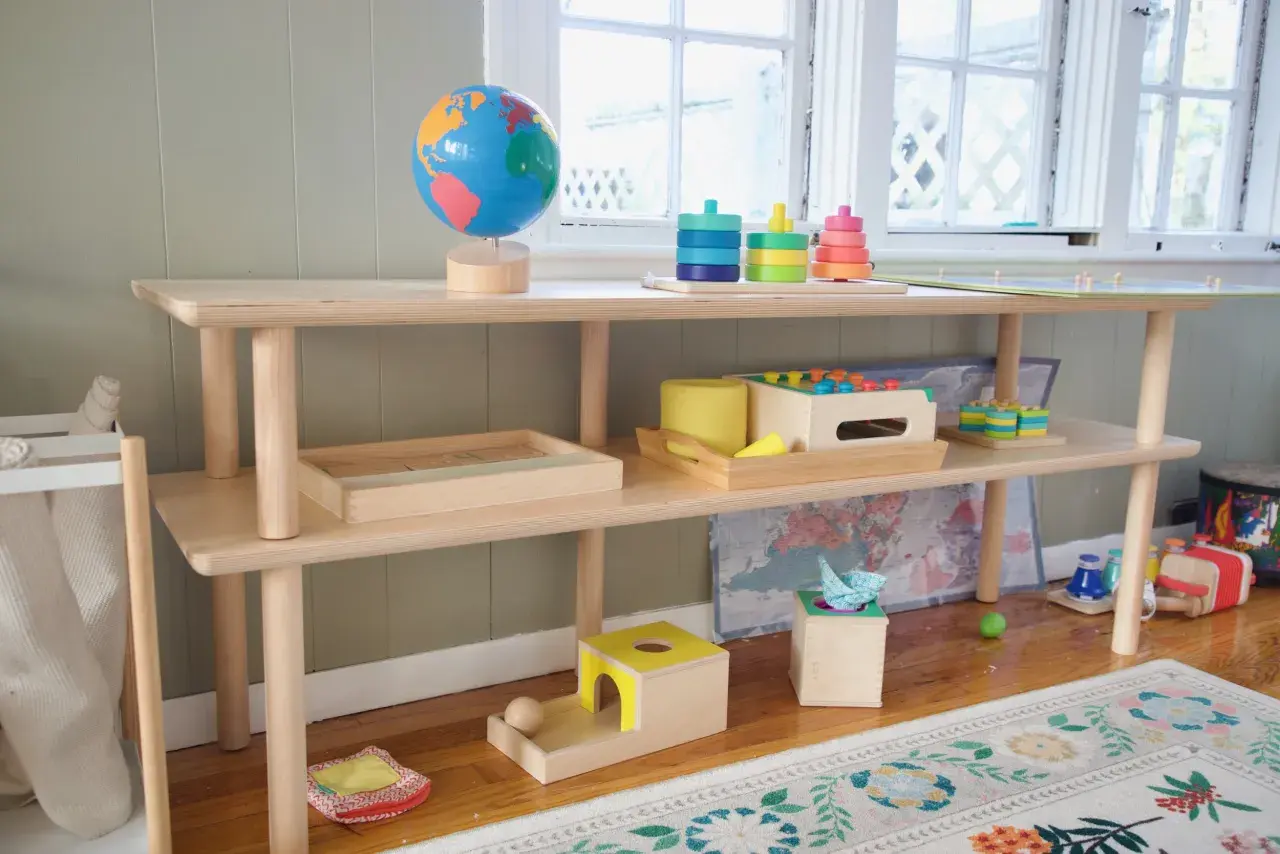
Montessori at one year old is less about teaching lessons and more about preparing a calm home where movement, repetition, language, and simple real-life tasks can happen safely. At this age, the setup matters as much as the toy: a low shelf, a handful of purposeful materials, and a routine that gives the child room to try, repeat, and eventually do more on their own. This guide breaks down what that looks like in practice, what to buy, what to skip, and how to keep the whole approach realistic.
The main thing to get right at this age
- A one-year-old needs a prepared environment, not a crowded playroom.
- Choose toys that focus on one skill at a time, such as posting, stacking, grasping, or movement.
- Practical life activities matter more than flashy educational gadgets.
- Safety is non-negotiable: small parts, loose cords, magnets, batteries, and unsafe sleep setups do not belong in a Montessori space.
- Keep the routine short, repeatable, and calm so the child can actually use the environment.
What Montessori looks like at 12 months
At around one year old, I think of Montessori as a way of organizing life around the child’s current abilities. The focus is not on academics. It is on supporting the real work of this age: refined grasp, early walking, a growing language burst, and simple one-step practical life activities like drinking from a cup, carrying objects, or putting toys away.
That is why the best Montessori spaces for this age feel simple. According to the American Montessori Society, infant and toddler environments are calm, homelike, uncluttered, and built around low shelves, child-sized furniture, and easy access to materials. That principle translates well to home: if the child cannot reach it, use it, or put it away with help, it probably does not belong in the daily rotation yet.
I also like to keep expectations grounded. A one-year-old does not need long attention spans or a perfect setup. What matters is repetition. The same toy, the same basket, the same small task, done again and again, is exactly what builds coordination and confidence.

Build a prepared home environment
The environment does most of the teaching, which is why I would start with the room before I start shopping. A good setup gives the child a few clear choices, a lot of freedom to move, and very little clutter to fight through.
| Area | What I would change | Why it helps |
|---|---|---|
| Play space | Leave a clear floor area for crawling, cruising, and first steps. | Movement is a major part of development at this age. |
| Storage | Use one low shelf with 5 to 8 visible items. | Fewer choices make it easier for the child to choose and return materials. |
| Books | Keep board books in a small basket at child height. | Books become part of daily life instead of an afterthought. |
| Practical life area | Set out a small tray with a cloth, a cup, or a spooning activity. | Real tools build coordination and independence. |
| Sleep space | Keep the sleep area simple, firm, and free of loose items. | Sleep safety should stay separate from decorative trends. |
If you use a crib or portable play yard, keep it bare and follow safe sleep guidance. If you use a floor bed, I would treat it as a safety project first and a Montessori choice second: the room needs to be fully childproofed, and every reachable hazard has to be removed. The American Academy of Pediatrics is clear that firm, flat sleep surfaces and an empty sleep space matter most in early childhood.
For me, the biggest win is not expensive furniture. It is reducing friction. When the child can reach a book, choose a toy, or help with a tiny task without waiting on an adult every time, the whole room starts working better.
Choose toys and activities that match real development
At one year old, the best Montessori-style toys are simple enough to understand quickly and useful enough to repeat many times. I want a toy to do one job well. If it sings, flashes, talks, spins, and teaches seven things at once, it is usually working harder than the child is.
| Toy or activity | What it builds | Why it works at this age |
|---|---|---|
| Object permanence box or posting toy | Hand-eye coordination, cause and effect, concentration | Dropping an object and seeing it reappear is endlessly satisfying for a young toddler. |
| Stacking rings or nesting cups | Grasp, sorting, order, early problem solving | The child can repeat the same movement without needing an advanced skill set. |
| Large knob puzzle | Pincer grasp, shape awareness, persistence | The big knob gives the child a real chance of success without frustration. |
| Push toy or stable walker | Balance, gross motor control, confidence in movement | This supports walking practice without taking over the movement for the child. |
| Board books in a basket | Language, naming, visual focus | Books are most useful when they are easy to reach and easy to revisit. |
| Practical life tray | Spooning, pouring, wiping, carrying | Real-life work is often more engaging than commercial toys because it has a clear purpose. |
| Music basket with a bell or shaker | Listening, rhythm, controlled movement | Simple instruments give feedback without overwhelming the child. |
I usually advise parents to rotate rather than overload. Five to eight visible items is enough for most one-year-olds. When interest fades, swap one item out instead of adding three more. That keeps the shelf readable and helps the child notice what is actually there.
Practical life activities deserve special attention. Pouring water with a tiny pitcher, wiping a spill with a small cloth, putting socks in a basket, or carrying a spoon to the table may look ordinary, but they are exactly the sort of work that builds order, coordination, and independence.
Keep materials safe and age-appropriate
Montessori only works well when the space is safe enough for real exploration. The American Academy of Pediatrics recommends choosing toys that are large enough to avoid choking risk, sturdy enough to withstand chewing, and free of dangerous add-ons like loose magnets, button batteries, sharp edges, and long strings. For a one-year-old, I also avoid anything that is loud enough to be annoying to adults and potentially harmful to hearing.
- Choose pieces that cannot fit into a child’s mouth.
- Avoid toys with button batteries or loose magnets.
- Skip strings longer than about 7 inches.
- Use sturdy materials that do not splinter, crack, or break into sharp parts.
- Check hand-me-downs carefully, especially older plastic toys and stuffed toys with worn seams.
- Remove any recalled toy immediately.
Sleep safety belongs in the same conversation. If the sleep area has blankets, pillows, stuffed animals, or bumpers, it is not truly ready. That is why I prefer a stripped-down sleep setup over a cute one. A room can look beautiful and still be unsafe if the child can reach something hazardous from the bed.
One more practical point: supervise the first few uses of any new material. Montessori is not about leaving a child alone with a toy and hoping for the best. It is about showing the correct use, then stepping back enough for the child to practice safely.
Common mistakes that make Montessori feel harder than it is
The biggest mistake I see is turning the method into a shopping list. Montessori is not a brand of toys, and it is not a room full of expensive wooden objects. It is a way of helping a child participate in real life with as much independence as their age allows.
- Too many toys on display at once.
- Buying multi-function toys that do everything except let the child think.
- Expecting long solo play from a one-year-old.
- Confusing independence with “leave them alone.”
- Using baby talk for every interaction instead of naming things clearly.
- Skipping movement opportunities and focusing only on table toys.
- Setting up a beautiful shelf but never showing the child how to use it.
I also think parents underestimate how much guidance a one-year-old still needs. Independence at this age is not freedom from adults. It is freedom to try, with an adult close enough to support, repeat, and protect.
If the environment feels chaotic, I usually reduce the number of choices before I change anything else. That one adjustment often does more than buying another toy.
A simple starter plan for the next 30 days
If I were setting up a Montessori-style home for a one-year-old from scratch, I would keep the first month very small and very practical. The goal is not to finish a room. The goal is to build a rhythm the child can actually use.
- Clear one low shelf and leave only 5 to 8 materials on it.
- Add one basket of books and place it where the child can reach it.
- Choose one movement item, such as a push toy or stable walker.
- Set out one practical life tray with a cloth, spoon, or small pitcher.
- Keep one simple music item available, not a whole electronic toy bin.
- Remove anything with tiny parts, loose cords, or unnecessary noise.
- Watch what the child returns to most, then rotate the rest.
That is enough to create a meaningful Montessori environment without overcomplicating family life. Start with the shelf, the floor space, and the safety basics. Once those are in place, the child will tell you what belongs next through repeated use, not through guesswork.
For most families, the best result is a home that feels calmer, a child who gets more chances to do things independently, and a toy setup that finally makes sense. That is the version of Montessori I would trust in a real U.S. home: simple, safe, and useful every day.
