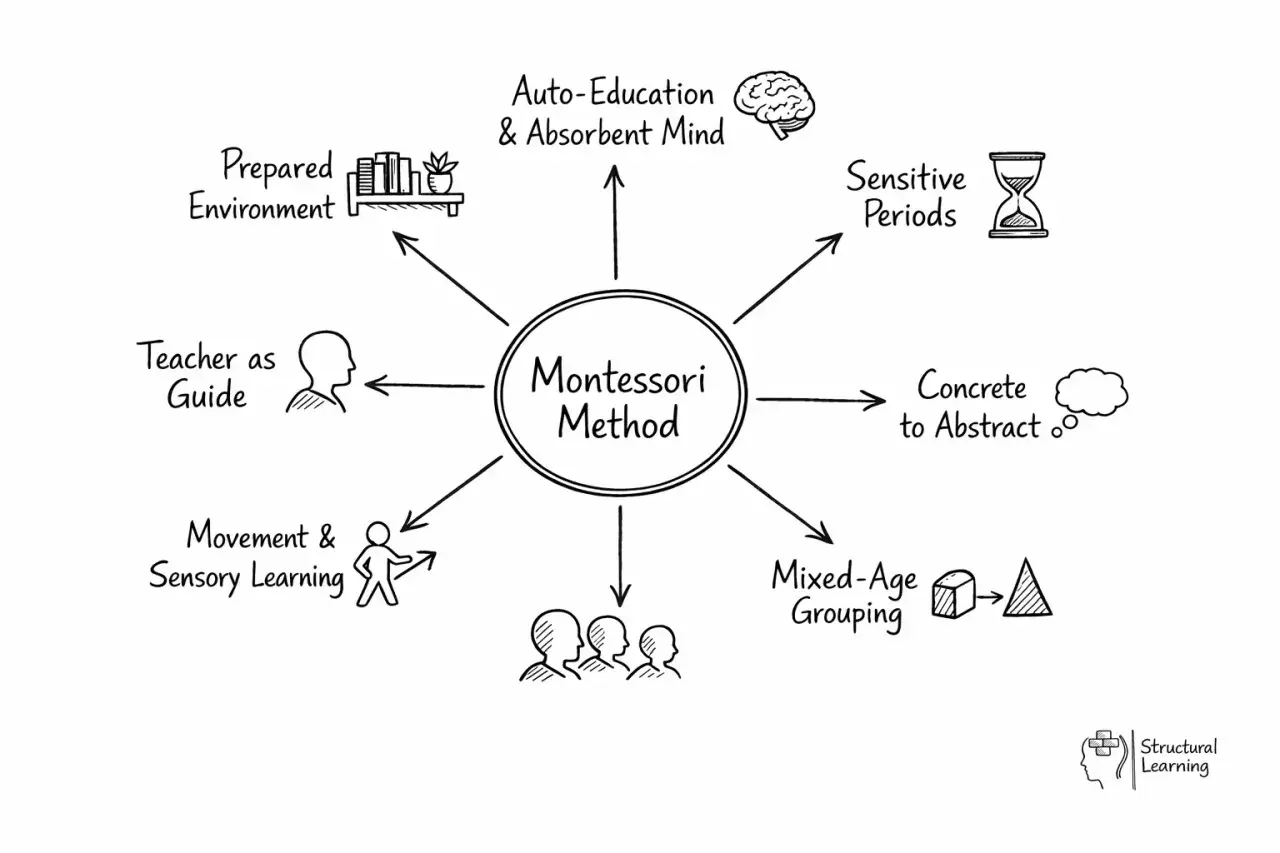
Montessori language work starts long before a child reads a page or writes a sentence. The method builds speech, sound awareness, vocabulary, and handwriting in a sequence that feels practical rather than abstract, which is why it often works so well for young children. In this article, I break down how the sequence works, which materials matter most, how to use it at home, and where parents usually get stuck.
The sequence works best when speech, sound, symbol, and writing build in order
- Oral language comes first: conversation, songs, stories, and precise vocabulary.
- Sound games prepare the ear before letters ever appear.
- Sandpaper letters and the moveable alphabet make abstract symbols tangible.
- Writing often appears before fluent reading because children can build words with letters before handwriting catches up.
- Short, well-timed lessons usually beat long drills.
What the language sequence is designed to do
In a Montessori classroom, language is not treated as a separate worksheet subject. It is part of daily life: naming things accurately, listening closely, telling stories, and learning how spoken words turn into written ones. The real goal is confident communication backed by a strong listening ear and a child who can move from meaning to symbol without strain.
I find it helpful to separate two sound skills that adults often blend together. Phonological awareness is hearing the larger patterns in speech, such as rhyme, syllables, and word play. Phonemic awareness is the finer skill of hearing individual sounds inside a word. Montessori language work usually starts with the bigger listening games, then narrows toward those tiny sounds, because children need to hear language clearly before they can build it with letters.
That is also why the method looks so concrete. Instead of asking a child to memorize abstract rules, it lets the child touch letters, move them, and hear them in isolation. Once that foundation is in place, reading and writing feel less like a leap and more like a natural next step. From here, the materials make the sequence visible.

The core materials that make the sequence concrete
The materials are not decoration. Each one isolates a single idea so the child can focus on it without distraction. That is one reason Montessori language work can feel so calm compared with more crowded early-literacy programs.
| Material | What the child does | What it builds | Why it matters |
|---|---|---|---|
| Sound games and rhymes | Claps syllables, finds rhymes, isolates first or final sounds | Listening discrimination and early phonological awareness | The child learns to hear language before trying to decode it |
| Sandpaper letters | Traces textured letters while saying the sound | Sound-symbol connection and muscle memory | The hand, eye, and ear work together instead of separately |
| Moveable alphabet | Builds words and short sentences with loose letters | Encoding, spelling, and early composition | This is where many children start writing before handwriting feels easy |
| Metal insets | Traces geometric shapes and controlled lines | Pencil control, hand strength, and line awareness | It prepares the hand for writing without forcing letters too early |
| Classified and nomenclature cards | Names, sorts, and discusses real objects or images | Precise vocabulary and categorization | Children learn words in meaningful sets rather than as isolated flashcards |
| Reading cards and simple books | Reads phonetic words, commands, and short passages | Decoding, comprehension, and confidence | The child sees reading as useful, not as a test |
This vocabulary work is often called nomenclature, which simply means naming things precisely and in useful categories. I like that term because it reminds adults that language is not just spelling; it is also the habit of saying the right word for the right thing.
Direction also matters. In English, children quietly absorb left-to-right flow while laying out letters, tracking words, and reading short cards. That small detail matters more than people think, because it supports how print is actually organized on the page. Once that sequence is clear, the next question is how to use it in a home setting without overdoing it.
How to use the approach at home without over-teaching
If I were building this into a nursery, playroom, or homeschool shelf, I would keep the lessons short and ordinary. I usually cap a preschool presentation at 10 to 15 minutes, especially when the child is also getting rich conversation and read-aloud time during the day.
- Narrate real life. Say exactly what you are doing, seeing, and comparing. “This is rough. This is smooth.” “That bird is a cardinal.” Precision gives children better language than generic chatter does.
- Read aloud every day. Mix picture books with poems, nursery rhymes, and simple nonfiction. Rich language in the ear usually shows up later in the mouth and hand.
- Use one lesson at a time. A child does not need five new materials at once. I prefer one sound game, one tactile letter activity, or one vocabulary set, then repetition.
- Use the three-period lesson for naming. First I name it, then I ask the child to recognize it, and finally I ask the child to recall it. It is simple, but it keeps the child active rather than passive.
- Stop before fatigue. Montessori works best when the child leaves wanting a little more. If attention drops, the presentation was already long enough.
In a typical U.S. home, that can mean a small shelf in the nursery, a basket on the floor, or a low tray on a table. The biggest mistake is trying to turn every activity into a lesson with a correct answer. A better model is to make the environment rich, then step back and let the child repeat what feels interesting. That leads naturally into the question of readiness, because age matters less than the stage the child is actually in.
How the work changes from toddler years to elementary age
Readiness matters more than age. Children do not all move through language in the same order, and Montessori makes room for that. What changes is the level of abstraction the child can handle, not the underlying respect for language itself.
| Age band | Main focus | Best-fit activities | What not to rush |
|---|---|---|---|
| Birth to 3 | Absorbing spoken language | Conversation, songs, rhymes, naming objects, board books, listening games | Worksheets, formal phonics, pressure to speak on command |
| 3 to 6 | Sound awareness, symbol matching, early writing | Sound games, sandpaper letters, moveable alphabet, metal insets, simple reading cards | Long handwriting drills or too many grammar rules at once |
| 6 to 9 | Grammar, sentence structure, reading for meaning | Grammar symbols, sentence analysis, command cards, short research writing | Reducing reading to decoding only |
| 9 to 12 | Vocabulary growth, word origins, composition | Morphology, etymology, editing, essays, presentations, wider reading | Oversimplifying books or assuming the basics are no longer needed |
In practice, I watch for signs of readiness: the child repeats sound games with ease, starts noticing letters in the environment, or begins inventing words with the moveable alphabet. Those cues matter more than a calendar age. When readiness is ignored, that is usually when the method feels slow or forced, which brings me to the mistakes I see most often.
Where Montessori language work usually breaks down
Most problems are not with the method itself. They come from using it out of sequence or expecting it to do a job it was never meant to do.
- Starting with letter names instead of sounds. Children need to connect sound to symbol before alphabet recitation becomes useful.
- Overloading the shelf. Too many cards, too many alphabets, and too many versions of the same activity make it harder for a child to settle into real repetition.
- Rushing handwriting. If the hand is not ready, the child often ends up fighting the pencil instead of learning the word.
- Correcting every slip immediately. A child who is still exploring language needs room to try, hear, and adjust.
- Ignoring oral language. If children do not hear rich vocabulary, they have less to work with when they begin to read and write.
- Ignoring support needs. If a child is not hearing sounds clearly, is not adding words over time, or struggles with speech in a persistent way, Montessori materials should be part of the picture, not the only answer.
What I take from that is simple: the method works best when adults stay patient, observant, and selective. If the child keeps stumbling, I do not push harder; I step back to the last point of success and rebuild from there. That makes the final setup much more useful than a room full of materials ever could.
A lean home setup that still gives children enough language to grow
If you want the smallest useful version of this at home, I would start with five things: a basket of board books and poetry, a set of real-object or picture cards, sandpaper letters or another tactile alphabet, a moveable alphabet, and a few materials for rhyming and sound play. That is enough to support a real language environment grounded in Montessori principles without turning the house into a classroom.
- Keep books visible and easy to reach.
- Rotate only a few materials at a time.
- Use real names for objects instead of baby talk.
- Let the child touch, move, sort, and repeat.
- Favor quiet concentration over novelty.
If you only keep one rule, make it this: keep the environment richer than the child, but the presentation simpler than you think. That balance is what lets the method stay gentle, practical, and genuinely useful.
