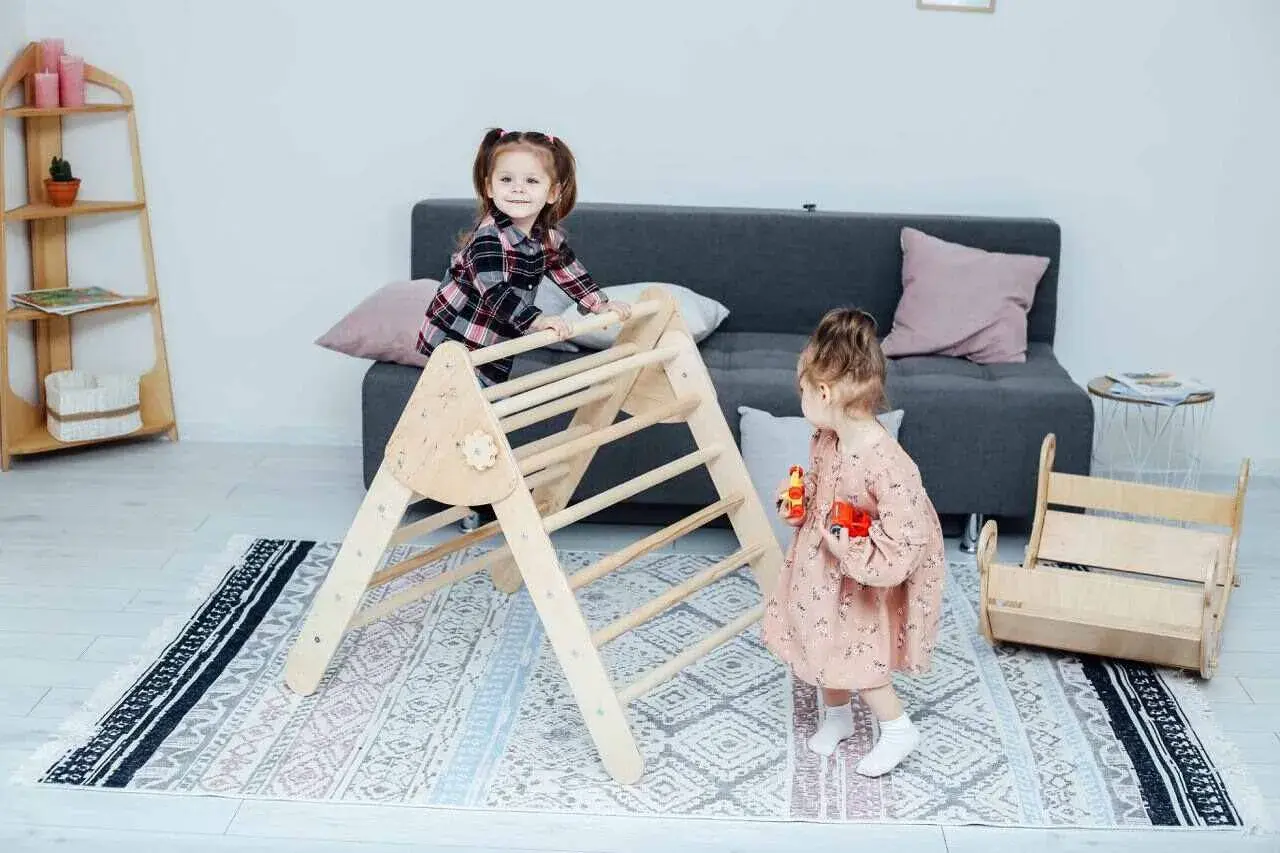
Simple, age-matched play does more than a crowded toy box
- Montessori for babies is really about prepared space, real materials, and observing what the child is ready for.
- Short, repeatable sessions usually work better than long activity blocks.
- Tummy time, treasure baskets, mirrors, mobiles, and object permanence games cover most of the useful baby work.
- Age matters: newborns need visual calm, older babies need reaching, transferring, crawling, and cruising practice.
- Safety comes first, so skip small parts, strings, loose magnets, and anything that fails the toilet-paper-roll test.
- Expensive Montessori-branded products are optional, because many of the best materials are household items used with intention.
What Montessori play means in the first year
In infancy, Montessori is less about teaching and more about removing clutter between the baby and the experience. I want the adult to prepare the environment, observe what the child is ready for, and then step back enough for repetition to do its job.
The American Montessori Society describes infant work as supporting independence, coordination, concentration, language, and problem-solving through everyday living. That matches what I see in real homes: babies do best when the task is clear, the materials are real, and the adult does not rush to entertain them every 30 seconds.
This is also why many Montessori-inspired activities are surprisingly ordinary. A mirror, a wooden spoon, a cloth square, or a simple basket can be more useful than a battery-powered toy because each one gives the baby one thing to notice. Once that idea clicks, the rest becomes a question of matching the activity to the stage.
That stage-by-stage match is where most families see the biggest difference, because the right invitation at the wrong age still feels like the wrong invitation.

Activities that match each baby stage
Age matters more than branding. A newborn needs visual clarity; a 10-month-old needs room to move and a few objects that invite problem-solving. I sort baby activities by what the nervous system is ready to practice, not by what looks cute in a catalog.
| Age band | Activities that fit | What they develop |
|---|---|---|
| 0 to 3 months | High-contrast mobile, face-to-face talking, slow singing, short mirror time, gentle tracking from left to right | Visual focus, bonding, early attention |
| 4 to 6 months | Tummy time with a toy just beyond reach, grasping a ring, fabric squares, reaching for a scarf, side-to-side tracking | Head and shoulder strength, reaching, hand opening |
| 6 to 9 months | Treasure basket, object permanence box, hand-to-hand transfer, open-and-close containers, tapping a spoon on a tray | Sensory discrimination, cause and effect, fine motor control |
| 9 to 12 months | Posting box, stacking cups, low shelf pick-and-return, cruising from couch to toy, simple sorting with large objects | Crawling, pulling up, balance, problem-solving |
The pattern is simple: at first the baby needs something to look at, then something to reach for, then something to manipulate, and finally something that makes movement part of the learning. If an activity feels too advanced, I scale it back instead of pushing through.
For newborns, the win is not volume; it is clarity. For older babies, repetition becomes the work. When a baby drops the same ring 20 times or pulls the same cloth from a basket again and again, that is not boredom. That is practice.
That idea matters when you set up the room, because the environment should make repetition easy, not exhausting.
How to set up a room that invites independence
A Montessori-friendly baby space does not need a full nursery makeover. I usually think in three zones: a floor area for movement, a low shelf for the current rotation, and a care area where diapers, clothes, and other routine items are easy to reach for the adult but not piled on top of the baby’s play space.
- Keep the floor open. A mat or soft rug matters more than decorative furniture, because babies need space to roll, reach, and eventually crawl.
- Use a low shelf. Three to five items at a time are enough for most infants. Too many choices turn into visual noise.
- Add a mirror. A secure, baby-safe mirror gives the child a reason to lift the head, track movement, and notice the body.
- Rotate rather than crowd. When interest drops, I swap one or two pieces instead of overhauling the whole setup.
- Keep real life nearby. A basket of cloths, a spoon, or a small natural sponge often belongs in the environment as much as a toy does.
If you are trying to do this on a budget, that is a good place to stop and breathe. A calm, reachable setup is the point, not a catalog-perfect room. Once the space works, the next decision is which materials deserve a place in it.
The materials and toys I would actually choose
I prefer a short list of materials that feel honest in the hand. Wood, metal, cotton, woven fabric, and sturdy cardboard all give different feedback, which is exactly what a baby is learning to notice.
| Material or toy | Why I use it | Best stage |
|---|---|---|
| High-contrast mobile | Supports visual tracking without overwhelming a newborn | Birth to about 3 months, during awake time |
| Baby-safe mirror | Encourages body awareness, head lifting, and movement | From birth, during floor play |
| Treasure basket | Offers texture, weight, shape, and sound in one calm setup | Once baby can sit with support and explore safely |
| Grasping ring or wooden rattle | Helps with open hand work, transfer, and midline control | During the reaching and grasping stage |
| Object permanence box or posting box | Makes cause and effect easy to see and repeat | Later in the first year |
What I skip is just as important. If a toy does the work for the child with lights, noise, and random motion, it often belongs outside this list. I want the baby to act on the object, not to watch the object perform.
A wooden spoon is not glamorous, but it is honest. It has weight, temperature, and sound, and that is exactly why a baby pays attention to it. That is also why I would rather have a few real materials than a box of plastic items that all feel the same in the hand.
Those materials only pay off when they fit naturally into the day, so the next question is how to use them without turning home life into a project.
How to fit these activities into a real day
The easiest Montessori routine is the one you can repeat without building a production around it. I like to keep activities tied to natural pauses in the day, because babies are far more available for learning when they are rested, fed, and already on the floor.
- After waking: offer a few minutes of movement time, mirror time, or a mobile, depending on age.
- After a diaper change: sing, name body parts, or offer one book instead of a stack of toys.
- Midmorning: bring out a treasure basket or grasping object and let the baby explore one item at a time.
- After a nap: return to tummy time, reaching, or rolling practice while the baby is alert.
- Before wind-down: keep the environment quieter and simpler, with books, cuddling, or gentle sensory play.
I usually leave the same materials out for several days before rotating them. Repetition is not a weakness in infancy; it is how concentration and motor control become stable. When a baby wants the same ring, the same book, or the same basket again and again, I take that seriously.
That rhythm works best when the materials are safe and the activity level matches the baby’s actual stage, which is where most preventable mistakes show up.
Safety rules and common mistakes that matter most
Montessori should never be used as a reason to relax basic baby safety. In the U.S., toy age labels are there for a reason, and the American Academy of Pediatrics notes that those recommendations reflect choking risk as well as developmental fit.
- Use the size test. If an object can fit inside a toilet paper roll, I keep it away from babies and young toddlers.
- Avoid choking risks. Small parts, loose beads, tiny balls, cracked pieces, and detachable decorations do not belong in baby play.
- Watch strings and cords. Anything long enough to loop around the body or neck is not worth the risk in a baby space.
- Supervise mouthable objects. Treasure baskets are for observation and exploration, not for unattended use.
- Do not overfill the room. Clutter makes it harder for a baby to choose, focus, and finish a movement.
- Do not rush milestones. If a baby is not sitting, crawling, or pulling up yet, I work with the stage that is actually here.
The biggest mistake I see is buying “Montessori” as a look instead of as a method. A toy can be beautifully made and still be wrong for the baby’s stage. If it is too advanced, too busy, or too unsafe, it misses the point.
Once the safety basics are handled, the easiest way to avoid overthinking is to start with a tiny starter kit and let the baby’s responses shape what comes next.
The smallest starter kit that still feels complete
If I were setting this up from scratch, I would begin with fewer items than most parents expect. One floor mat, one safe mirror, one visual mobile or high-contrast object, one treasure basket with a handful of safe household pieces, and one simple grasping toy are enough to cover a lot of ground in the first months.
- Floor mat or soft rug for movement
- Baby-safe mirror for self-discovery and head lifting
- One visual mobile or simple high-contrast image for early tracking
- Treasure basket with 5 to 8 large, safe, varied objects
- Grasping ring, rattle, or cloth square for hand work
- Later, an object permanence box or posting box for cause and effect
The real strength of Montessori activities for babies is not the label but the way they respect pace, movement, and attention. If the room is calm, the materials are safe, and the activity matches the stage, you do not need much else. Start small, watch closely, and let the baby show you when it is time to change the next thing.
