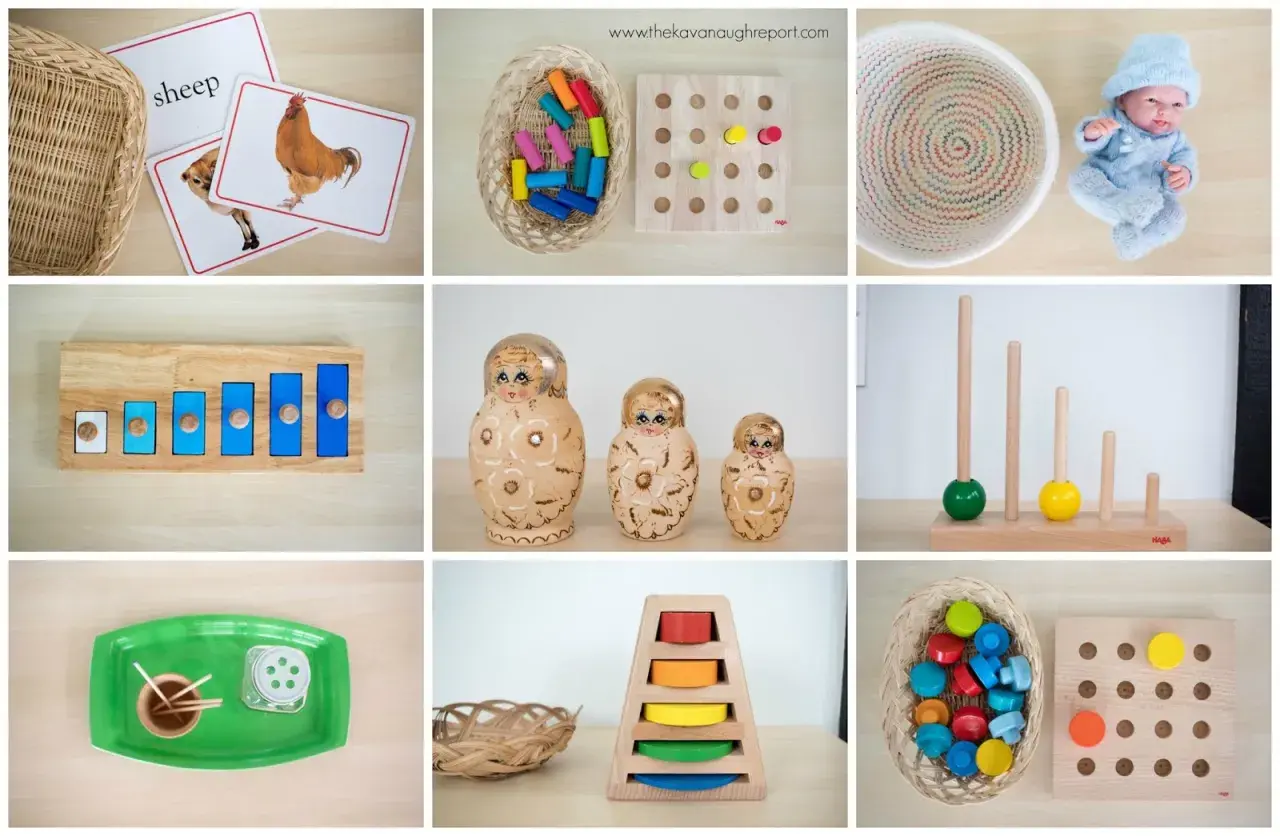
An 18-month-old does not need a packed schedule or fancy materials. The best montessori activities for 18 month old children are simple, hands-on, and tied to real life: pouring, carrying, matching, scribbling, climbing, and helping with everyday routines. In this article, I break down what is developmentally realistic at this age, which activities are actually worth setting up at home, and how to keep the environment calm enough for real concentration.
The essentials at a glance
- Prioritize practical life first: pouring, spooning, wiping, dressing, and carrying.
- Keep each activity short and repeatable, usually around 5 to 15 minutes.
- Use real, child-sized tools whenever possible instead of toy substitutes.
- Limit the shelf to a few carefully chosen options so the child can choose without overload.
- Look for activities that build coordination, language, order, and independence at the same time.
- Expect mess, repetition, and slow progress; those are signs the work is age-appropriate.
What an 18-month-old is actually ready for
At this stage, I think less about “teaching” and more about matching the child’s natural drive. Most 18-month-olds are walking independently, trying to feed themselves, pointing to interest, scribbling, copying household actions, and beginning to use a few words on purpose. That makes them ideal candidates for work that involves movement, repetition, and clear cause and effect.
They are also in a very sensitive period for order and independence. If the environment is calm and the steps are simple, they can concentrate far longer than many adults expect. What they usually cannot handle is a task with too many steps, too many pieces, or too much adult talking. That is why Montessori at this age works best when the activity is concrete, visible, and connected to daily life.
In practical terms, I look for three things: can the child do part of it alone, can the hands learn something useful, and does the task invite repetition without frustration? If the answer is yes, the activity is probably a good fit. That leads directly to the kinds of work that should live on the shelf or kitchen counter.

The activities that work best at this age
The strongest Montessori work for this age group usually falls into five lanes: practical life, sensory sorting, movement, language, and early mark-making. I like to choose activities that serve more than one purpose, because an 18-month-old learns best when the body and mind are engaged together.
| Activity | What it builds | Simple setup | Why it works at 18 months |
|---|---|---|---|
| Pouring from a small pitcher | Hand control, concentration, coordination | Two small pitchers, a tray, a towel | It is concrete, repeatable, and gives instant feedback |
| Spooning dry items | Pincer grasp, wrist control, sequencing | Spoon, bowl, transfer material such as large pom-poms or beans under supervision | The movement is simple but still requires focus |
| Wiping a table or shelf | Practical independence, order, gross motor coordination | Small cloth, low surface, a little spill | Children love doing what adults do, especially when the task is real |
| Object matching and sorting | Vocabulary, visual discrimination, order | Two baskets, two or three matching objects | It feels like play, but it is quietly training attention |
| Board books and naming objects | Language, attention, pointing, comprehension | 4 to 6 sturdy books in a basket | Short, repeatable book sessions fit the toddler attention span |
| Scribbling with thick crayons | Pre-writing control, grip strength, creative expression | Large paper, chunky crayons, low table or floor mat | It supports hand development without demanding precision |
| Step up and down practice | Balance, coordination, confidence | One safe step, floor pillow, or movement path | At this age, the body is hungry for challenge |
| Watering a plant | Responsibility, motor control, care of environment | Small watering can, tray, one sturdy plant | It gives the child a clear role in family life |
Practical life work that feels real
This is where I would start almost every time. An 18-month-old can carry a washcloth to the sink, place napkins on a low table, help move laundry, or bring a spoon to the counter. These tasks matter because they are not pretend; they make the child feel useful while training fine motor control and sequencing.
Good beginner choices include pouring water between two small pitchers, spooning dry beans under close supervision, wiping a spill, brushing crumbs into a dustpan, and holding out an arm or foot while dressing. The value is not that the task gets done perfectly. The value is that the child gets repeated, meaningful practice.
Sensory and sorting activities
At 18 months, I keep sensory work simple and limited. A child this age does not need a complicated sensory bin with ten materials. Two or three large, safe objects that can be sorted, stacked, nested, or matched are usually enough. Wooden blocks, nesting cups, large rings, or color-matched containers all work well.
The point here is not novelty. It is refining the child’s ability to notice differences and make choices. Sorting by color or size may seem basic, but it is laying groundwork for later math and language. The child is learning how to compare, classify, and repeat a pattern without being pushed into an academic-looking lesson too soon.
Movement and coordination work
Montessori is never only about quiet table work. An 18-month-old needs room to move, push, carry, climb, squat, and recover balance. I like low obstacle paths, climbing on safe furniture with supervision, carrying light objects from one point to another, and walking while pushing a stable toy.
These activities strengthen the whole body and help the child build confidence in space. They also support concentration better than many people expect. A toddler who gets enough movement is often more settled when it is time to sit for a puzzle or a book.
Language and book activities
For language, I prefer real objects and simple naming over flashy educational toys. A basket of board books, a few object cards, or a small set of everyday items can be enough. I will point, name, pause, and let the child respond in their own way. At this age, the conversation is often more important than the perfect word.
Books should be sturdy, short, and visually clear. One or two pages may be enough for some children. I also like books that connect to real life, like food, animals, clothing, and family routines, because they help the child connect language to the world around them.
Read Also: Montessori Fine Motor Activities - Boost Skills & Independence
Early art without the chaos
Art at this age should be process-based. Thick crayons, washable markers, large paper, and a simple easel are enough. Finger paint can work too, but only if the setup is controlled and the cleanup is part of the activity. I would skip anything that requires precision or a long explanation.
What matters most is that the child learns how to make a mark, hold a tool, and finish with a sense of ownership. That is a much better goal than producing a “cute” result for adults. The next step is making the environment support all of this work instead of fighting it.
How to set up a home environment that supports concentration
The environment does half the teaching. If the room is too crowded, too noisy, or full of plastic clutter, even excellent activities can fall flat. For a toddler, I aim for a shelf with 5 to 7 choices max, each one easy to return and easy to understand. Clear trays, baskets, and low shelves matter more than expensive materials.
- Keep materials low so the child can reach them independently.
- Offer only one version of each activity at a time.
- Use trays or baskets so the work has a beginning and an end.
- Choose real tools: child-sized pitcher, sponge, brush, small cloth, wooden spoon.
- Make the setup safe enough for independent use, but not so perfect that the child cannot touch it.
For kitchen participation, a stable step stool or learning tower is worth considering if your child likes to help with food prep. That lets them wash fruit, stir batter, or carry napkins without being held the whole time. I also like a small floor space with one mat or rug for activities that need visual boundaries. It sounds simple, but that boundary helps the child understand where the work begins and ends.
If the home is prepared well, the child does not need constant direction. That is the moment Montessori starts to feel less like a method and more like a habit of daily life, which is where adult guidance becomes important.
How to guide without taking over
With toddlers, the hardest part is often adult restraint. I want to show the work once, slowly, and then let the child try. If I narrate too much, correct every spill, or rescue the task too early, I take away the very thing that makes the activity valuable. The child needs time to explore the movement and finish it in their own rhythm.
I also pay attention to the language I use. Instead of praising every outcome, I try to name the effort or the action: “You carried the bowl carefully,” or “You found the blue piece.” That kind of feedback is more specific and helps the child notice what they did well. It is a small shift, but it makes the interaction feel respectful rather than performative.
| Helpful adult move | Less helpful version |
|---|---|
| Demonstrate once, then pause | Talk through every step repeatedly |
| Use short, clear words | Give a long explanation before the child starts |
| Let the child finish imperfectly | Fix the work as soon as it looks messy |
| Offer one small choice | Ask open-ended questions that overwhelm the child |
| Redirect calmly when needed | Turn the activity into a power struggle |
There is a limit, of course. If a task becomes unsafe, too frustrating, or clearly beyond the child’s current ability, I step in and simplify it. Montessori is not about leaving the child alone; it is about offering the right amount of help at the right time. That balance is easiest to maintain when you know the common mistakes.
Common mistakes that make toddler work fall apart
The biggest mistake I see is overloading the child. Too many materials, too much choice, and too much stimulation turn a calm environment into visual noise. A toddler cannot concentrate well when every shelf is shouting at them. Fewer activities, used more often, usually works better than a wide variety that gets ignored.
- Choosing activities that are too abstract or too fiddly for small hands.
- Expecting the child to use the material “correctly” on the first try.
- Giving toys that entertain but do not build a real skill.
- Leaving out fragile, unsafe, or choking-prone objects without supervision.
- Interrupting concentration too quickly because the work looks slow.
- Rotating materials so often that the child never gets repetition.
- Using screens or background noise during work time and then wondering why focus is shallow.
I also think adults sometimes mistake neatness for success. A spilled bowl, a crooked wipe, or a badly placed block is not failure at this age. It is evidence that the child is practicing. If the task is always pristine, the child may not be doing enough of it themselves. That is why a realistic routine matters more than a perfect shelf.
A starter rhythm that keeps the work useful all week
If I were setting this up from scratch, I would keep the weekly rhythm very simple. Each day would include one practical life activity, one language activity, one movement opportunity, and one open-ended creative option. That does not mean four formal lessons. It means making sure the child has repeated access to the kinds of work their brain and body are asking for.
- Daily practical life: pouring, wiping, spooning, carrying, dressing practice, or plant care.
- Daily language: a few board books, object naming, songs, or picture cards.
- Daily movement: climbing, pushing, stepping, or carrying across a room.
- Daily mark-making: crayons, a simple easel, or large paper on the floor.
- Weekly rotation: swap only one or two items so the shelf stays familiar but not stale.
For families building a small Montessori corner at home, I would start with a tray, two child-sized pitchers, a small basket of cloths, thick crayons, a few sturdy books, and one movement challenge. That is enough to cover the essentials without turning the room into a classroom. If you choose well, the child will return to the same materials again and again, and that repetition is what turns an ordinary setup into meaningful developmental support.
For an 18-month-old, the best Montessori work is not elaborate. It is real, repeatable, and just challenging enough to earn a second try. When the environment is calm and the materials are honest, toddlers do exactly what they are supposed to do: they practice, repeat, and grow into independence one small task at a time.
