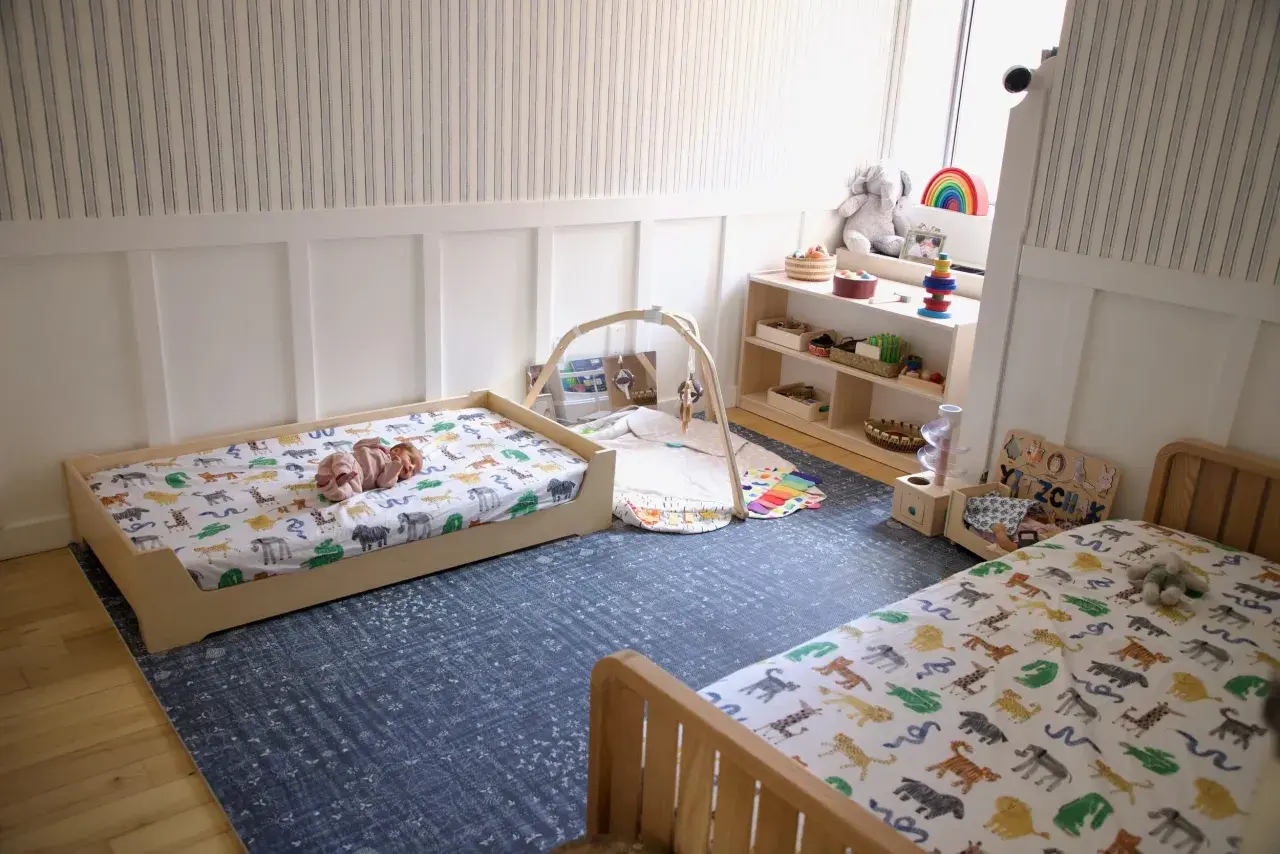
A Montessori floor bed can work beautifully, but only when it serves the child and the room is truly ready for it. The real question is not whether a mattress sits close to the ground; it is whether the sleep setup supports independence without compromising safe sleep. In this guide, I explain what the approach means, when it makes sense, how to set it up, and how it compares with a crib or toddler bed.
The decisions that matter most before you switch
- For newborns and young infants, a crib, bassinet, or play yard that meets safety standards is still the safer default.
- Montessori-style floor sleeping is about independence, access, and a prepared room, not just putting a mattress on the ground.
- The setup only works when the room is childproofed, the mattress is firm, and the bedtime routine stays consistent.
- The biggest advantage is freedom of movement; the biggest risk is assuming the bed solves safety problems the room has not solved.
- Many families make the switch when a child is rolling, crawling, or climbing, but readiness matters more than a fixed age.
What a Montessori floor bed actually is
In Montessori, the bed is part of a prepared bedroom. The Montessori Foundation’s home checklist even describes the bedroom with a floor bed or low bed so a child can get in and out independently. That is the point: the child can move, choose, and settle without being lifted in and out of a tall crib.
This is not the same thing as putting a baby on a random rug or skipping sleep safety. For infants, the American Academy of Pediatrics is still clear about the basics: back sleeping, a firm flat sleep surface, room-sharing without bed-sharing, and no loose bedding. So I do not treat the Montessori idea as a replacement for safe-sleep rules. I treat it as a different way to organize the sleep environment once the child is ready.
That distinction matters, because a floor bed can be thoughtful and developmentally appropriate, or it can be a stylish shortcut. The difference is almost always in the details, which leads directly to the bigger question: when is it actually a good fit?
When it makes sense and when it doesn’t
I think the cleanest way to judge a floor bed is to ask whether the child can safely benefit from the freedom it creates. A floor bed makes sense when the child is mobile, the room is completely prepared, and the family wants the child to have more autonomy around sleep. It is often a good fit for toddlers and older babies who can roll, crawl, or walk and who do better with the ability to settle themselves.
It does not make sense just because the room looks minimalist. If the child is a newborn or a young infant who still needs a crib or bassinet for safer containment, I would not rush the transition. I also would not use a floor bed in a room that still has unsecured furniture, dangling cords, easy climbing hazards, or anything else that would become dangerous the moment the child wakes up alone.
Here is the short version I use in practice:
- Good fit: a mobile child, a childproof room, a stable bedtime routine, and parents who want more child-led independence.
- Poor fit: a newborn, a room that is not fully safe, or a family that needs the tighter containment of a crib for now.
- Gray area: older infants who are moving well but still wake often. In that case, I would look at the whole sleep environment before changing the bed itself.
So yes, the Montessori approach can be very practical. But it only works when the environment is doing real work, not just the furniture. That is why the setup matters so much.

How to set up a safer floor bed
If I were building this from scratch, I would think in layers: mattress, room safety, bedtime boundaries, and daily maintenance. The mattress is only the visible part. The room does the heavier lifting.
- Start with a firm sleep surface. Choose a firm mattress that fits the child’s sleep space well. Avoid plush toppers, thick padding, and anything that lets the face sink in. For infants, keep the surface flat and simple.
- Keep bedding minimal. For babies, skip pillows, quilts, and loose blankets. For older toddlers, a light blanket is usually enough. I like to keep the sleep zone visually calm so it stays clearly separate from play.
- Childproof the entire room. Anchor dressers and shelves to the wall, cover outlets, secure cords, and remove anything that can tip, tangle, or tempt climbing. If the room is near stairs, a gate is not optional in my view.
- Control the doorway, not the bed. A floor bed works better when the room boundary is safe. Many families use a door gate or another barrier to keep a wandering toddler from roaming the house at night.
- Watch the floor itself. If the mattress sits directly on the floor, check for moisture, dust, and ventilation issues. In humid homes, a low frame or slatted base can help airflow. I would especially avoid trapping a mattress on damp carpet.
- Keep the room boring at bedtime. Use a nightlight if needed, but skip bright toys and visual clutter. The room should invite sleep, not exploration.
That is the heart of the Montessori setup: simple, safe, and easy for the child to navigate. Once that foundation is in place, it becomes much easier to compare the floor bed with the alternatives.
How it compares with a crib or toddler bed
When parents ask me whether a floor bed is “better,” I usually answer that better depends on the child and the stage. A crib is still the strongest choice for containment in the infant months. A toddler bed is a familiar middle step. A floor bed gives the most freedom, but it also asks the most of the room.
| Option | Best for | Strengths | Tradeoffs |
|---|---|---|---|
| Crib or bassinet | Newborns and young infants | Strong containment, simpler safe-sleep setup, less wandering | Less independence, outgrown faster |
| Montessori floor bed | Mobile babies and toddlers in a fully childproof room | Easy in-and-out access, supports autonomy, low fall height | Needs a highly prepared room and more boundary setting |
| Toddler bed | Older toddlers who want a “big kid” bed | Familiar transition, often easy to buy, some models add rails | Higher than a floor bed and easier for a child to get in and out repeatedly |
What this table does not show is the emotional side of the switch. Some children love the freedom immediately. Others treat it like an invitation to explore. That is where the most common mistakes start.
The mistakes that make the setup fail
Most problems I see are not caused by the bed itself. They come from parents assuming the bed will do the job of the room, the routine, and the boundaries all at once.
- Switching too early. A child who still needs the tighter containment of a crib is not magically ready just because the bed is low.
- Skipping room safety. A floor bed in an unsafe room is still an unsafe room.
- Using too much bedding. Decorative pillows and heavy blankets may look cozy, but they create unnecessary risk and clutter.
- Expecting instant sleep changes. A floor bed is not sleep training. It changes access and independence, not your child’s temperament overnight.
- Letting the room become a playground. If bedtime turns into climbing, opening drawers, and exploring shelves, the environment needs to be simplified again.
I also see parents underestimate how boring consistency needs to be. The first few nights are not the time for elaborate explanations or dramatic reactions. A child learns the new setup by repeating it, not by hearing a speech about it.
A realistic transition plan for the first two weeks
If you decide the floor bed is the right move, I would not frame it as a one-night transformation. I prefer a gradual transition, especially for toddlers who are already attached to a crib routine.
- Keep the bedtime routine the same. Start with the familiar parts first: bath, books, cuddle, lights out. The bed can change; the sequence should not.
- Begin with naps if that feels easier. Some children adapt to daytime sleep faster than nighttime sleep. That lets you test the setup without making the whole night depend on it.
- Respond calmly when the child gets up. If they wander, bring them back with as little excitement as possible. The goal is not to punish curiosity; it is to make the sleep boundary boring and predictable.
- Review the room after each wake-up. If the child is repeatedly drawn to the same drawer, shelf, or cord, remove the temptation instead of repeating yourself endlessly.
- Reassess after about 1 to 2 weeks. If sleep is getting more chaotic instead of more settled, the setup may need more structure or a slower transition.
For younger babies, I would be more conservative and default back to the AAP safe-sleep framework if there is any doubt. For older toddlers, the real question is usually not “Can they sleep on the floor?” but “Can they sleep safely in this room with this amount of freedom?” That distinction is what keeps the Montessori version useful instead of merely trendy.
The version of Montessori sleep that actually holds up at home
The setup that works best in real homes is usually the least dramatic one: a firm sleep surface, a childproofed room, and a routine that makes bedtime feel steady rather than negotiable. When those pieces are in place, the Montessori approach supports independence without turning the bedroom into a hazard zone.
- Use a crib or bassinet first if your baby still needs the safer containment of an infant sleep space.
- Move to a floor bed when mobility, room safety, and family routine line up.
- Keep the nursery simple so the sleep area stays clear and easy to understand.
If the room is not ready, the right move is not to force the bed. It is to prepare the environment first and let the sleep setup follow.
