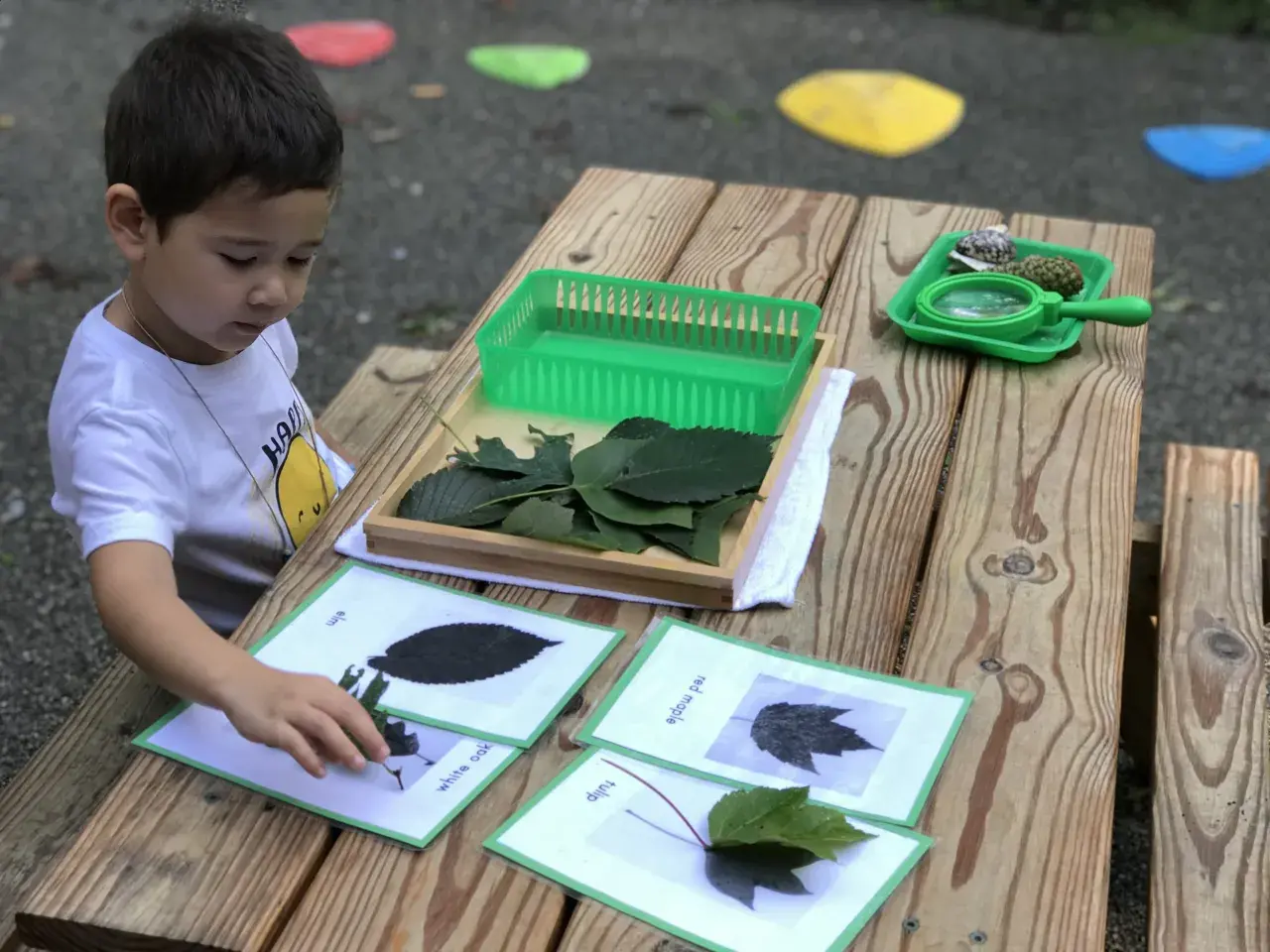
Outdoor time becomes much more useful when it has a clear purpose. In Montessori practice, children do best when they can handle real tools, repeat meaningful tasks, and care for living things instead of just passing the time. In this article, I break down what the best Montessori outdoor activities look like, how to match them to age and attention span, how to set up a simple space, and what usually gets in the way.
The Montessori outdoors works best when children have real work, simple tools, and room to repeat it
- Purpose matters more than novelty; the child should be doing something useful, not just staying busy.
- Real tools beat toy versions because they support coordination, responsibility, and independence.
- Age and stamina shape the activity; toddlers, preschoolers, and elementary children need different levels of challenge.
- Observation is part of the work; watching insects, weather, and plant growth is not a side note.
- Simple routines last longer than elaborate setups; a few repeatable jobs are enough to build skill.
What makes outdoor activity Montessori rather than just outdoor play
What I look for first is purpose. A child running outside for the sake of movement is having a good time, but a child watering beans, sweeping a path, or checking birdbath water is doing something more specific: practical life work in a prepared environment. That difference matters because Montessori is built around freedom within limits, repetition, and real responsibility.
The Montessori Foundation describes the outdoor classroom as an extension of the same principles used indoors: order, beauty, independence, and hands-on work. In plain terms, that means the adult prepares the space, shows the child what to do once, then steps back enough for concentration to happen. The child is not performing for an audience. The child is practicing a skill.
| Typical outdoor play | Montessori outdoor work | What changes for the child |
|---|---|---|
| Random movement and noise | A clear task with a beginning, middle, and end | More focus and a stronger sense of completion |
| Plastic toys with one obvious use | Real child-sized tools and natural materials | Better coordination and a stronger sense of responsibility |
| Adult-led entertainment | Child-led repetition within safe limits | More independence and longer concentration |
| Success means “they had fun” | Success means “they practiced, cared, and repeated” | Learning becomes visible and measurable |
I also pay attention to whether the child can repeat the work without needing constant correction. That repetition is not boring in Montessori terms; it is where mastery starts to show. Once you see that difference, age and stamina become the next things to solve, which is why I map activities to the child’s stage rather than to a cute theme.
Age and stage matter more than the activity name
The right outdoor task depends less on the label and more on what the child can actually manage. A toddler needs short, simple, highly physical work. A preschooler can handle more sequencing and care routines. An elementary child can take on observation, recording, and longer projects that connect outdoors and indoors.
| Age range | Best outdoor focus | Good activity examples | Typical session length |
|---|---|---|---|
| 18 months to 3 years | Carrying, pouring, wiping, simple observing | Carry leaves in a basket, pour water into a pot, wipe a bench, place stones in a bowl | 5 to 15 minutes |
| 3 to 6 years | Practical life, gardening, sorting, simple documentation | Water plants, sweep a path, plant seeds, sort shells or seeds, make leaf rubbings | 15 to 30 minutes |
| 6 to 9 years | Multi-step care, observation, measurement, stewardship | Track plant growth, maintain compost, log birds, harvest herbs, measure rainfall | 30 to 60 minutes |
If a task needs constant adult rescue, it is usually too advanced or the setup is too complicated. I would rather simplify the activity than slow the child down with repeated corrections. For younger children especially, the outdoor work should feel concrete: carry, pour, sweep, observe, repeat. Once the stage is right, the activities themselves become much easier to choose.

Outdoor activities that actually work
When people ask me for Montessori-inspired outdoor ideas, I usually start with work that has a visible result. Children like to see that their effort changed something. That is why the strongest activities are often the simplest ones.
- Watering plants - A child-sized watering can gives real control over flow and volume. It also creates ownership, because the child can see the direct effect of careful pouring.
- Sweeping paths or porches - This is classic practical life outdoors. It teaches sequence, motor planning, and the idea that cleanup is part of the work, not something separate.
- Carrying baskets of leaves, herbs, or stones - The task looks small, but it builds coordination and calm movement. I like it because it helps younger children work without needing advanced fine-motor skills.
- Sorting natural objects - Seeds, shells, cones, pebbles, and leaves are excellent for classification. The child begins to notice shape, size, texture, and difference, which is a quiet foundation for later science work.
- Bird feeder and birdbath care - Filling, checking, and refilling create a real stewardship routine. Children often stay with this work longer than adults expect because living things make the task meaningful.
- Leaf rubbings and bark tracing - These turn observation into documentation. A child is not just looking at nature; the child is recording what was noticed.
- Harvesting and washing herbs or vegetables - This combines gardening with food preparation and gives a strong sense of sequence. It is one of the clearest bridges between the yard and the kitchen.
- Nature walks with a notebook or basket - A short walk can become a study if the child is asked to look for one thing, collect one thing, or sketch one thing. Without that focus, it turns into wandering.
I am cautious about outdoor setups that look playful but do not offer real work. A mud kitchen can be useful if it stays simple and uses real scoops, pitchers, and bowls, but it can also turn into a noisy pretend corner if the materials are overdone. The best activities are the ones a child can repeat tomorrow without needing a new script, and that depends on how the space is arranged.
How to set up the space without overbuying
You do not need a large garden to make this work. A patio, balcony, school courtyard, or small backyard can support Montessori outdoor work if the environment is organized clearly. I usually think in three zones: one for doing, one for caring, and one for observing.
| Zone | What belongs there | Why it helps |
|---|---|---|
| Work zone | Mat, tray, trowel, watering can, small broom | Keeps the child’s task visible and reduces wandering |
| Care zone | Bird feeder, compost bucket, plant labels, cloths | Makes responsibility part of the routine |
| Observation zone | Basket, magnifier, notebook, pencils, specimen jar if appropriate | Turns curiosity into noticing and recording |
For a basic starter kit, I would usually keep the budget around $30 to $60 in the US if you buy only what you need: a child-sized watering can, a small broom, a hand trowel, a basket, gloves, and one or two containers for sorting or carrying. I would rather buy six durable items than fifteen decorative ones. If the child cannot lift it, carry it, pour from it, or put it back independently, it is probably not the right tool.
Weather matters, too. In hotter climates, shade and water access are more important than decorative furniture. In colder or wetter regions, the issue is not whether children can go outside, but whether clothing and timing make the work comfortable enough to repeat. Once the space is clear and usable, the real challenge becomes avoiding the small mistakes that slowly drain the method.
Common mistakes that quietly ruin the experience
The biggest mistakes are usually subtle. They do not look like failure at first, but they make the child depend on the adult too much or turn meaningful work into a short-lived novelty.
- Too many materials at once - A crowded setup weakens concentration. One basket, one task, and one clear place for tools often works better than a yard full of options.
- Turning the activity into entertainment - If every outdoor session needs to feel exciting, repetition disappears. Montessori depends on the child being willing to do the same useful thing again.
- Using toys instead of tools - Real tools teach grip, control, and caution. Toy versions are sometimes fine for play, but they usually weaken the sense of responsibility.
- Speaking too much - A long explanation can kill momentum. Show once, name the key steps, then let the child work.
- Skipping the reset - Putting tools away, wiping spills, and returning materials to their place are part of the lesson. If cleanup is always done by the adult, the child loses the full work cycle.
- Ignoring the child’s stamina - A great activity can still fail if it lasts too long. Shorter, repeatable sessions beat ambitious one-offs.
I have seen the method work best when adults resist the urge to perfect every detail. The goal is not a picture-perfect yard; the goal is a child who knows how to use the space with care. Once the obvious friction points are removed, the routine becomes easier to keep, which is exactly what makes it useful over time.
A simple weekly rhythm keeps the outdoor work alive
If I were starting from scratch, I would not try to build a full outdoor program in one weekend. I would build a rhythm. One small daily responsibility, one weekly observation task, and one seasonal project are enough to create real continuity without overwhelming the child or the adult.
- Daily: water one plant, sweep one area, or refill one birdbath.
- Weekly: observe one change, such as new leaves, insects, clouds, or bird activity.
- Seasonal: plant seeds, harvest herbs, refresh compost, or document growth in a simple notebook.
That kind of rhythm works at home and in nurseries because it is easy to repeat and easy to adapt. It also keeps the outdoors from becoming a special event that appears once a month and then disappears. If I had to start with just one basket of materials, I would choose a watering can, a small broom, a basket, and a notebook, because those four things already support a surprisingly complete Montessori outdoor routine.
