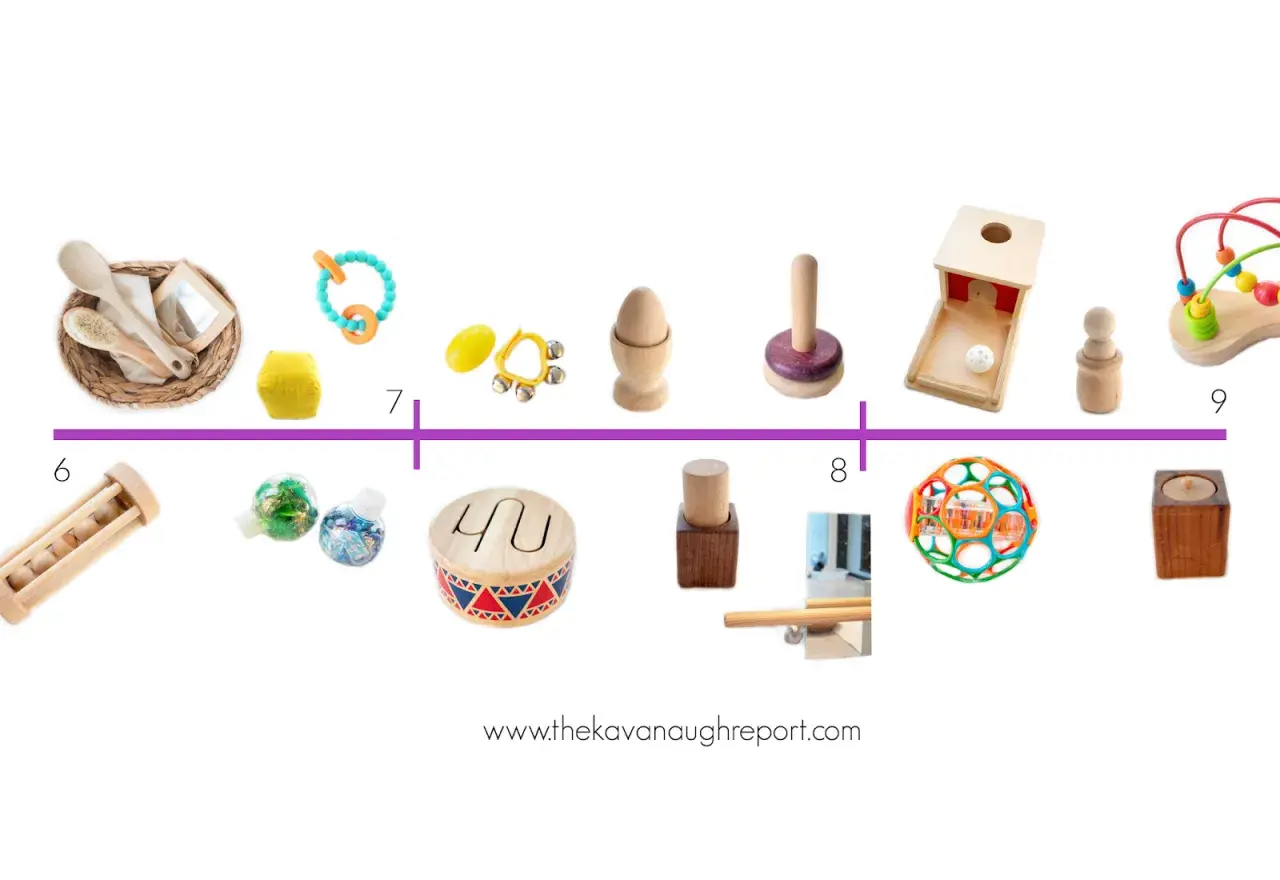
At nine months, babies learn best through repetition, movement, and simple real-life experiences. The most useful Montessori-style activities are the ones that let a baby crawl, reach, grasp, drop, pull, and explore without being overstimulated. In this article I focus on practical ideas, safe setup tips, and the small details that make these activities actually work at home.
Key things to know before choosing activities
- At this age, the best work is usually movement-based, sensory, and very simple.
- Repeatable activities matter more than variety; babies learn by doing the same thing many times.
- Use real, safe objects whenever possible instead of overloading the room with toys.
- Short sessions of 2 to 10 minutes are enough; follow the baby’s attention, not a schedule.
- Safety comes first: supervise closely, remove choking risks, and keep the environment calm and open.
Why nine months is a strong Montessori stage
This is one of those ages where the room suddenly matters more than the toy. Many babies are becoming steadier on the floor, exploring with both hands, and showing more interest in what happens when they drop, pull, poke, or hide something. I usually think of this stage as the moment when a baby stops only noticing objects and starts testing what those objects can do.
That matters because Montessori at nine months is not about teaching a formal skill. It is about giving the baby repeated chances to practice movement, grasping, attention, and simple cause and effect in a calm setting. Object permanence also starts to become more visible here, which is why hidden toys, peekaboo, and open-and-close games suddenly feel exciting instead of random. That shift tells us which activities are worth offering next.
Movement and balance come first
If I had to choose only one category for this age, I would pick movement. Crawling, reaching, rotating, pulling up, and cruising all feed the nervous system in a way that sitting toys never quite can. A baby does not need a complicated setup; a clear floor and one or two interesting targets usually work better than a pile of gear.
- Crawling path - Place a toy, scarf, or soft ball a short distance away and let the baby move toward it on a mat. The goal is not speed; it is the repetition of moving, pausing, and reaching.
- Rolling ball game - Roll a soft ball back and forth over a short distance. This builds visual tracking, timing, and the first sense of turn-taking without needing any special equipment.
- Cruising station - Use a stable couch edge or low, secure furniture so the baby can pull up and side-step. I keep this very simple because the value is in the body work, not the furniture itself.
- Floor mirror play - A securely mounted mirror at baby height encourages reaching, shifting weight, and visual curiosity. It is also one of the easiest ways to keep a baby engaged without adding noise.
- Cushion climb with supervision - A low cushion stack lets the baby practice climbing over and around soft obstacles. I only use this when the baby is already comfortable on the floor and can be watched closely.
The pattern here is simple: give the body something just challenging enough to solve, then stay out of the way. Once movement is working, the hands are usually ready for more detailed tasks.
Fine motor play that builds the hand
Hand work at this age should feel concrete. Babies are still learning how to open, release, transfer, and control the shape of their grip, so I keep the materials large, easy to hold, and limited to a few pieces. This is where a lot of people overbuy; in practice, a basket of five good objects is often better than a bin of twenty noisy ones.
| Activity | What it develops | How I present it |
|---|---|---|
| Treasure basket | Grasping, texture awareness, concentration | Use 3 to 5 oversized safe objects with different weights and finishes |
| Object permanence box | Cause and effect, memory, hand-eye coordination | Show the object dropping once, then let the baby repeat the action |
| Large-object transfer | Crossing the midline, bilateral coordination | Move rings, fabric squares, or soft balls between two bowls |
| Stacking cups | Sequencing, releasing, wrist control | Offer 3 or 4 cups instead of a full tower set |
| Lid and container play | Problem-solving, rotation, patience | Use one easy-open container with one large item inside |
I keep these sessions short, usually 5 to 10 minutes, because the point is not to exhaust the baby. The baby should be able to repeat the action several times and still want one more turn. That is where learning tends to stick.
Practical life can start now
Practical life sounds bigger than it is. For a nine-month-old, it simply means letting the baby take part in ordinary family routines in a way that makes sense for their stage. The baby is not trying to become independent yet; the baby is trying to belong.
- Preloaded spoon practice - Let the baby hold a spoon while you help with feeding. Even if most of the food ends up on the tray, the hand-to-mouth pattern is valuable.
- Open cup practice - Offer a tiny amount of water in a small open cup with full supervision. This helps the baby learn control instead of relying only on sippy cups.
- Wiping the tray - Give the baby a damp cloth and let them drag it across the highchair tray or low table. It is simple, real, and surprisingly satisfying.
- Dropping laundry - Let the baby put socks or washcloths into a basket. That repetition builds release, aim, and attention to sequence.
- Pulling cloths from a basket - A small basket with scarves or soft cloths gives the baby a real task and a clear end point.
These activities work because they are not pretend. The baby sees that hands change the environment, and that is a powerful lesson at this age. From here, sensory play becomes even more meaningful because the baby already understands that actions lead to results.
Sensory games and object permanence
At nine months, sensory play should do more than entertain. It should help the baby notice differences, remember where things went, and tolerate a small amount of uncertainty before the object comes back. That is why I prefer simple hide-and-find games over overly flashy toys.
- Peekaboo with a scarf - Hide your face or a small object under a soft cloth and reveal it again. The repetition is what makes it useful, not the surprise itself.
- Find the bell - Place a safe bell or rattle under a cloth and let the baby uncover it. This supports searching behavior and memory.
- Texture basket - Offer a few items with clearly different surfaces, such as wood, fabric, silicone, or metal. The baby learns by comparing weight, temperature, and feel.
- Simple sound bottles - If they are securely sealed and large enough to be safe, sound bottles can give the baby cause-and-effect feedback without extra screen-like stimulation.
- Board book routine - Thick books with one image per page work well because they slow the interaction down. I like books that let the baby point, touch, and turn pages with help.
What matters here is not how many sensations you pack in. It is whether the baby can notice one thing, remember it, and then try again. That is a much better use of sensory play than chasing novelty for its own sake.

How to set up a small Montessori space
A good setup does most of the teaching for you. I prefer a small, calm area with just a few choices visible at once, because that keeps the baby focused and makes cleanup much easier. You do not need a perfect nursery or a large budget; a floor mat, a low basket, and one secure mirror can already do a lot.
| Space element | Why it helps | What to keep in mind |
|---|---|---|
| Low shelf or basket | Keeps choices visible and limited | Show only 3 to 5 activities at a time |
| Open floor space | Supports crawling, rolling, and reaching | Leave it uncluttered so movement stays natural |
| Secure mirror | Encourages visual tracking and self-recognition | Anchor it well and place it at baby height |
| Rotation basket | Maintains interest without flooding the room | Rotate every few days, not every hour |
| Oversized real objects | Builds practical grasping and sensory learning | Choose items that are too large to swallow and safe for mouthing |
If I were choosing nursery essentials with Montessori in mind, I would spend less on themed toys and more on the environment itself. The room is the curriculum at this age, which is why the next section is mostly about what to leave out.
Mistakes that make this age harder than it needs to be
Most problems at nine months come from too much, too soon, or too complicated. Babies this age are naturally curious, but they are not looking for variety in the adult sense. They are looking for repetition, clarity, and enough room to use their bodies.
| Mistake | Why it backfires | Better move |
|---|---|---|
| Offering too many toys at once | The baby has no clear focus and switches quickly | Put out one activity at a time |
| Using activities that are too advanced | Frustration replaces repetition | Drop back to simpler, more physical work |
| Relying on gadgets and containers | Less floor time, less body awareness | Keep the baby on the floor whenever possible |
| Expecting long independent play | That expectation is usually unrealistic at this age | Stay nearby and interact briefly, then step back |
| Choosing noisy, overstimulating toys | Attention gets scattered instead of deepened | Use calm materials with one clear action |
My rule of thumb is simple: if the baby cannot repeat the action, simplify the setup. Montessori works best when the child can see what to do, do it again, and feel successful without adult rescue every few seconds.
What I would keep if I had to simplify the day
If I had to narrow everything down, I would keep just three rhythms: a movement activity, a hand-work activity, and one practical-life moment. That combination covers the whole baby - body, hands, and participation in daily life - without turning the day into a schedule of constant stimulation.
For example, I might start with rolling and crawling on the floor, then offer a treasure basket or transfer activity, and later let the baby help with a small part of mealtime or cleanup. That is enough for most nine-month-olds, and honestly, it is often better than a crowded room full of expensive toys. The method works when the environment is simple enough for the baby to repeat, explore, and succeed.
The best Montessori approach at this age is not to do more. It is to notice what the baby is already trying to practice and make that practice easier to repeat. Start with a clear floor, one good basket, and one real routine the baby can join, then build only when the current setup is clearly being used.
