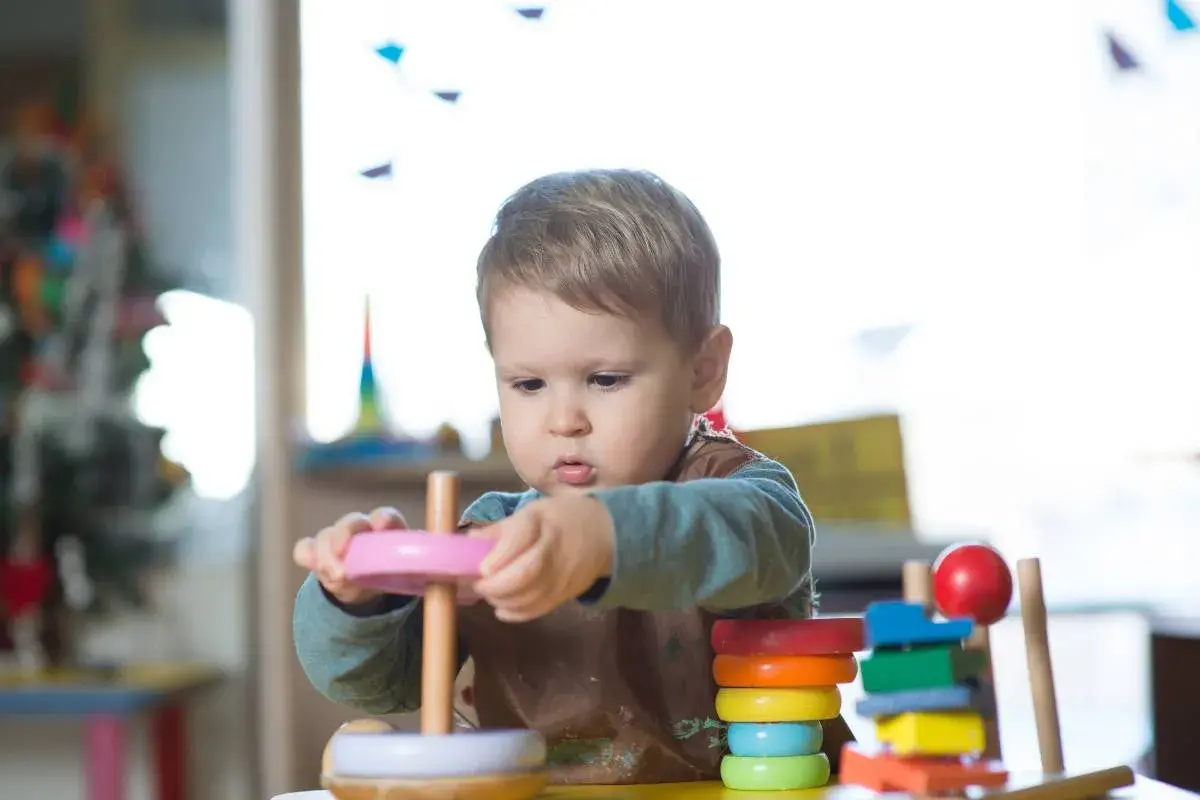
Montessori schemas are recurring patterns of action and thought that children use to test ideas, repeat discoveries, and make sense of their environment. In practice, that means I am looking at why a child keeps filling, dumping, lining up, spinning, wrapping, or carrying, not just what the child is doing. This article explains how those patterns fit Montessori thinking, how to recognize the most common ones, and which toys and nursery essentials actually support them.
What matters most at a glance
- Schemas are normal repetition patterns, not random habits.
- They fit Montessori well because they reveal what the child is ready to explore.
- The best response is usually to simplify the environment and protect concentration.
- Open-ended toys, baskets, ramps, blocks, and practical life materials usually outperform flashy gadgets.
- Repetition is healthy unless it becomes rigid, distressing, unsafe, or clearly out of proportion.
Why schema play fits Montessori so naturally
Strictly speaking, schema theory is not one of Maria Montessori’s original terms, but it fits her approach with almost no friction. Montessori education is built on observation, movement, repetition, and a prepared environment, which is exactly the kind of setting where repeating patterns become visible. I find that when adults stop trying to interrupt the repetition, they usually see a much clearer learning process underneath it.
The connection is especially strong with the absorbent mind and the sensitive periods. Young children are not just playing for amusement, they are collecting information about how objects behave, how space works, and what they can control with their own bodies. A child who carries objects from one end of the room to another may look busy in a meaningless way, but the child is often refining balance, sequence, coordination, and spatial understanding at the same time.
That is why schemas matter in Montessori homes and classrooms. They help me see the child’s repeated action as a clue, not a problem, and that clue often tells me what kind of material, movement, or boundary will support the next leap in learning. Once that is clear, the next step is learning to spot the pattern behind the action.
The patterns I see most often
Different educators group schemas a little differently, so I do not treat the labels as rigid. What matters is the child’s intent. A child can move between several patterns in one morning, and one behavior can reflect more than one schema at once. I care less about the name than about the repeating idea behind it.
| Pattern | What it often looks like | What the child is testing | Montessori-friendly support |
|---|---|---|---|
| Transporting | Carrying objects, filling and emptying containers, moving items between areas | Distance, weight, volume, sequence, ownership | Baskets, trays, small pitchers, child-sized wagons |
| Connecting and disconnecting | Snapping, stacking, taping, tying, taking things apart | Cause and effect, force, coordination, separation | Blocks, lacing cards, fasteners, peg work, simple construction sets |
| Positioning and ordering | Lining up toys, sorting by size or color, placing things in exact spots | Spatial order, comparison, predictability, pattern | Sorting trays, nested bowls, shelf order, matching work |
| Trajectory | Throwing, dropping, kicking, building and knocking down | Movement, gravity, speed, force | Balls, ramps, soft blocks, beanbags, safe throwing work |
| Rotation and circularity | Spinning, twisting lids, turning wheels, making swirls | Circular motion, turning, repetition, flow | Spinning tops, screw-top jars, wheels, spiral tracing |
| Orientation | Looking upside down, climbing, turning the body, changing viewpoints | Perspective, balance, body awareness, spatial relationship | Mirrors, low climbing structures, floor mats, viewpoint play |
| Enclosing and enveloping | Wrapping, hiding, building forts, covering objects, crawling into spaces | Boundaries, inside and outside, protection, containment | Boxes, scarves, tunnels, blanket forts, nesting toys |
| Transforming | Mixing, smearing, changing materials, knocking structures down | Change, flexibility, permanence, experimentation | Playdough, water work, paint, food prep, sand trays |
A child may spend weeks repeating one of these patterns, then move on, then come back again. That does not mean the child is stuck. It usually means the mind has found a problem worth solving. Knowing the names helps, but support matters more than labeling, which is where the real Montessori work begins.
How I support it without taking over the play
The temptation is to narrate, redirect, or improve the activity too quickly. I try to resist that. If a child is deeply engaged, my job is not to manage the play, but to protect it. Observation comes first. Once I know what the child is repeating, I can offer just enough structure to let the repetition continue with more purpose and less friction.
- Watch before you intervene. Give the child a little time to reveal the pattern instead of assuming the first action tells the whole story.
- Offer one clear invitation. A tray with balls, a basket of blocks, or a set of nesting bowls is often more useful than a shelf full of options.
- Match the level of challenge. If the child is exploring transport, do not jump straight to sorting or counting. Stay close to the real interest.
- Keep materials child-sized. Heavy, awkward, or overcomplicated tools get in the way of repetition and independence.
- Leave room for repetition. The same activity, repeated cleanly, is often more valuable than a constantly changing setup.
- Step back when concentration appears. The moment the child settles into the work is the moment I become less important.
I also try not to “teach around” the schema too aggressively. If the child is moving objects, I do not have to turn it into a lesson on colors, numbers, and vocabulary all at once. Montessori works best when the environment is doing most of the talking. That is why the materials you choose matter just as much as how you respond.
Toy and nursery choices that do the heavy lifting
For a home setup, I look for toys and nursery essentials that can be used repeatedly in more than one way. The point is not novelty. The point is to give the child something worth returning to. In my experience, the best materials are usually simple, sturdy, and open-ended enough to support more than one pattern of exploration.
| Material or setup | Best for | Why it helps | When I use it |
|---|---|---|---|
| Open-ended blocks | Connecting, ordering, enclosing, trajectory | The same pieces can become a tower, fence, road, or container | When the child needs flexible repetition instead of a fixed toy script |
| Baskets, trays, and bowls | Transporting, positioning, sorting | They make carrying and organizing visible and manageable | When the child wants to move things or arrange them carefully |
| Ramps, balls, and rolling objects | Trajectory, rotation | The child gets immediate feedback from movement and gravity | When the child keeps dropping, throwing, or spinning objects |
| Scarves, boxes, tunnels, nesting toys | Enveloping, enclosing, orientation | They support hiding, covering, going inside, and coming back out | When the child is drawn to boundaries, concealment, or body space |
| Fasteners, lacing, and simple practical life work | Connecting and disconnecting | They refine hand control while keeping the task purposeful | When the child loves taking apart, fastening, tying, or undoing |
| Water, dough, paint, and transfer work | Transforming | They let the child change material safely and watch cause and effect | When the child is mixing, smearing, stacking, or remaking materials |
If I am setting up a nursery or play area, I usually prioritize a low shelf, a few trays or baskets, one or two moving objects, a simple nesting or wrapping option, and enough clear floor space to move. I do not want the room to shout at the child. I want it to invite repetition with very little friction. That becomes even more important when I need to separate healthy repetition from behavior that deserves closer attention.
When repetition is healthy and when I pay closer attention
Repetition by itself is not a warning sign. In fact, it is often how a child stabilizes learning. What matters is the child’s emotional state, flexibility, and overall development. I usually ask whether the pattern looks absorbed and purposeful, or trapped and distressed.
| Usually healthy | Worth closer attention |
|---|---|
| The child is calm, focused, and engaged | The child seems panicked, frustrated, or dysregulated |
| The behavior has small variations over time | The behavior is rigid and barely changes across settings |
| The child can stop, transition, and return later | The child cannot shift without a major meltdown |
| The repetition appears connected to movement, order, or exploration | The repetition is paired with loss of language, sleep, appetite, or social engagement |
| The pattern comes and goes as interests change | The pattern is intense, unsafe, or self-injurious |
If the repetition is accompanied by regression, very limited play range, persistent sensory distress, or a broad change in behavior, I would talk with a pediatrician or an early childhood professional in the United States rather than trying to interpret it alone. That is not because repetition is bad, but because context matters. When the pattern is healthy, the bigger risk is usually adult interference, not the child’s repetition.
The mistakes that quietly work against schema play
Most problems come from good intentions taken too far. Adults want to help, so they add more toys, more language, more direction, and more correction. I think that usually muddies the picture. The child does not need a performance; the child needs room to explore the idea fully.
- Overloading the shelf. Too many options make it harder to repeat one idea long enough for it to deepen.
- Interrupting the concentration. A quick question or correction can break the child’s line of thought just when it is becoming productive.
- Turning every action into a lesson. Not every schema needs a vocabulary card, and not every play pattern needs adult commentary.
- Using toys that do the work. Flashy toys often reduce repetition instead of supporting it, because they control the outcome for the child.
- Assuming one pattern defines the child. A child who loves lining things up today may be building, wrapping, or transporting next week.
My rule of thumb is simple: if the setup makes the child more dependent on me, it is probably too busy or too prescriptive. If the setup lets the child keep returning to the same idea with increasing confidence, I am much closer to what Montessori asks of the environment. With those mistakes out of the way, the setup becomes much simpler and much more effective.
The simplest setup I would start with
If I were building a Montessori-friendly home around schema play from scratch, I would not begin with a shopping spree. I would begin with a small, deliberate set of anchors that support movement, repetition, and order. That approach keeps the room calm and keeps the child in charge of the exploration.
- A low shelf with a few rotated materials instead of a crowded toy wall.
- One basket or tray for carrying and transferring work.
- One rolling or spinning material for trajectory or rotation.
- One enclosing option, such as a box, tunnel, or nesting set.
- One practical life tray with pouring, spooning, or fastening work.
- Open floor space so the child can move without constantly hitting furniture or clutter.
That is enough to start seeing the pattern behind the play, and once you can see it, you can support it much more precisely. In my view, that is where Montessori and schema observation meet most cleanly: the environment stays simple, the child stays active, and the repeated behavior finally makes sense.
