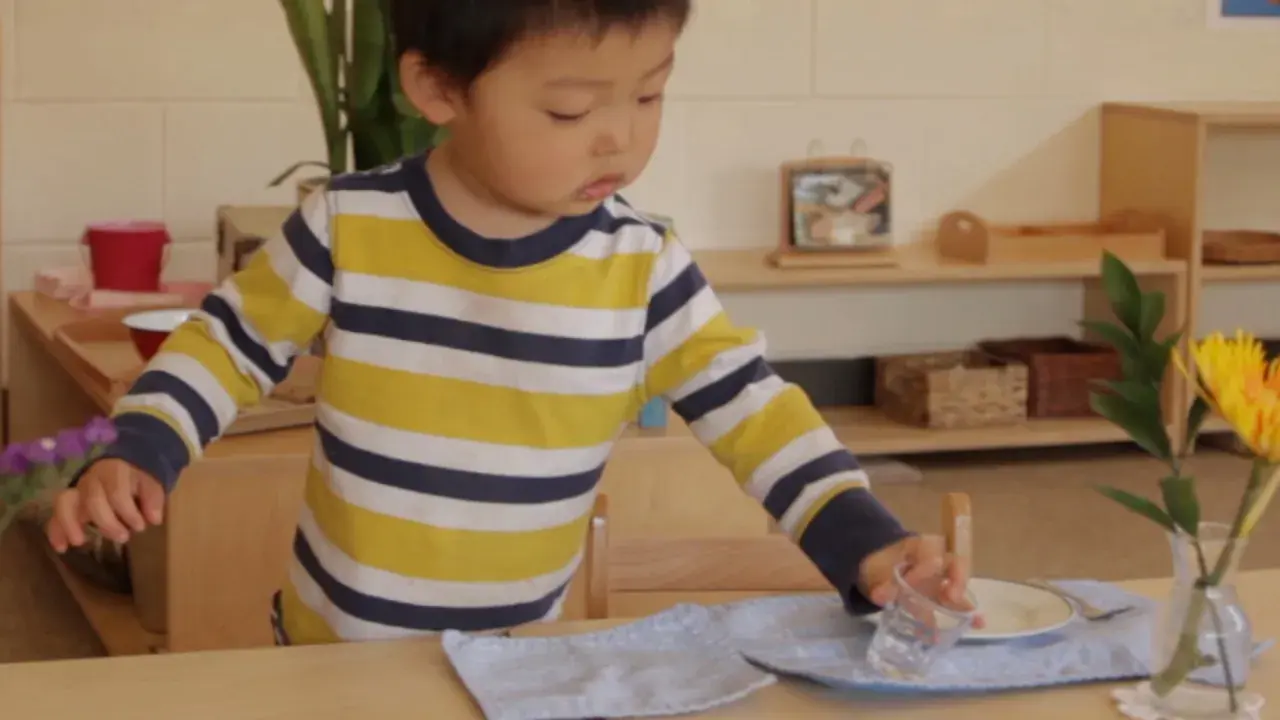
At 18 months, Montessori is less about special toys and more about giving a toddler a world they can actually use. In this article, I focus on what an 18-month-old is ready for, how to set up a simple home environment, which activities fit this stage, what is worth buying, and where safety and realism matter most.
What matters most at this age
- Most 18-month-olds want to copy real life, not sit through formal lessons.
- The best Montessori setup is simple: low shelves, limited choices, and child-sized tools.
- Practical life work is the core of this age because it builds coordination, language, and independence at once.
- Short, repeatable activities usually work better than expensive toys or crowded playrooms.
- Safety has to rise as independence rises, especially with furniture, cords, small parts, and cleaning products.
What Montessori looks like at 18 months
I think of this stage as the beginning of real participation. The child is no longer just exploring with hands and mouth; they are trying to join daily life. The CDC’s 18-month milestone list is useful here because it includes walking without support, scribbling, drinking from an open cup, feeding with fingers, trying a spoon, and climbing on and off furniture without help.
That matters because Montessori at this age should match the child’s current drive: move, imitate, repeat, and do things independently. I am not looking for polished performance. I am looking for willingness, concentration, and a growing sense of “I can do it.”
- They want to copy what adults do.
- They often prefer one clear task over a pile of choices.
- They learn best through movement and hands-on repetition.
- They usually need short activities, not long explanations.
That is why I avoid pushing academic-style tasks too early. At 18 months, the real work is practical, physical, and very concrete. Once that is in place, the home becomes much easier to manage in the next stage.

How I set up the home so independence is realistic
A Montessori home for an 18-month-old should feel calm, low, and readable. I want the child to see what is available, reach it without help, and put it back again. In practice, that means open shelves, a few choices per shelf, child-sized tools, and enough floor space for movement.
| Area | What I set out | Why it works |
|---|---|---|
| Snack | Small cup, snack bowl, cloth | Makes pouring, carrying, and cleaning part of the routine |
| Dressing | Low hook, shoes in a basket, simple clothes | Lets the child try self-dressing without frustration |
| Cleaning | Mini broom, sponge, tiny spray bottle with water | Turns “helping” into a real job the child can repeat |
| Play | 4 to 6 activities on open shelves | Reduces visual noise and makes choice easier |
I usually keep only a handful of materials visible at once. If I put out too much, the shelf becomes a distraction instead of an invitation. Rotation also helps: I swap out a few items every 1 to 2 weeks so the child does not get bored, but the room never feels overloaded.
HealthyChildren also recommends open shelving over toy boxes, because a hinged lid can trap a child or fall onto them. I take that seriously. A beautiful room is not helpful if the storage itself creates risk.
Once the space supports the child, the activities become much more natural to introduce.
Activities that fit an 18-month-old without forcing the pace
The best activities at this age are short, repeatable, and tied to real life. I prefer tasks that have a clear beginning and end. If I can explain the activity in one sentence, it usually belongs on the shelf.
Practical life tasks
- Pouring water from one small container to another
- Wiping a table with a damp cloth after a meal
- Putting socks or washcloths into a basket
- Carrying a small pitcher, bowl, or stack of cloths from one place to another
- Washing fruit in a bowl of water under close supervision
- Trying to use a spoon during snacks, even if most of the food misses at first
Movement and problem solving
- Climbing a low step or stable cushion
- Pushing a sturdy cart or wheeled toy that moves smoothly
- Posting a large object into a slot box
- Simple nesting cups, stacking rings, and very easy puzzles with 2 to 4 pieces
- Sorting large objects by color, size, or type
Read Also: Montessori - Real Freedom, Not Chaos: Your Guide
Language and concentration
- Book baskets with real photos and simple images
- Naming everyday objects during routines, such as “cup,” “spoon,” and “shoe”
- Two-choice questions with real objects, not abstract language
- Scribbling with chunky crayons on paper placed on the floor or a tray
- Matching the same object to itself, such as cup to cup or spoon to spoon
Many 18-month-olds stay with one activity for only 5 to 10 minutes, and that is normal. I treat concentration as something to protect, not something to demand. Repetition matters more than novelty at this age, and a toddler who returns to the same tray ten times is doing valuable work.
The next question is what deserves shelf space and what does not, especially if you want the room to support development instead of clutter it.
What toys and nursery essentials are worth the shelf space
If I am buying for this age, I choose materials that can be used in more than one way and that support real movement or real-life routines. The best Montessori-friendly items are usually simple, sturdy, and not very flashy. That fits the toy and nursery side of the topic well, because this is the age when less often does more.
| Category | Good options | Why I prefer them | Skip when possible |
|---|---|---|---|
| Practical life | Pitchers, small spoons, bowls, sponges, child-sized cloths | They connect directly to daily living and are easy to repeat | Oversized or decorative versions that the child cannot use well |
| Open-ended play | Blocks, stacking cups, nesting bowls, simple shape sorters | One item can support many different kinds of play | Battery-driven toys that do all the work for the child |
| Movement | Push cart, low climbing piece, ball, sturdy step stool | Supports gross motor development and coordination | Walkers that force an awkward body position |
| Storage | Open baskets, low shelf, wall hooks, small trays | Makes cleanup possible without adult rescue | Deep toy chests with heavy lids |
| Art | Chunky crayons, thick paper, washable paint with supervision | Builds control without overwhelming the child | Complicated craft kits meant for older children |
I would rather own six good materials than thirty random toys. That is especially true at 18 months, when the child benefits more from repetition than from constant novelty. A small shelf with a few meaningful choices will usually beat a room full of noise.
Even a good setup fails if the safety layer is sloppy, so I pay close attention to the risks that appear as mobility increases.
Safety and the mistakes that break the method
Independence and safety have to grow together. That means I childproof first, then I invite participation. I anchor furniture, secure cords, store cleaning products and medicines out of reach, and keep magnets, batteries, and small parts locked away. I also review the room often, because a space that was fine last month may not be fine after a new burst of climbing or opening.
- Too many toys visible at once
- Activities that are too hard for the child’s current coordination
- Expecting neatness instead of process
- Interrupting concentration every few minutes
- Using screens to replace real participation
- Confusing independence with total access to every room and object
I also think potty learning deserves a realistic note. Some children show interest around this age, but I never treat that as a deadline. If a child is curious, I can introduce the bathroom routine and keep it low-pressure. If they are not ready, I wait. Montessori works better when the adult follows readiness instead of forcing a schedule.
That same patience is what makes the approach sustainable over time, which is where the last part matters most.
The Montessori rhythm I would keep for the next few months
If I had to simplify everything, I would keep three habits: prepare the space, offer real tasks, and protect repetition. That is enough to support a toddler without turning home life into a project.
- Keep the shelf small enough for the child to choose confidently.
- Use real tools whenever safety allows.
- Repeat the same activities until they become familiar and easy.
- Let the child help with daily life instead of only “playing” beside it.
At 18 months, Montessori is not a special category of products. It is a way of arranging the day so a young child can practice being capable. If I do that consistently, the home feels calmer, the child gets more independent, and the activities start to look less like lessons and more like life.
