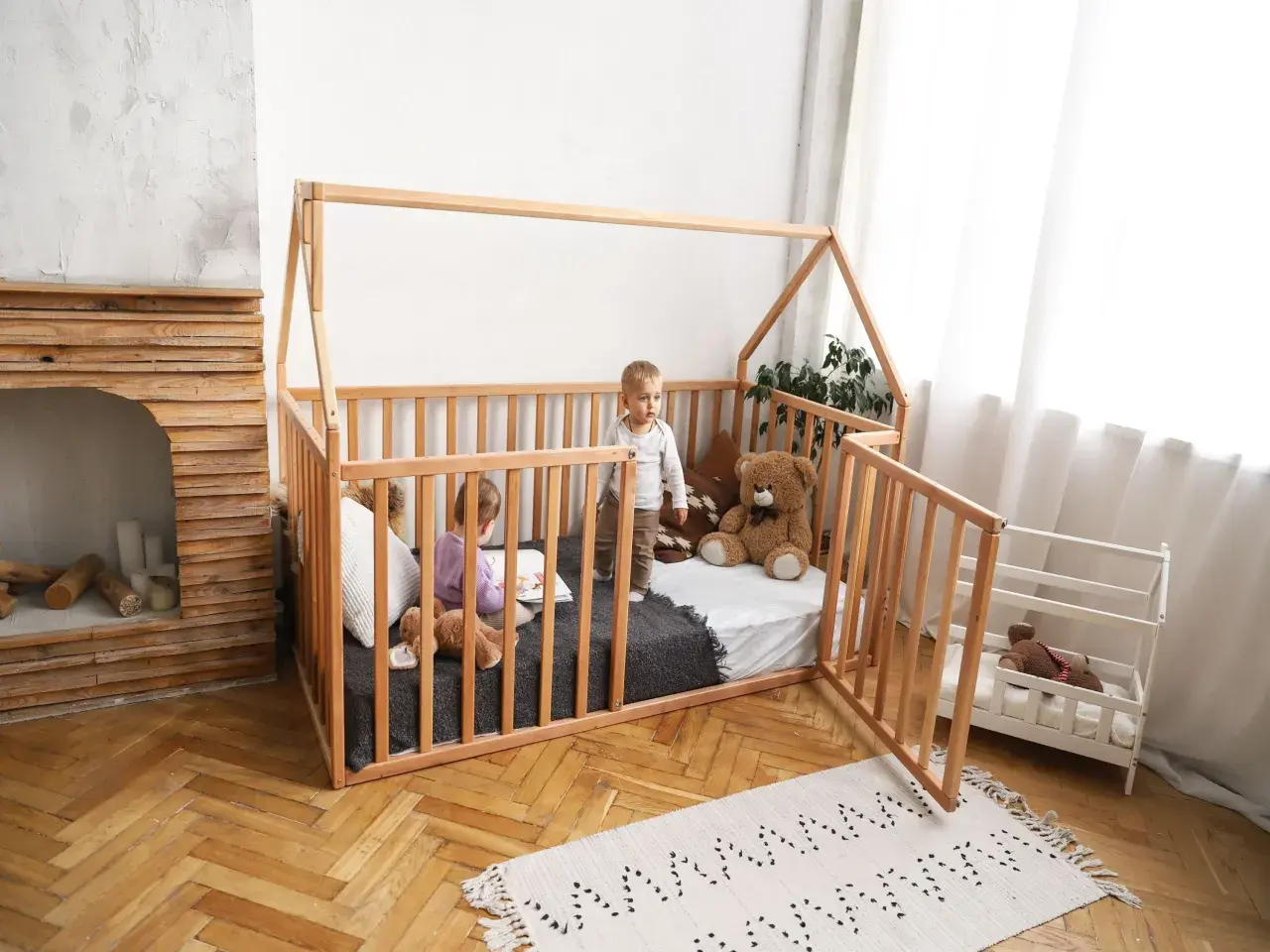
A playpen floor bed can be a practical middle ground when you want a low, contained sleep space without jumping straight to a toddler bed. The catch is that safety depends on the exact product, the mattress that comes with it, and how little extra furniture you add around it. In this article, I break down what the setup really is, when it makes sense, how to build it correctly, and where parents most often go wrong.
Key points to know before setting one up
- A play yard and a true floor bed solve different problems, so they should not be treated as the same thing.
- The safest sleep version is firm, flat, and bare except for a fitted sheet.
- Extra padding is usually the wrong fix; a compliant sleep surface matters more than softness.
- Room sharing is especially useful for infants in the first 6 months, and often up to the first year.
- If your child can climb out or is close to 35 inches tall, the setup has a limited runway left.
What this setup really is
In plain English, this is usually a play yard being used as a sleep space at floor level, not a mattress dropped into a random enclosure. CPSC describes a play yard as a framed enclosure with a floor and mesh or fabric sides, and that definition matters because the product is meant to function as both a play space and a sleep space for children who cannot climb out and are under 35 inches tall.
I think of it as a bridge: more contained than a Montessori-style floor bed, more portable than a crib, and far less forgiving if you start modifying it with aftermarket cushions, toppers, or decorative extras. That tradeoff is why the next question is not whether you can make it work, but when it actually makes sense.
When a playpen floor bed makes sense
This setup works best in a few specific situations, and I would be selective about them.
- You are room-sharing in a small apartment or compact nursery and need a sleep space that fits beside your bed.
- You travel often and want something familiar that folds, packs, and resets quickly.
- You need a transition step between a crib and a true floor bed, but your child is not ready for an open room yet.
- Your child wants some independence, but still benefits from a visible boundary and a familiar routine.
It stops making sense when the child can climb out, when the space needs more freedom, or when the only way to make it comfortable is to add soft layers. At that point, the product is telling you something important: you do not need a clever workaround, you need a different sleep solution.

How to set it up safely
The safest setup is also the least dramatic one. HealthyChildren.org, the AAP's parent guide, recommends a firm, flat sleep surface and room sharing for at least the first 6 months, ideally the first year. That matches how I would approach this in practice: keep the surface flat, keep the room simple, and resist the urge to "improve" comfort with extra layers.- Use a play yard that is specifically intended for sleep and meets current U.S. safety requirements.
- Use the original mattress or only a replacement made for that exact model.
- Keep the surface firm and flat. Current play yard rules keep mattress thickness at 1.5 inches or less, and any incline over 10 degrees is too much for infant sleep.
- Fit only a tight sheet over the mattress. No pillows, blankets, bumpers, stuffed toys, wedges, or positioners.
- Place the setup where you can supervise easily, ideally beside your bed for an infant.
- Check the frame, mesh, seams, and locking points regularly, especially if the unit folds for travel.
If the sleep space feels too plain, that is usually a sign you are closer to a safe setup, not further away. The plainness is the point, and it leads directly into the bigger comparison between a play yard, a crib, and a true floor bed.
Play yard, crib, or true floor bed
Parents often compare these three because they all sit somewhere on the same spectrum, but they solve different problems. I find it easier to decide by asking which one fits the child’s stage, not which one looks nicest in the nursery.
| Option | Best for | Strengths | Limits |
|---|---|---|---|
| Play yard with the original mattress | Travel, room sharing, temporary sleep space | Portable, enclosed, easy to supervise, and useful for both naps and play | Shorter usable window, must stay bare, and should not be turned into a decorated mini-room |
| Crib | Infant sleep at home | Stable long-term infant sleep product, predictable routine, and straightforward safety expectations | Less portable and less flexible in very small spaces |
| True floor bed | Childproof toddler room | Supports independence, easy in-and-out access, and a gentler move toward open sleeping | The room must be fully babyproofed because the child can move freely |
| Toddler bed | Older toddler ready for more freedom | Simple transition, familiar size, and more room than a crib | Less containment and a greater chance of wandering at bedtime |
Containment is the deciding factor. A play yard gives you a regulated enclosure, a crib gives you a dedicated sleep station, and a true floor bed gives the child freedom inside a fully childproofed room. Once you see those as separate jobs, the choice gets much easier.
Mistakes that make the setup unsafe
I see the same errors over and over, and most of them come from trying to make the space feel cozier rather than safer.
- Adding a thick aftermarket mattress or foam topper because the original pad feels thin.
- Using loose blankets, pillows, crib bumpers, sleep wedges, or stuffed toys.
- Turning the play yard into a decorative mini-room with hanging organizers and cords.
- Ignoring height limits and continuing to use it after the child can climb out.
- Setting it on a bed, couch, or other raised surface because you want it closer to eye level.
- Assuming soft equals comfortable for infant sleep, when softness can create risk before it creates comfort.
If you are tempted to add layers, I would step back and ask whether you actually want a different product category. The need for customization is often the clearest sign that the current setup has reached its limit.
What I would check before buying one
Because this is a sleep product, I would read the specs more carefully than the marketing copy. The words "Montessori" or "modern" tell you almost nothing; the details tell you everything.
- It clearly states that it can be used for sleep, not just play.
- It has the proper safety labeling, instructions, and no recall history.
- The included mattress fits tightly and lies flat with no gaps.
- The frame locks securely and does not wobble when pressure is applied to the sides.
- The mesh or fabric sides are breathable, intact, and easy to inspect.
- The mattress and accessories stay within current play yard safety limits instead of depending on extra padding to feel usable.
- The size matches your room and your child’s growth pattern, not just the nursery photo you liked online.
That last point matters more than people expect. A product can be technically compliant and still be the wrong long-term fit if your child is already close to climbing out or if your room setup makes supervision awkward.
What usually works best once the novelty wears off
The version that holds up over time is usually the least complicated one: a compliant play yard used exactly as designed, or a true floor bed once the room is ready for that level of freedom. In other words, I would not build a hybrid out of extra foam, decorative inserts, and wishful thinking; I would pick the sleep product that already matches the child’s stage.
That approach is not flashy, but it is practical. It keeps the sleep space easy to understand, easier to clean, and easier to trust, which is exactly what parents need when the nursery has to work at 2 a.m. and again at naptime the next day.
