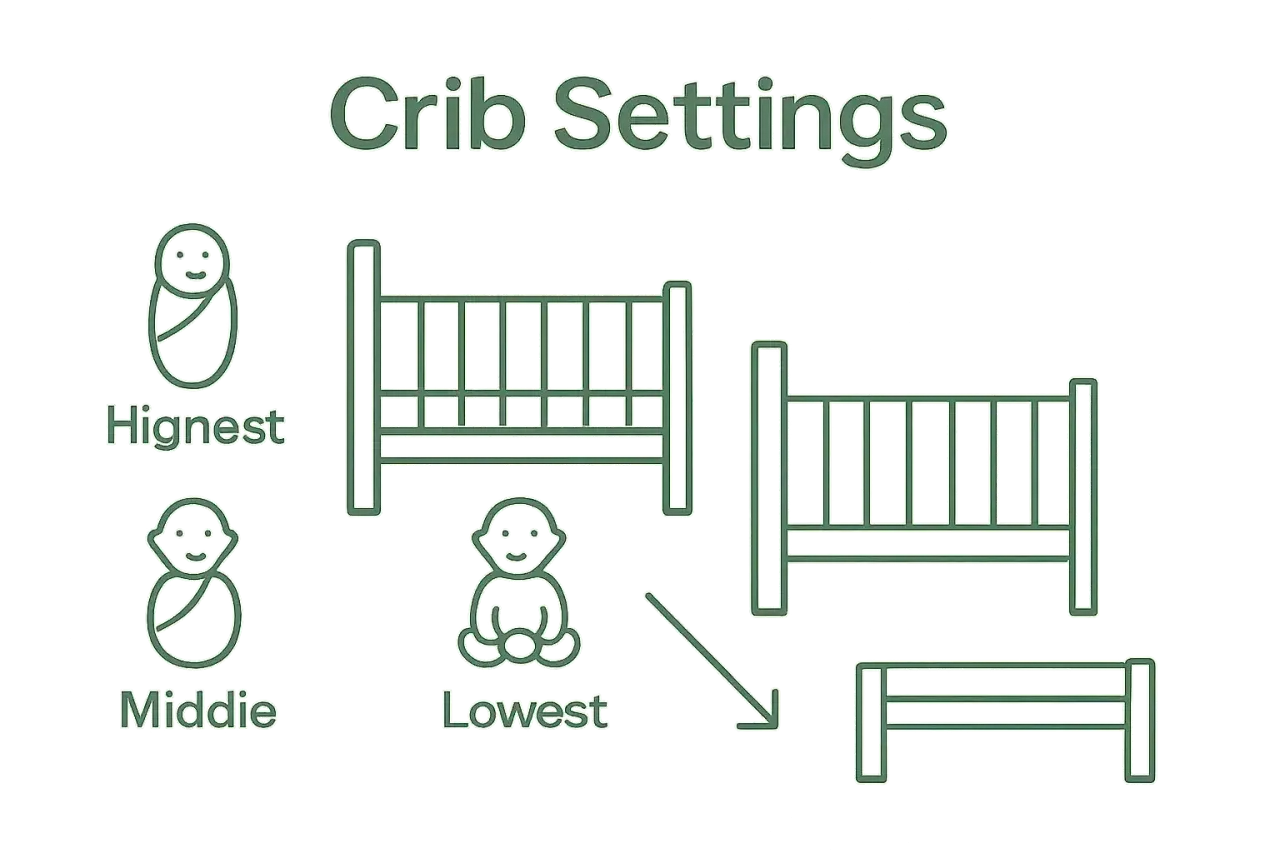
Crib height is one of those nursery details that looks minor until it starts affecting safety. A mattress set too high becomes a fall risk as soon as a baby can sit, crawl, or pull to standing, while lowering it too early usually adds inconvenience rather than protection. In this guide, I cover when to move the mattress down, how to do it without creating gaps, when floor level is actually appropriate, and what I check afterward.
The safest change is the one that matches your baby's movement
- Use the highest setting only while your baby cannot sit up or push into a more mobile position.
- Plan the first drop once sitting, hands-and-knees crawling, or commando crawling starts.
- Move to the lowest setting as soon as your baby can stand or pull to standing.
- Do not improvise a floor-level setup unless the crib was built for that configuration.
- After every change, confirm a snug mattress fit, tight hardware, and a bare sleep space.
- If the child can climb out, the crib has usually done its job and it is time to think about a toddler bed.
Why crib height matters more than most parents expect
I think of crib height as a simple balancing act: you want easy access for the adult and enough containment for the child. The CPSC baseline is firm and tight-fitting, with no pillows, quilts, stuffed toys, or loose bedding in the crib. Once a baby has enough strength to change posture quickly, that tall top setting stops being convenient and starts becoming a fall hazard.
What changes first is not age, but movement. A baby who can roll is in a different category from a baby who can sit, and a baby who can sit is in a different category from one who can pull up on the rails. I usually ignore the calendar and watch the body: the more upright and mobile the child gets, the lower the mattress should go.
That is why the “right” height is temporary. The newborn setting is about access and support, the middle setting is about buying time, and the lowest setting is about preventing a head-first tumble when the child starts using the crib as climbing practice.
Once that logic clicks, the next step is matching the mattress height to the actual milestone in front of you.
The milestones that tell me it is time to lower the mattress
I do not wait for a birthday. I watch for the first real signs of leverage, because leverage is what turns a crib rail into a launch point.
| Baby behavior | What it usually means | What I’d do |
|---|---|---|
| Stays flat and cannot sit up | The crib is still serving as a safe, easy-access sleep space | Keep the mattress at the highest setting |
| Sits independently or gets onto hands and knees | The baby can shift weight quickly and may topple forward | Lower to the middle setting, or straight to the lowest if the crib only has two positions |
| Commando crawls or moves around the crib with confidence | Mobility is increasing fast and reach is improving | Lower before the child starts experimenting with standing |
| Pulls to standing or stands while holding the rail | The crib has become a climbing aid | Move to the lowest setting immediately |
| Attempts to climb out | Containment is no longer reliable | Plan a move to a toddler bed or another age-appropriate sleep setup |
In practical terms, many families hit the first adjustment somewhere around the sitting stage and the final drop when standing starts. The exact month matters less than the movement itself. If the baby can get into an upright position without help, I treat that as a warning to lower the mattress sooner rather than later.
The timing matters, but the actual adjustment matters too, which is where most mistakes happen.
How I lower a crib mattress safely
The safest adjustment is boring: use the manual, keep every part where it belongs, and do not force a configuration that was never designed into the crib.
- Read the specific manual for your model. Different cribs use brackets, clips, screws, or support rails in different places. If the manual is missing, I would look it up before touching the hardware.
- Clear the crib completely. Take out bedding, toys, and the mattress so you can see the support system on both sides.
- Move both sides evenly. The support height should match on the left and right. If one side sits higher than the other, the mattress can tilt or shift.
- Re-seat the mattress and check the fit. A firm crib mattress should sit snugly, with no useful gap at the edges or corners.
- Tighten every screw, bolt, and bracket. I recheck the hardware after the first night because vibration and use can loosen a weak joint.
- Test the crib with your hands before putting the baby back. Press on the mattress, shake the frame lightly, and make sure nothing wobbles, creaks, or slides.
If anything feels improvised, it usually is. A crib should not need blocks, stacked padding, or a DIY shelf to reach the right height. Those fixes create the kind of gap that turns a safety upgrade into a trap.
That leads straight to the part many parents misunderstand: lower does not always mean literally on the floor.
When floor level makes sense and when it does not
Most standard cribs are not meant to have the mattress sitting on the nursery floor. In a typical crib, “lower” means the mattress support moves to the lowest built-in slot, not that you remove the support and improvise a floor bed under the frame.
| Setup | Safe when | Main risk | Best use |
|---|---|---|---|
| Lowest built-in crib setting | The baby is mobile, but the crib still contains them safely | Very little, if the mattress fits properly and hardware is tight | Most crib users after the sitting or standing stage |
| Manufacturer-designed floor-level configuration | The crib manual explicitly allows it and the frame was built for that setup | Misassembly if the instructions are ignored | Special convertible or floor-bed-style products |
| DIY floor conversion | Almost never | Gaps, poor airflow, entrapment, or a mattress that shifts out of position | None |
| Separate floor bed | The child is old enough for a different sleep setup and the room is fully babyproofed | Loss of containment if the room is not prepared | Older toddlers, not young infants |
If the manufacturer does not specifically allow a floor-level setup, I would not try to engineer one. That is one of those places where “close enough” is not close enough. The safest path is either the crib’s lowest built-in setting or a separate sleep system that was designed to sit at floor level from the start.
Once the mattress is in place, the final job is to confirm that the whole sleep space still meets basic safety rules.
What I check after the adjustment
I treat the crib as a system, not just a mattress height. A safe setting on paper can still become unsafe if the hardware is loose or the mattress fit is sloppy.
- Mattress fit. The mattress should fit tightly, with no meaningful gap around the edges.
- Hardware. Screws, brackets, and support rails should all be secure and level.
- Slat spacing. On a standard crib, the slats should be close enough that a baby’s body cannot fit through; in U.S. safety guidance, the spacing limit is 2 3/8 inches.
- Sleep surface. Keep the crib bare except for a fitted sheet designed for that mattress.
- Product condition. If the crib is older, secondhand, or missing parts, I would check for recalls and any signs of damage before trusting the new height.
- Outgrowing the crib. The AAP uses clues like a child reaching about 35 inches, lining up with the chest rail, or climbing out as signs that it is time for a bed instead of another mattress adjustment.
This is also the point where I remind parents not to let convenience override the setup. If the child is already climbing, lowering the mattress one more notch is not always the answer; sometimes the crib has reached its limit and the safer move is a toddler bed.
That is the line I keep coming back to: lower the crib for mobility, not as a workaround for an outgrown sleep space.
The simplest rule I follow in real nurseries
If a baby can sit, stand, or pull up, I lower the mattress quickly and I do it according to the manual, not by eye. If the crib was not designed for a floor-level setup, I leave the DIY ideas out of it and use the lowest safe position the product was built to support.
In the end, the goal is not to make the crib look lower. The goal is to keep the sleep space firm, flat, and predictable while the child is still small enough to need it. Once climbing starts to win, the better question is no longer how low the mattress can go, but whether the crib should still be the right bed at all.
