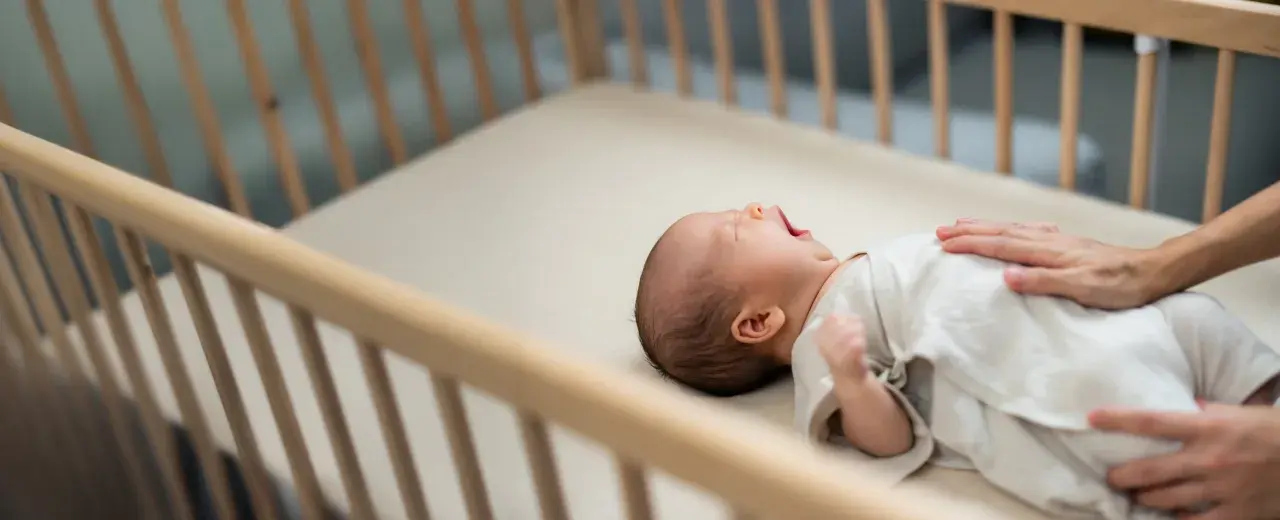
Mini cribs can be a smart fit for small rooms, grandparents' homes, or the first few months of sleep, but they only stay safe when they meet current U.S. standards and are used exactly as intended. Are mini cribs safe? In the U.S., the answer is yes for some models and no for others, depending on certification, mattress fit, hardware, and how the sleep space is set up at night. I will break down the rules that matter, the red flags I look for, and the point where a mini crib has done its job and should be replaced.
The safe answer depends on certification, fit, and daily use
- Legal category matters. In the U.S., a mini crib is usually a non-full-size baby crib, and current new-product compliance tracks 16 CFR part 1220 and ASTM F406-24.
- Size alone is not enough. CPSC treats a crib as non-full-size when its interior length is smaller than 49 3/4 in. or larger than 55 in., or its interior width is smaller than 25 3/8 in. or larger than 30 5/8 in.
- Fit matters most. The mattress should be firm and snug, with no visible gap at the sides or ends.
- Bare is best. Keep the crib to a fitted sheet only; skip bumpers, blankets, pillows, toys, wedges, and add-on accessories.
- Growth ends the run. Follow the manufacturer's limit and move out when the baby can sit, kneel, pull up, or climb.
What current U.S. rules say about mini cribs
In federal terms, the real category is a non-full-size baby crib. CPSC defines that category by interior dimensions, and "mini" by itself is just a marketing word. As of 2026, new products manufactured or imported after April 5, 2025 must meet ASTM F406-24 with CPSC modifications under 16 CFR part 1220.
- Permanent labeling. I want to see the manufacturer or importer name, U.S. contact information, model name or number, and date of manufacture.
- Certification. For a new product, the maker or importer should be able to certify compliance with the current federal standard.
- Structural testing. The standard covers locking mechanisms, openings, stability, cords and straps, mattress support, protrusions, and mis-assembly risks.
I like that standard because it tests the parts that actually fail in real life, not just the way the crib looks in a product photo. If the paperwork is missing or the label is vague, I treat the crib as a pass, no matter how cute it looks. Once you know where the rule comes from, the practical question becomes how the crib behaves in daily use.
The safety features that matter most at home
A crib can pass a lab test and still be used badly in a nursery. My home-use checklist is simple: firm mattress, tight fit, bare sleep surface, and a frame that stays solid when you push on it.
- Mattress fit. The mattress should sit snugly with no visible gap at the sides or ends. A loose mattress is the kind of problem that turns a small crib into a serious entrapment risk.
- Mattress firmness. It should feel firm, not plush or pillow-like. The goal is support, not cushioning.
- Bare sleep space. Keep only a fitted sheet in the crib. No bumpers, blankets, pillows, stuffed toys, wedges, positioners, or decorative add-ons.
- Back sleeping. Place the baby on their back for every sleep unless a clinician has given a rare medical instruction.
- Hardware and frame. Tight joints, locked sides, intact slats, no sharp edges, and no wobble when you shake the crib lightly.
- Placement. Keep cords, curtains, blinds, and hanging decor out of reach. Loose strings are a hazard whether the crib is mini or full-size.
The biggest mistake I see is treating a smaller crib as if it needs softer bedding to feel cozy. It does not. Safe sleep is spare sleep. Those are the basics; the next step is checking the actual product before money changes hands.

How I inspect a mini crib before buying
I am far more comfortable with a mini crib when the seller can show the model label, the instructions, and the exact mattress that was designed for it. If any of those pieces are missing, the bargain usually is not worth it.
| Check | What I want to see | Red flag |
|---|---|---|
| Label and paperwork | Model number, manufacture date, clear instructions, U.S. contact info | No instructions, no model number, or a seller who is not sure |
| Certification | A clear statement that the crib meets the current non-full-size crib rule | Marketing language with no compliance proof |
| Mattress | Firm mattress made for that crib, with no gap | Universal mattress that shifts or leaves space |
| Structure | Stable frame, secure latches, intact slats, no damage | Wobble, broken parts, missing hardware, sharp edges |
| Recall history | Nothing on the recall list and a clean ownership history | Unknown past use or a recalled model |
| Add-ons | Nothing extra attached unless the maker included and certified it | Canopy, bumper, organizer, straps, or decorative ties |
Secondhand can be fine, but only if you are willing to verify every one of those points yourself. A crib that looks clean can still hide age, wear, or missing parts. If you are still choosing between small-sleep options, the comparison below makes the tradeoffs easier to see.
Mini crib, full-size crib, or play yard
I usually recommend a mini crib when floor space is real, not imaginary. If the room can handle a full-size crib, the standard option often buys you time; if the family needs something portable, a compliant play yard may be the better second sleep space.
| Option | Best for | Main advantage | Main tradeoff |
|---|---|---|---|
| Mini crib / non-full-size crib | Small rooms, guest rooms, early infancy | Smaller footprint and easier placement | Outgrown sooner; mattress fit is model-specific |
| Full-size crib | A longer nursery setup | Standard mattress size of 52 3/8 in. x 28 in. makes shopping easier | Takes more space |
| Play yard | Travel, grandparents' homes, temporary backup sleep | Portable and folds away | Must meet federal sleep requirements; intended for a child under 35 in. tall who cannot climb out |
I tend to see a mini crib as a space-saving nursery tool, not a lifetime solution. That is fine. If it helps keep the baby off a couch, out of a crowded adult bed, or in a clear sleep space that is easier to supervise, that smaller footprint can be a real advantage. After that choice is clear, the remaining issue is knowing when the mini crib has simply become too small.
When a mini crib stops being the right choice
The manufacturer's weight and height limits are the final word here, and they vary by model. I do not stretch those limits just because the crib still feels sturdy. Once a baby can sit, kneel, pull up, or climb, or once the top rail no longer leaves enough clearance, I start planning the move to a larger sleep space.
- Move on if the baby reaches the crib's stated weight or height limit.
- Move on if the child can pull up and the rail is near chest or shoulder level.
- Move on if sleep becomes cramped, the mattress is too small for the child to turn comfortably, or the crib starts to feel unstable under normal use.
- Do not assume a mini crib converts into a toddler bed; many do not.
This is one of those places where caution pays off. A crib can still be compliant and still be the wrong size for the child in front of you. The safest nursery is not the fanciest one, but the one that is registered, fitted correctly, and easy to keep bare.
The details I would not skip before trusting one
If I were setting up a nursery today, I would register the crib the same day it arrives, save the model number and purchase record, and check recall status before the baby sleeps in it for the first time. I would also keep the mattress, sheet, and any replacement parts tied to that exact model, because the fit is where many small cribs quietly go wrong.
My practical rule is straightforward: if the crib does not have clear labels, a snug mattress, intact hardware, and a clean compliance story, I pass. If it does, a mini crib can be a safe, sensible sleep space for the stage when space matters most. The goal is not to buy the smallest crib possible; it is to build the clearest, cleanest sleep setup possible.
