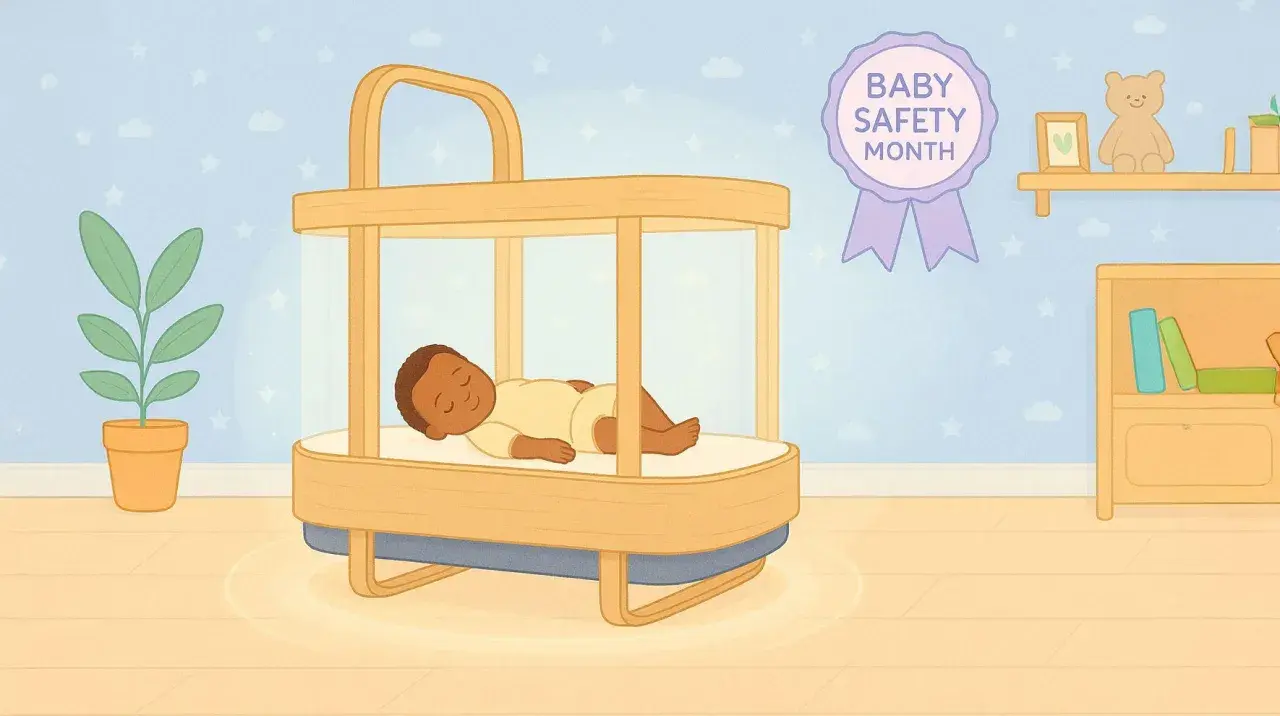
At eight months, the goal is not to make sleep look more grown-up. A bed for an 8-month-old is really a flat, firm, simple sleep space that can handle rolling, sitting, and occasional night-time movement. In most homes, that means a crib or a compliant play yard, not an adult bed, and I’ll walk through the safest options, the main tradeoffs, and the mistakes that matter most.
What matters most at this age
- Best default: a crib or compliant play yard with a firm mattress and fitted sheet only.
- Bassinets: often too small by 8 months, so check the product limits before using one.
- Room-sharing: keep baby near you if that helps, but not in your bed.
- Big hazards: soft bedding, bumpers, pillows, loungers, swings, and couches.
- Transition timing: save toddler beds for later; they are not the right stage for most 8-month-olds.

The safest sleep setup for an 8-month-old
For an eight-month-old, I start with the simplest question: where can the baby sleep without extra risk? The answer is usually a crib. A full-size crib gives enough room for rolling and stretching while still keeping the baby contained in a properly designed sleep space. A compliant play yard is the next best option if you need portability, a second sleep space, or something that can move between rooms.
I would not move straight to a toddler bed. In the U.S., toddler beds are intended for children at least 15 months old and up to 50 lb, which tells you this product class is built for a much later stage. At eight months, the issue is not independence; it is keeping sleep predictable and physically safe.
| Sleep option | Good fit at 8 months | Why it works or does not |
|---|---|---|
| Crib | Yes | Best long-term choice if it meets current safety standards and the mattress fits tightly. |
| Play yard | Yes | Good for travel or a backup room; designed for sleeping as long as the child cannot climb out and is under 35 in. |
| Bassinet | Usually no | Many babies outgrow bassinets much earlier, especially once they roll, sit, or push up. |
| Toddler bed | No | Too early for most babies and not built for infant-safe sleep boundaries. |
| Adult bed | No | Soft bedding, gaps, and falls create too much risk for routine infant sleep. |
Once that comparison is clear, the next step is making sure the crib itself is set up the right way, because even the right furniture can be used badly.
Why the crib usually wins over every other option
The crib is the default I trust most because it lets you control the details that matter: firmness, fit, and boundaries. A safe setup is plain on purpose. The mattress should be tight against the frame, the sheet should stay snug, and there should be no gap where an arm, leg, or head could slip through.
- Use a firm mattress. If it dents deeply under the baby, it is too soft.
- Keep the crib bare. No pillows, quilts, bumpers, stuffed toys, or decorative bedding.
- Check the hardware. Loose screws, cracked slats, or missing parts are not small issues.
- Watch the spacing. Older cribs with wider slat gaps should not be used.
- Lower the mattress when needed. Once a baby can sit or pull up, the mattress should be set lower.
- Skip old drop-side designs. If a crib has questionable history or missing instructions, I would pass on it.
This is also where parents sometimes overcomplicate the nursery. I would spend my attention on the structure of the crib and mattress, not on matching bedding sets that should not be in the crib anyway. That leads naturally to the short-term options, because bassinets and play yards do have a place, just not forever.
When a bassinet or play yard still makes sense
A bassinet can work only if the individual product still fits the baby’s age, weight, height, and movement stage. At eight months, that is often no longer true. Babies at this age are stronger, more mobile, and more likely to push up or roll, which makes a small sleep space a poor long-term plan even when the baby technically still fits.
A play yard is more flexible. Federal safety rules treat it as a sleep-and-play product for a child who cannot climb out and is under 35 inches tall. That makes it especially useful for families who want one product for home and travel, or for grandparents who need a safe backup sleep setup that does not depend on a separate nursery.- Use the manual first. The manufacturer’s limits matter more than guesswork.
- Do not stretch a bassinet past its limit. If it is too small, the answer is a crib, not a workaround.
- Use the bassinet attachment carefully. If a play yard includes one, it follows the stricter bassinet rules, not the looser play-yard rules.
- Keep the sleep surface flat. If a product leans, reclines, or feels cushioned, I would not use it for routine sleep.
Once those temporary solutions are in the right box, the next thing to tackle is what to avoid altogether, because that is where many sleep setups go off track.
What I would avoid completely
Most sleep mistakes are not dramatic. They are usually small comfort choices that look harmless to adults but create a real hazard for babies. The biggest one is bed-sharing. A baby sleeping in an adult bed can slide into gaps, get trapped against pillows or the headboard, or be exposed to soft bedding that blocks breathing. Room-sharing is the safer compromise; same bed is not.
I would also avoid anything that turns sleep into a soft nest. That means pillows, quilts, comforters, bumper pads, plush toys, sleep positioners, loungers, and extra-padding marketed as a comfort upgrade. For an infant, softness is not a feature. It is the hazard.
- Adult beds used for routine sleep.
- Couches and armchairs, even for naps.
- Swings, bouncers, and car seats once the baby is asleep.
- Aftermarket plush mattresses or toppers.
- Weighted bedding or swaddling once rolling starts.
If a baby falls asleep in the wrong place, I move them as soon as I can to the crib or play yard. That simple habit solves more problems than any nursery accessory ever will, and it is the best bridge into choosing the right furniture in the first place.
How I would choose a crib or mattress today
If I were buying from scratch, I would think in this order: safety, fit, then convenience. The model name matters less than whether the crib and mattress were designed to work together. A mattress that is technically the correct size but leaves a gap at the edge is not good enough.
For a practical purchase, I would look for a crib that is easy to lower, sturdy enough to handle a mobile baby, and simple to clean. If I were choosing between a fancy bedding bundle and a better mattress, I would take the mattress every time, because the bedding should stay minimal anyway.
- Choose current safety standards over style. A clean, stable crib beats a pretty one with weak hardware.
- Use the right mattress. It should fit snugly with no loose space around the edges.
- Keep one fitted sheet on hand. That is usually all you need.
- Check any used crib carefully. If parts are missing, cracked, or impossible to verify, I would not use it.
- Think about the next stage, but do not buy for it yet. A convertible crib is useful only if it is still a safe crib now.
That leaves one last question: when does the sleeping arrangement actually need to change? The answer is usually later than parents expect, and the signs are easier to read than people think.
My no-drama rule for the next sleep switch
My rule is simple: if your baby is under 12 months, I would keep the default setup as a crib or compliant play yard, use a firm flat surface, and keep the sleep space bare. If the bassinet is getting tight, if the baby is rolling or pushing up, or if the manual says the product has been outgrown, that is the signal to move up to a crib rather than improvise.For the longer term, I would wait on a toddler bed until your child is actually ready to climb out of the crib or has clearly outgrown it developmentally. Until then, the safest “bed” is the one that lets your baby sleep without extra objects, extra softness, or extra ways to get trapped. If you want one clean decision rule, use this one: pick the safest flat sleep surface that still fits your baby today, not the one that looks like the next milestone.
