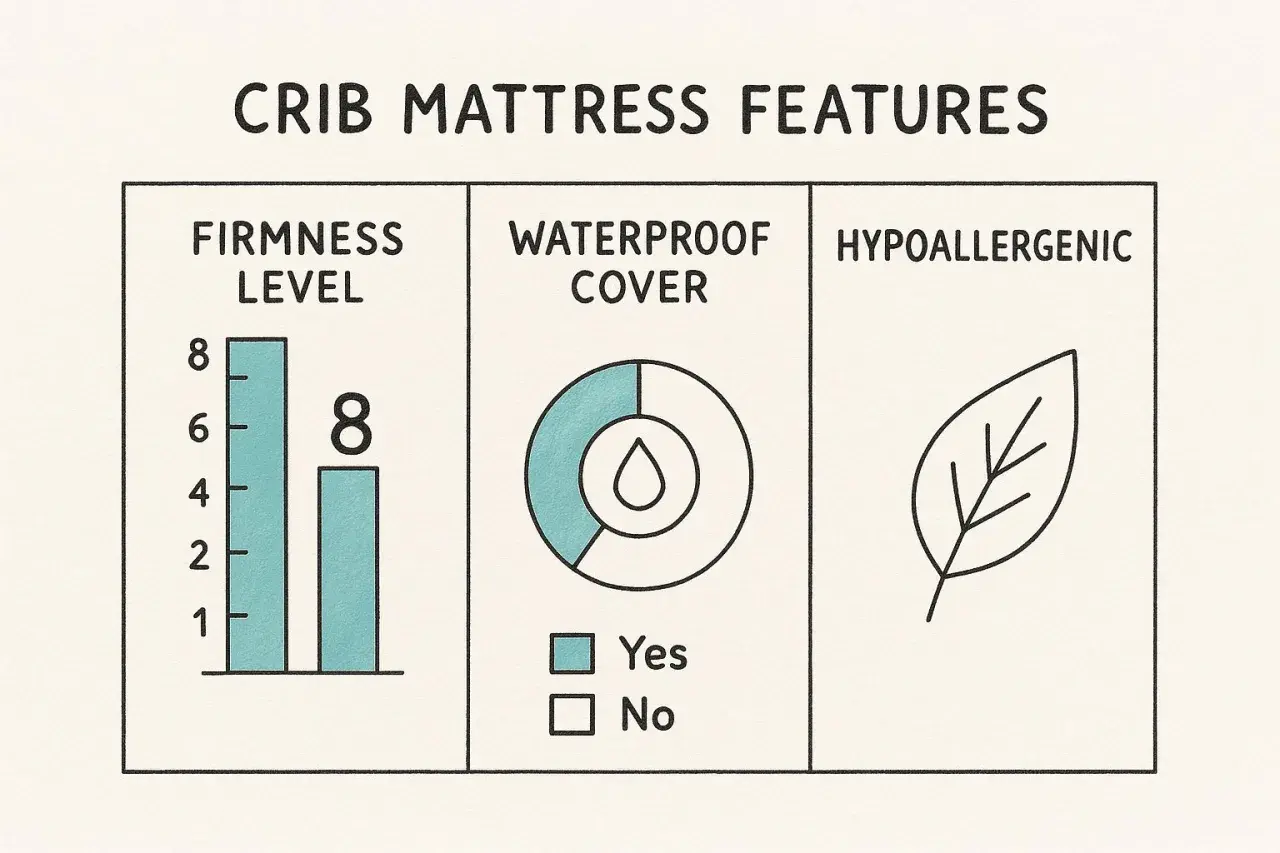
A good crib mattress has to do four things at once: fit the crib tightly, stay firm under a baby’s weight, clean up easily, and meet U.S. safety expectations. The problem is that product pages often bury those basics under words like “organic,” “breathable,” or “premium comfort.” This guide breaks down how to pick a crib mattress without getting lost in marketing claims.
The safest crib mattress is firm, exact-fitting, and easy to clean
- Fit comes first. A full-size U.S. crib mattress is about 52 3/8 by 28 inches, and non-standard cribs need the mattress made for that exact model.
- Firm beats plush. A baby mattress should feel flatter and harder than most adults expect.
- Foam is lighter, innerspring is sturdier, and hybrids split the difference. The right choice depends on how often you move it and how long you want it to last.
- Cleaning matters every week. A waterproof surface or removable washable cover saves time and reduces hassle after leaks.
- Labels help, but they do not replace basics. Safety certifications are useful only after fit and firmness are right.
Measure the crib before you look at products
I always start with the crib, not the mattress. In the U.S., a standard full-size crib mattress is roughly 52 3/8 inches by 28 inches, but mini cribs, round cribs, and play yards use different dimensions. That matters because a mattress can be “crib sized” in marketing terms and still leave unsafe gaps in the wrong frame.Measure the inside length and width of the crib, not the outer frame. Then check the crib manual for the mattress dimensions the manufacturer actually approves. If you are replacing a mattress for a hand-me-down crib, I would be even more careful, because older furniture sometimes has worn support hardware or model-specific sizing that is easy to miss.
- Measure from inner rail to inner rail.
- Check the crib manual for the exact mattress size and type.
- Use the mattress made for the specific mini crib or non-full-size crib if that is what you own.
- Inspect the crib base for level support before you buy anything new.
Once the fit is right, the rest of the decision gets much simpler, because you can focus on comfort, construction, and upkeep instead of guessing whether the mattress will work at all.
Firmness is non-negotiable
A crib mattress should feel firm to an adult hand. Not stone-hard, but definitely not plush, contouring, or pillow-top soft. The American Academy of Pediatrics and CPSC safe-sleep guidance both point parents toward a firm, flat, tight-fitting sleep surface, because softness and indentation increase the risk of suffocation or entrapment. That is why I ignore comfort language that sounds more appropriate for a grown-up bed.
My quick test is simple: I press the center and edges with my palm. A good infant mattress resists the pressure and springs back without holding a deep handprint. If it feels like memory foam, a cushion, or a mini mattress topper, I move on. A baby does not need sink-in comfort; a stable sleep surface matters far more.
- Choose a flat surface with no incline.
- Avoid pillow-top quilting and plush comfort layers.
- Skip mattresses that visibly contour under hand pressure.
- Do not add soft toppers or extra padding.
When firmness is settled, the next decision is the mattress construction itself, because different materials change weight, durability, and day-to-day convenience.

Foam, innerspring, and hybrid mattresses each solve a different problem
This is where many shoppers overfocus on the wrong detail. Material affects how the mattress feels in your hands, how long it lasts, and how annoying it is to change sheets, but it does not override the core rules of fit and firmness.
| Type | What it does well | Tradeoffs | Typical U.S. price range | Best for |
|---|---|---|---|---|
| Foam | Lightweight, easy to lift, usually less expensive, often quieter during sheet changes | Cheaper foam can sag sooner; quality varies a lot | $50 to $150 | Parents who want low weight and a simpler budget pick |
| Innerspring | Often feels firmer and more structured, usually longer-lasting | Heavier and often pricier than foam | $100 to $250 | Families who want a sturdier feel and plan to use the mattress for years |
| Hybrid | Tries to balance support, durability, and comfort in one build | Can cost more and still be heavy | $150 to $300+ | Buyers who want a middle ground and do not mind paying a bit more |
| Natural or organic-focused | Appeals to parents who care about materials and finish | “Natural” does not automatically mean safer; some are expensive without adding much real-world value | $120 to $350+ | Families who want material preferences to matter after safety basics are covered |
My rule is simple: I buy the construction that fits daily reality. If you will move the mattress often, weight matters. If you want the longest-lived support, a good innerspring can be worth the extra money. If low odor or specific material preferences matter to you, look for that after the mattress has already passed the fit and firmness test.
Materials and construction details that make life easier
Once the core build is right, the cover and finishing details decide whether the mattress is practical or annoying. Babies leak, spit up, and soak through sheets at inconvenient times, so a mattress that is hard to clean quickly becomes a burden.
- Look for a waterproof or water-resistant sleep surface, or at least a fully removable, washable cover.
- Check that seams are tight and that zippers or edges do not leave rough exposed areas.
- If the mattress uses foam, a low-odor or low-emission certification can be a nice bonus for indoor air quality, but it is not a substitute for safety.
- “Breathable” covers are fine as comfort features, but they do not replace firmness or proper fit.
- If the mattress uses coils, press near the edge and center to make sure nothing pokes through and the support feels even.
When I compare two mattresses that seem equally safe, I usually give the edge to the one that will be easier to wipe down and keep fresh. That practical detail matters more than people expect in the first year.
The mistakes that turn a decent buy into a poor one
The wrong crib mattress is usually not wrong because of one obvious flaw. It is wrong because of a few small compromises that add up. I see the same mistakes over and over, and most of them are avoidable.
- Buying by label alone. “Organic” or “breathable” can sound reassuring, but neither term guarantees the right fit or firmness.
- Choosing a mattress that is slightly undersized. A small gap may look harmless in the store, but it becomes a real problem once the mattress shifts.
- Picking something plush because it feels comfortable to an adult. Adult comfort is the wrong standard for infant sleep.
- Assuming every crib uses the same size. Standard, mini, and non-full-size setups are not interchangeable.
- Ignoring the return policy. If the mattress arrives with a smell, warped edge, or poor fit, you want an easy way out.
- Buying a heavily used mattress without checking condition. Compression, staining, and hidden damage erase the value of the bargain fast.
If budget is tight, I would rather see someone buy a straightforward new mattress than a questionable used one with unknown wear. A lower price is not a savings if the mattress no longer fits right or no longer supports the crib safely.
The last checks I make before I buy
Before I place an order, I run through five quick questions: does it match the crib’s measurements, does it feel firm enough, is the cover easy to clean, does it have clear safety labeling, and will it still work once a fitted sheet is on it? If any of those answers is shaky, I keep looking. A crib mattress is one of those purchases where the boring choice is usually the best one: firm, exact-fitting, and simple to maintain.
That is the real shortcut when you want to know how to pick a crib mattress without second-guessing yourself later.
