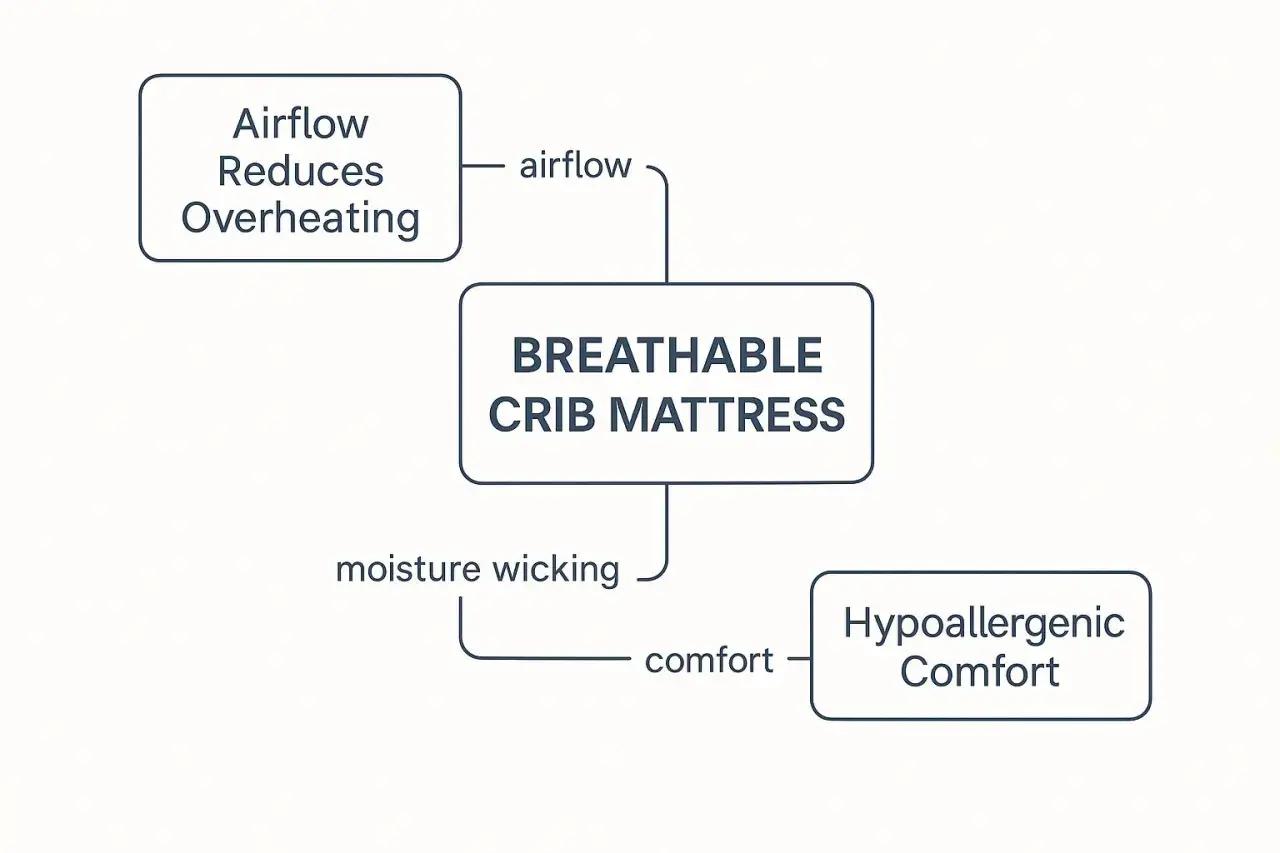
At its simplest, what is a breathable mattress? It is a mattress designed to let air move through the surface and core so heat and moisture do not build up as quickly. I think of it less as a buzzword and more as a construction choice: open structures, air channels, and fabrics that let the bed release warmth instead of holding onto it. For nursery use, that distinction matters even more, because a crib mattress still has to be firm, flat, and fitted correctly.
The main things that separate a breathable mattress from a warm one
- Breathability is about airflow and moisture release, not softness or plushness.
- Open-cell foam, latex, pocketed coils, and mesh-style covers usually breathe better than dense closed-cell foam.
- For babies, a breathable crib mattress still needs a firm, flat surface and a tight fit.
- Cooling and breathability overlap, but they are not the same feature.
- The build matters more than the label, especially when marketing claims sound too broad.
How airflow changes the way a mattress sleeps
When I evaluate breathability, I look at the mattress microclimate, which is the pocket of temperature and humidity that forms around your body while you sleep. A mattress that moves air well clears that pocket faster, so the surface feels less clammy and the bed recovers from body heat more quickly. That can matter for hot sleepers, humid bedrooms, and any crib setup where you want less trapped warmth under a fitted sheet.
Breathability does not mean air blows freely through every inch of the mattress. It usually means the materials and layers create enough space for heat to escape and for moisture vapor to move away. A bed can feel breathable on top but still run warm if the support core is dense, the cover is impermeable, or the foam layers are too sealed up. That is why the next question is not whether a mattress is breathable in theory, but which materials actually create that effect.

Which materials actually make a mattress breathable
I usually separate surface breathability from core breathability. A mattress can have a nice airy cover and still trap heat underneath if the inside is built like a sealed block. The most useful breathable designs do both jobs well: they let air move across the top and through the interior.
| Construction | How it helps airflow | Tradeoff | Best fit |
|---|---|---|---|
| Open-cell foam | Interconnected cells let air and heat move more easily than in traditional closed foam. | Still less airy than coils or natural latex in many builds. | People who want a foam feel with better temperature control. |
| Latex | Its springy structure stays open and responsive, so heat does not pool as easily. | Usually pricier and heavier. | Hot sleepers who want a resilient, durable surface. |
| Pocketed coils | Large internal air spaces let heat escape through the core. | Comfort depends on the top layers above the coils. | Hybrids and beds that need strong support plus airflow. |
| Mesh or 3D knit cover | Improves surface ventilation and moisture release. | Does not fix a dense core by itself. | Crib mattresses and beds that need a more breathable top layer. |
| Dense closed-cell foam | Very little airflow compared with the options above. | Can sleep warmer and hold moisture longer. | Budget beds or pressure relief when airflow is not the priority. |
That table is the practical version of breathability. If a brand only talks about a breathable cover but the core is dense foam, I treat that as partial breathability, not a fully breathable mattress. In real use, the combination matters more than any single layer.
Why breathable matters more in crib mattresses
For cribs, breathability sits inside a bigger safety rule: the sleep surface still has to be firm, flat, and covered only with a fitted sheet. The AAP recommends that setup for infant sleep, along with keeping loose blankets, bumpers, pillows, and stuffed items out of the crib. That is why I never treat breathable design as a replacement for proper fit or firmness.
The CPSC has also noted, in the context of infant products, that breathable is an undefined term, which is a useful reality check. In other words, the label alone does not tell you whether the mattress will stay firm, fit the crib correctly, or control heat in a meaningful way. For nursery use, I care about breathability as one piece of the puzzle, not the whole safety story.
- For a full-size crib in the U.S., the mattress should match the crib’s interior dimensions closely and should not exceed 6 inches in thickness.
- A mattress that leaves visible side gaps is the wrong choice, no matter how airy the marketing sounds.
- Soft, pillow-like surfaces are a poor trade for infant sleep, even if they are described as breathable.
- Washability matters because moisture, spills, and spit-up can undermine airflow over time.
Once fit and firmness are handled, the next challenge is separating real airflow from cooling marketing.
Breathable and cooling are related but not identical
People mix these up all the time. A mattress can feel cool at first touch and still hold heat after an hour, while another bed can be breathable without feeling icy. I separate the two like this:
| Feature | Breathable mattress | Cooling mattress | Why the difference matters |
|---|---|---|---|
| Main job | Move air and moisture through the bed. | Lower the surface temperature or slow heat buildup. | A bed can do one well without fully doing the other. |
| How it works | Open materials, airflow channels, and ventilated covers. | Cooling gels, phase-change fabrics, breathable covers, and airflow-friendly cores. | Some cooling features are surface-level and fade quickly. |
| What you feel | Less trapped warmth and less dampness. | A cooler touch at first contact, sometimes with longer-term temperature control. | First-touch coolness is not the same as all-night comfort. |
| Common trap | A breathable cover over a heat-trapping core. | A cool-feeling layer that does not improve airflow. | Marketing can make both sound stronger than they really are. |
In practice, the best mattresses often combine both ideas. A breathable build plus a surface that releases heat well is much more convincing than a single flashy material claim. That becomes even more important when you start comparing products side by side.
How I would choose one without buying hype
When I shop for a breathable mattress, I start with use case, not slogans. The right answer for a nursery is not the same as the right answer for a hot sleeper in a queen bed, and the wrong mattress often looks impressive online because the copy focuses on features instead of performance.
- Decide whether the mattress is for a crib, toddler bed, or adult bed.
- Ask whether the core breathes or only the cover does.
- Check firmness first for infants and support first for adults.
- Look for materials that support airflow, such as open-cell foam, latex, coils, or ventilated fabric.
- Verify the fit against the crib or bed frame instead of trusting a universal-fit claim.
- Prefer a design that stays breathable after a fitted sheet, protector, or washable cover is added.
For a standard full-size crib, I would verify the mattress against the crib’s instructions and the CPSC size limits rather than relying on a retailer’s “universal” promise. A mattress that fits loosely is a bad fit, even if it is technically airy. I would rather see an honest, well-built product than a long list of features that sound advanced but do not change sleep quality.
How to keep airflow from getting blocked
Even a well-designed mattress can lose some of its airy feel if you smother it with the wrong accessories. A breathable protector is useful; a thick, plastic-feeling layer is not. In a nursery, the same rule applies to sheets, pads, and toppers: the more layers you pile on, the more you can block the airflow you paid for.
- Use a fitted sheet that matches the mattress closely.
- Choose a protector that balances moisture resistance with breathability.
- Avoid oversized pads and plush toppers if heat is a problem.
- Let the mattress dry fully after spills before covering it again.
- Rotate the mattress if the manufacturer recommends it, especially on larger beds.
If a mattress only feels breathable when the cover is off, that is not a very useful design. The better goal is a surface and core that keep moving air even in everyday use.
The detail I would not skip after the label fades
If I had to reduce the whole topic to one sentence, it would be this: breathability is useful, but it only helps when the mattress is already the right firmness and size for the bed or crib. For adult sleepers, that usually means choosing the most open construction that still supports your body well. For babies, it means a firm, flat mattress with a breathable build that does not interfere with safe sleep rules.
I also pay attention to how a mattress handles real life. A washable cover, a moisture-resistant but not suffocating surface, and a core that does not collapse into body impressions all matter more than a dramatic claim on the box. When a mattress breathes well and is built honestly, you feel it as less heat, less dampness, and fewer midnight wake-ups. That is the version of airflow worth paying for.
