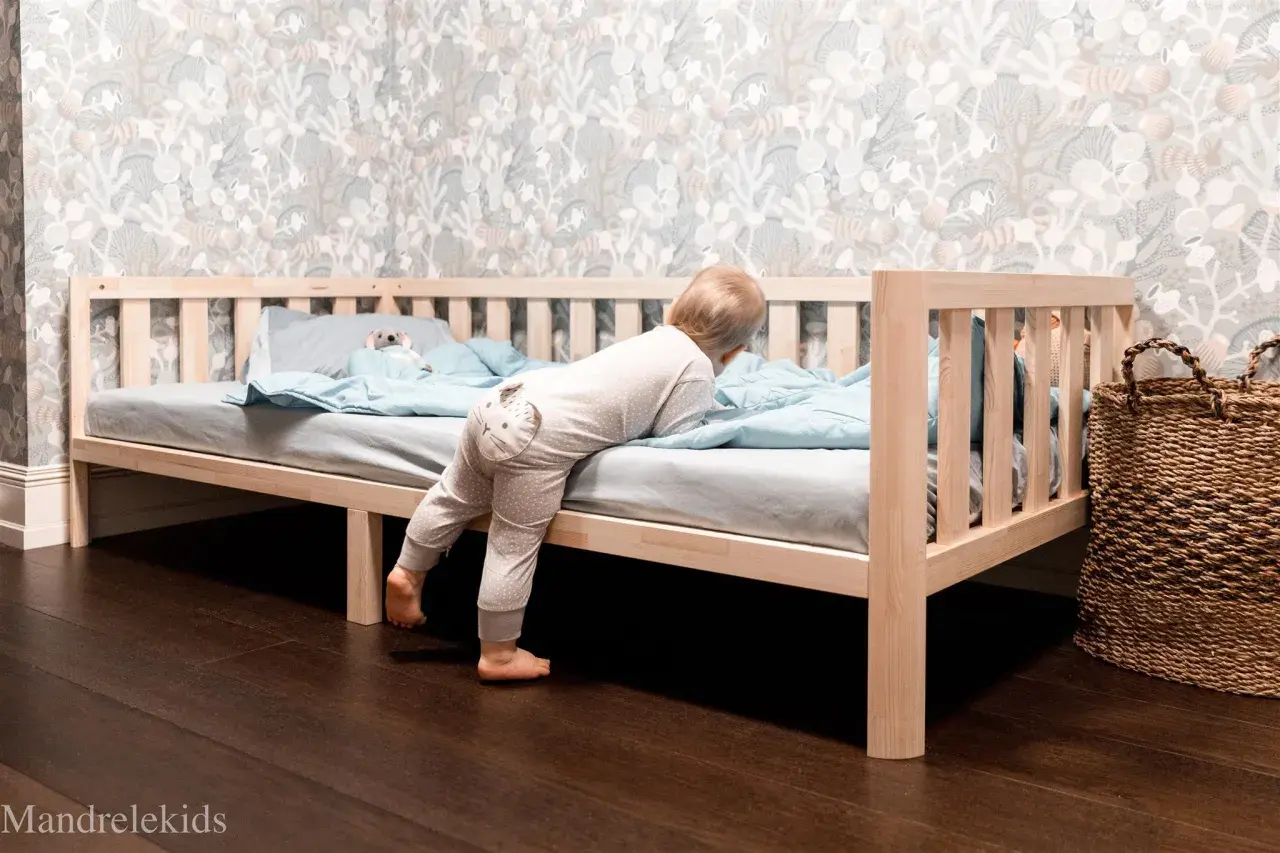
The sizes that matter most at a glance
- For a standard full-size crib in the U.S., the safety benchmark is a mattress at least 27 1/4 x 51 5/8 inches and no thicker than 6 inches.
- Most Montessori floor beds start with crib-size footprints around 28 x 52 inches, then move to twin at 38 x 75 inches or full at 54 x 75 inches.
- Mini cribs are usually built around 24 x 38-inch mattresses, but the exact fit depends on the model.
- Frame dimensions are usually a few inches larger than mattress dimensions, so measure the full footprint, not just the mattress label.
- For smaller nurseries, a crib-size floor bed usually gives the best balance of independence and space efficiency.
Why there is no single Montessori standard
The Montessori approach cares more about accessibility than a specific furniture style. A bed can be a mattress on the floor, a low frame with open sides, a crib-size setup reused from the nursery, or a standard twin placed low enough for a child to use independently. That flexibility is the point, but it also means there is no universal size that works for every child, room, or stage.
When I plan a Montessori room, I start by asking one simple question: what size lets the child get in and out safely without wasting precious floor space? For a newborn or young toddler, that usually means a smaller sleep surface. For an older toddler, the answer often shifts toward a twin or even a full bed if the room can handle it. That is why the next step is not style, but measurements.

A practical size chart for common Montessori beds
The easiest way to compare options is by mattress footprint. In U.S. nurseries, the most common Montessori-friendly sizes are crib, mini crib, twin, and full, with toddler floor beds usually sitting somewhere between crib and twin. Frame dimensions can be a little larger than the mattress, so I am listing the mattress size you actually need to shop for.
| Bed type | Typical U.S. mattress size | Best use | My practical note |
|---|---|---|---|
| Mini crib | 24 x 38 inches | Very small rooms, early infancy, portable setups | Great when space is tight, but always verify the exact mattress your crib model requires. |
| Crib-size floor bed | 28 x 52 inches | Infants and toddlers who still need a compact footprint | This is the most common Montessori starting point because it reuses a standard crib mattress. |
| Toddler floor bed | About 28-30 x 50-54 inches | Toddlers who need low access and a little more room | Useful when a crib mattress feels too small but a twin would overwhelm the room. |
| Twin | 38 x 75 inches | Longer runway, story time, growing children | A strong balance between comfort and room efficiency, especially if the bed will last several years. |
| Twin XL | 38 x 80 inches | Taller children who need extra legroom | Less common in Montessori nurseries, but it can be the smart move if height is the issue. |
| Full | 54 x 75 inches | Larger rooms, older children, parent-led bedtime routines | Comfortable, but it can dominate a nursery faster than most parents expect. |
One detail that matters more than people expect: a frame is not the same thing as the mattress. A low Montessori-style frame may add 1 to 4 inches on each side, and sometimes a little more if there is a built-in rail, canopy, or house shape. I always measure the full footprint against the room, because a bed that looks right on paper can feel bulky once it is inside the nursery. That leads straight into the next decision, which is how the bed fits the child and the room at the same time.
How to choose the right size for age and room layout
I usually think about Montessori sizing in three stages. First comes the smallest footprint that supports safe sleep and independent access. Then comes the size that gives the child room to grow. Finally, there is the size that still leaves enough floor space for movement, toys, and daily life.
For infants and early toddlers
If the room is small, a mini crib or crib-size floor bed usually makes the most sense. It keeps the sleep area compact and gives you more control over the rest of the nursery. A crib-size setup is also easier to anchor visually in a room, which matters when you are trying to build a calm space instead of filling every corner.
Read Also: Crib Height: When to Lower the Mattress for Baby Safety
For older toddlers and preschoolers
Once a child is moving confidently, a twin often becomes the sweet spot. It gives more length without taking over the room the way a full bed can. If you expect to stay in the nursery for years, or if you like sitting beside your child for bedtime reading, a twin or full bed can be worth the extra footprint. I would only jump to full if the room is large enough to keep the rest of the layout breathable.In practice, I like to leave about 24 to 36 inches of usable clearance on the open side of the bed whenever the room allows it. That gives enough space for walking, changing sheets, and letting a child move around without constantly bumping furniture. I also check door swings, dresser drawers, closet access, and the path to the crib or bed before I commit to a size. A bed that blocks the room flow will feel wrong, even if the mattress dimensions are technically fine.
Mattress thickness, firmness, and fit are part of the dimensions
As of 2026, the U.S. standard for a full-size crib mattress is still tightly defined. The Consumer Product Safety Commission requires a mattress to be at least 27 1/4 inches wide and 51 5/8 inches long, with a maximum thickness of 6 inches. That matters because crib safety is not just about length and width; it is also about preventing gaps and keeping the sleep surface firm and flat.For a Montessori-style floor bed, the same thinking applies even when the bed is not inside a crib frame. I want the mattress to sit low, stay stable, and avoid a plush, sink-in feel. Thick toppers, pillow-top layers, and loose add-ons can make a low bed less predictable and more awkward for a child to use independently. A flat, firm mattress usually works better than a softer one that looks cozy but behaves badly in daily use.
- Check the fit first. The mattress should sit snugly in the frame or on the platform without obvious side gaps.
- Match the manufacturer’s size. Mini cribs in particular vary, so the label on the frame matters more than a guess.
- Avoid extra softness. A floor bed should feel supportive, not marshmallow-like.
- Keep the profile low. The lower the sleep surface, the easier it is for a child to use the bed independently.
Once the mattress is sized correctly, the remaining problems are usually self-inflicted, which is why the next section is worth reading carefully.
Common mistakes that make a Montessori bed feel wrong
Most sizing problems are not really design problems. They come from a few predictable mistakes that are easy to avoid once you know where people go wrong.
- Mixing up mattress size and frame size. A listing may say 28 x 52, but the actual frame footprint can be noticeably larger.
- Choosing the bed by looks alone. A house frame or canopy can eat valuable floor space even when the mattress size is modest.
- Going too big too early. A full bed in a small nursery can make the room feel crowded and harder for a child to navigate.
- Ignoring thickness. A mattress that is technically the right length and width can still be a poor fit if it is too tall or too soft.
- Forgetting the room’s other functions. The bed should not block play space, storage, or the path to the door.
There is one more mistake I see often: parents size the bed for the child they imagine two or three years from now, then live with a clumsy setup today. A better approach is to choose the smallest bed that works now, then size up only when the room and the child both need it. That brings us to the decision I would make most often in a U.S. nursery.
The simplest sizing rule I use in real nurseries
If the room is tight, I would start with a crib-size floor bed or a mini crib. If the room has room to breathe and the child is already past the earliest infant stage, I would lean toward a twin because it gives the best long-term balance. I would only choose a full bed when the room is large enough that the bed does not steal the entire floor plan.
The cleanest rule is this: pick the smallest size that still supports independence, then leave enough open space for the child to actually use the room. That is the difference between a Montessori bedroom that feels calm and one that just feels filled with furniture. If you keep the mattress footprint, the frame footprint, and the walking space in view at the same time, the right choice usually becomes obvious.
