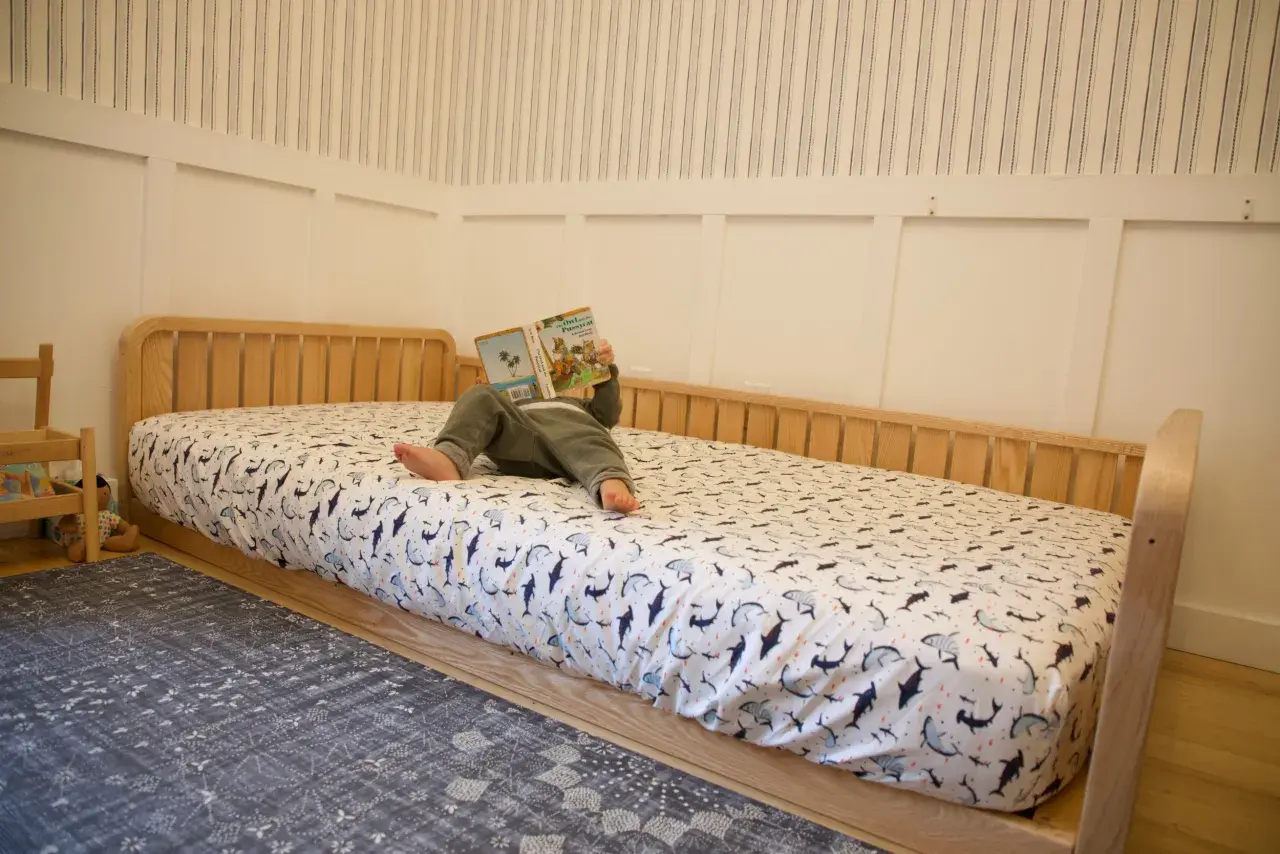
Key things to get right before the first night
- For infants under 12 months, I would still use a crib, bassinet, or play yard that meets current safe-sleep guidance.
- A low slatted platform is usually better than a mattress directly on the floor because it improves airflow and makes cleaning easier.
- Standard crib mattresses are 51 5/8 in. by 27 1/4 in., which makes them the simplest size to build around.
- The room matters as much as the frame: anchor furniture, manage cords, and clear climbing hazards first.
- Keep the sleep surface simple, firm, and low; the bed should support independence, not turn into a play structure.
When a floor bed actually makes sense
I think the biggest mistake people make is treating a floor bed as a universal answer. It is not. A floor bed makes sense when a child is ready to get in and out independently, the room can be fully childproofed, and the family wants a sleep setup that supports more autonomy than a crib does.
There is also a useful boundary from the CPSC: its toddler-bed definition is built around a standard crib mattress and a child who is at least 15 months old and no more than 50 lbs. I use that as a practical reference point, not as a magic green light. If the child is still an infant, I would not replace a regulated sleep product with a Montessori-style setup.
- If your child is climbing out of the crib, a low bed can reduce the risk of a higher fall.
- If your child still needs containment to sleep safely, the transition is probably too early.
- If the room cannot be secured, the bed choice matters less than the environment around it.
Once that decision is clear, the layout becomes much easier to choose, because the right build depends on the room and on the mattress you already own.
Choose the right layout before you cut any wood
When I plan one of these, I start with the layout, not the lumber. The three common versions are a mattress directly on the floor, a low slatted platform, and a low frame with a house-bed look. All three can work, but they behave very differently in daily use.
| Layout | Best for | Pros | Tradeoffs | My take |
|---|---|---|---|---|
| Mattress on the floor | Fastest possible setup | Almost no cost, very low profile, easy to test before you build | Less airflow, harder to sweep under, can trap moisture in humid rooms | Good as a temporary phase, not my first choice for long-term use |
| Low slatted platform | Most families | Breathes better, looks clean, stays low, easier to keep dust down | Needs basic carpentry and a little more time | My default recommendation for a DIY nursery bed |
| House-frame floor bed | Rooms where the look matters as much as the function | Visually playful, can make the corner feel cozy | More parts, more chance to create climbing points, more work than the bed really needs | Only worth it if you keep the frame simple and truly low-risk |
For most U.S. nurseries, I would build around a standard crib mattress first. That size is compact, easy to sheet, and easy to move later. A twin mattress is fine if you want the setup to last longer, but once you go that big, the room starts to matter much more, because the bed no longer feels like a minimal floor setup.
With the shape decided, I can size the materials instead of guessing as I go.
Materials and measurements that keep the build simple
I like simple parts lists because they are cheaper, faster, and easier to inspect later. For a standard crib mattress, I would plan a support deck of about 55 x 31 in. and a finished height of roughly 2 to 4 in. That gives the mattress enough room without turning the bed into a raised platform.
| Item | What I use it for | Notes |
|---|---|---|
| 2x4 kiln-dried lumber | Perimeter frame and supports | Strong, easy to source, and simple to screw together |
| 1x3 slats or 3/4 in. plywood | Mattress support | Slats breathe better; plywood is a fallback if you build carefully |
| 2.5 in. wood screws and wood glue | Joinery | Pre-drill to avoid splitting the wood |
| Felt or rubber pads | Floor protection | Useful on hardwood, tile, or any surface that scratches easily |
| Water-based finish | Surface protection | Low odor is helpful in a nursery, but let it cure fully before use |
My tool list stays short: tape measure, square, pencil, saw, drill/driver, clamps, and a sander. If you already own a miter saw, the build goes faster, but it is not required. A circular saw with a straight edge guide can handle the whole project.
- Measure the mattress first, not the room first. The mattress is the fixed dimension.
- Use slats with small gaps, ideally around 2 to 3 in., so the mattress is supported evenly and can breathe.
- Keep the frame low enough that the mattress does not become a step up.
- If you want a twin version, scale the deck instead of trying to stretch a crib-mattress plan.
Once the cuts are planned, the actual assembly is straightforward, and the details start to matter more than the design.
How I would build it step by step
- Measure the mattress and mark the target footprint. I start with the mattress size, then add only enough extra room for a clean fit and easy bedding. For a standard crib mattress, I would keep the platform close to 55 x 31 in. overall.
- Cut the perimeter frame. Build a square or rectangle that stays flat on the floor and does not wobble when you press on the corners. Dry-fit everything before driving screws.
- Add center support. A center rail or two short cross supports helps keep the slats from flexing over time. This matters more than decorative trim, and it is where many cheap beds fail first.
- Install the slats or support surface. If you use slats, keep the spacing even. If you use plywood, make sure the surface is smooth, sealed, and well supported so it does not flex or trap moisture.
- Sand every edge and corner. I round over the top edges just enough to remove the sharp feel. A child should be able to slide against the frame without meeting a splinter or a hard corner.
- Apply finish and let it cure. I prefer a low-odor water-based finish, but I always follow the full cure time on the can. Depending on the product, that can mean several days before the bed is ready.
- Set the bed in the room and test it. I push on every corner, sit on the edge, and check for rocking. If the bed shifts on the floor, I add pads or adjust the frame before the child ever uses it.
If you want a house-frame look, I would build the sleeping base first and then treat the top frame as decoration, not structure. That keeps the bed simple to repair later and keeps the decorative part from becoming a climbing invitation.
The bed itself is only half the job. The room around it decides whether the setup is calm or chaotic, which is why I spend as much time on safety as I do on carpentry.
Safety and room setup matter more than the frame
For infants under 12 months, I would stay with safe-sleep basics from the AAP: firm, flat sleep surface, back sleeping, and a bare sleep area except for a fitted sheet. That is not the stage for a floor bed, no matter how cute the build looks. For toddlers, the priorities change, but the sleep space should still stay simple and predictable.
- Anchor dressers, bookshelves, and any furniture a child could pull over.
- Keep blind cords, charging cables, and lamp cords out of reach.
- Use a gate at the bedroom door if wandering is a problem at night.
- Keep large toys, hard-edged furniture, and climbable decor away from the bed.
- Use a fitted sheet only on the mattress, and keep bedding as light and minimal as age-appropriate.
- Make sure the child has a clear path in and out of the bed without tripping over toys or rug edges.
I also like a soft night light placed low in the room, not bright overhead lighting. It makes midnight wakeups less dramatic and helps the room stay readable without turning it into a play space. If you live in a humid climate, airflow matters even more, so I would not skip the slatted base unless you have a very good reason.
Once the room is safe, the project comes down to cost, time, and the mistakes that are easiest to prevent.
The costs, timing, and mistakes I would avoid
The frame is usually the cheap part. The mattress, finish, and room prep are where the real value is, because a bed that looks finished but feels wrong will get used less and adjusted more. In practice, a basic build can stay very affordable if you keep the design simple.
| Build type | Typical material cost | Build time | Best for |
|---|---|---|---|
| Mattress on the floor | $0-$25 | 10-20 minutes | A temporary trial or the absolute cheapest setup |
| Low slatted platform | $75-$150 | 2-4 hours | Most DIY nursery projects |
| House-frame version | $150-$300+ | 4-8 hours | Families who want the visual style and are willing to do more work |
The mistakes I see most often are predictable, and they are easy to avoid once you know them.
- Making the bed too tall. The whole point is low, independent access.
- Using a mattress or topper that is too soft. Softness adds comfort, but too much of it hurts stability.
- Ignoring airflow. A mattress directly on the floor can collect moisture and dust faster than people expect.
- Skipping childproofing and assuming the bed itself will do the safety work.
- Adding decorative rails, arches, or roof pieces that create climbing points.
- Building a beautiful frame that is hard to vacuum, hard to move, and annoying to repair.
I would rather have a plain, sturdy bed that lasts than a themed build that looks finished for a week and then starts causing friction at bedtime. That practical mindset carries into the final check I always do before the first night.
What I would check before the first night
- The mattress lies flat and does not drift across the frame.
- The bed does not rock when I press on the corners.
- Every screw is snug and every edge feels smooth to the hand.
- The room is clear of reachable hazards, cords, and climbable furniture.
- The finish is fully cured and the floor under the bed is clean and dry.
If those five things are true, the setup is probably doing what it should: giving the child freedom without making the room feel unsafe or overcomplicated. That is the version of a Montessori-style bed I would actually trust in a real nursery, because it stays simple, breathable, and easy to live with long after the first night.
