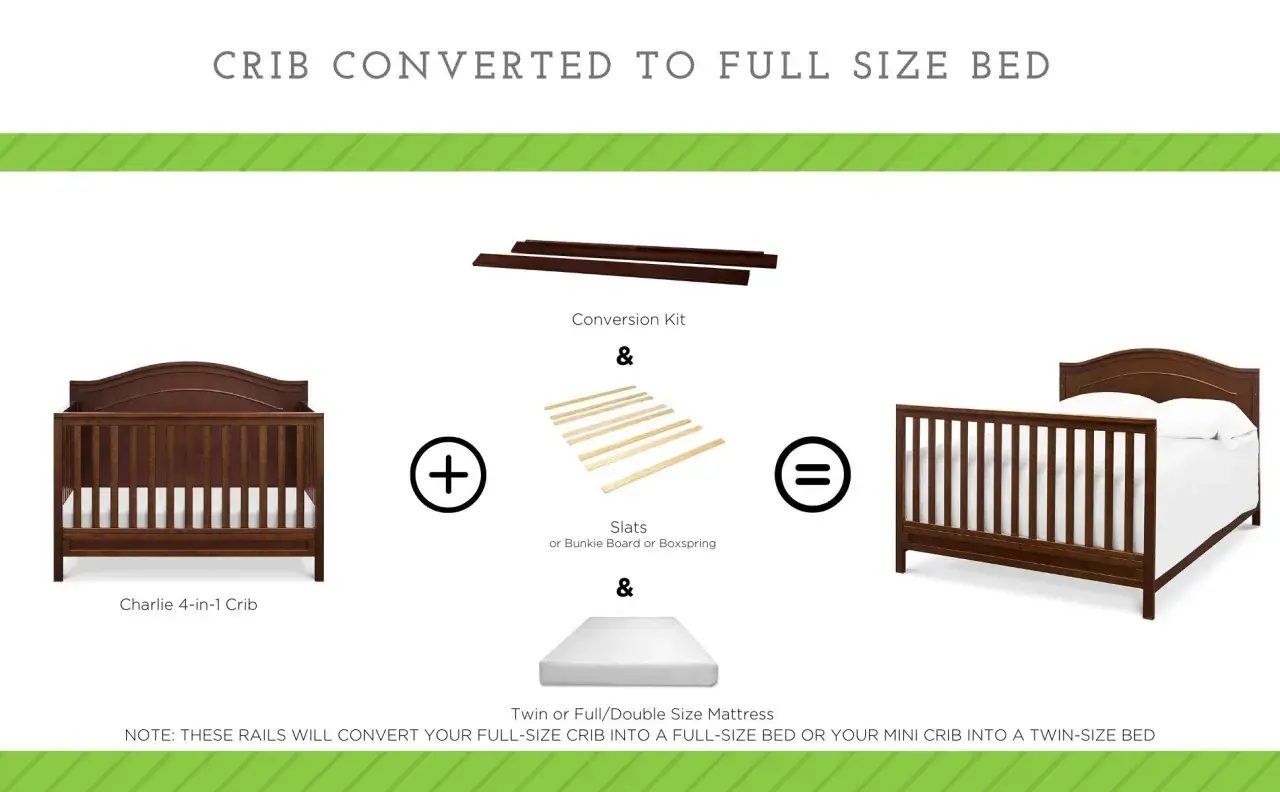
Convertible cribs are useful because they stretch a nursery budget, but the final bed size depends on the model, not the marketing label. In most U.S. nurseries, a standard crib becomes a toddler bed, daybed, and sometimes a full-size bed; a twin conversion is much less common and usually belongs to certain mini cribs or specialty systems. I’m going to break down what actually converts, what hardware you need, where people overspend, and how to decide whether a full-size or twin path makes more sense.
The conversion usually ends at full-size, while twin is the exception
- Most full-size convertible cribs are built to become a full-size bed, not a twin.
- Twin-bed conversion is typically limited to certain mini cribs or special conversion kits.
- You usually need a matching conversion kit, the right mattress, and sometimes a box spring or bunky board.
- A 4-in-1 or 5-in-1 label does not automatically mean every bed size is included in the box.
- The safest move is to match the crib model, hardware, and mattress size before you buy.
The short answer is full-size more often than twin
The CPSC defines a full-size baby crib by its interior dimensions, and that standard is what most convertible crib systems are built around. In plain English, a standard crib usually grows into a toddler bed first, then a daybed, and then a full-size bed if the brand designed it that way. Twin-bed conversion is not the normal path for a standard crib.
| Crib type | Typical conversion path | What it means in practice |
|---|---|---|
| Standard full-size convertible crib | Crib, toddler bed, daybed, full-size bed | Most common final stage; usually needs a conversion kit |
| Mini crib | Crib, daybed, then twin-size bed on select models | Possible only on certain models with the correct kit |
| Traditional non-convertible crib | Crib only | No bed-size upgrade built in |
In U.S. bedding sizes, a twin is usually 38 x 75 inches and a full is usually 54 x 75 inches, so the difference is mostly width. That is why the frame hardware matters so much. If the crib was built for a full-size mattress, it cannot simply be stretched into a twin without the right supporting parts. The next question is how to know what your specific crib was actually designed to become.

How to know what your crib was built to become
The fastest way to avoid a wrong purchase is to look past the product name and inspect the model details. I always check the model number, the instruction manual, and the final stage named by the manufacturer before I assume anything about the bed size.
- Look for the conversion count, but read the fine print. A 3-in-1, 4-in-1, or 5-in-1 label tells you there are multiple stages, not that every stage is included.
- Find the final bed type spelled out in the product copy or manual. Some cribs end at full-size, while others stop at toddler bed or daybed.
- Check whether the rails are included. Many brands sell the conversion kit separately, which can change the real cost more than the crib price itself.
- Confirm whether the model is a full-size crib or a mini crib. That one detail often decides whether the final step is full-size or twin-size.
- If the crib is secondhand, verify the hardware and check recall status before you use it again.
DaVinci’s support notes make the mini-crib exception especially clear: only certain mini cribs convert to twin beds. That is the rule I would keep in mind whenever a listing sounds more flexible than it really is. From there, the next question is what the conversion actually requires in terms of parts and mattress support.
What the conversion hardware actually changes
A crib conversion is usually less dramatic than people expect. The crib mattress does not become the bed mattress; instead, the frame is reconfigured with rails, brackets, or support slats so it can hold a larger sleep surface. A bunky board is a thin support platform that replaces a box spring when the frame needs a flatter, lower foundation.
Here is the practical version of what most families need:
| Final bed size | Common parts needed | What to watch for |
|---|---|---|
| Full-size bed | Conversion kit, full mattress, and often a box spring or bunky board | Headboard and footboard hardware may be separate |
| Twin-size bed | Special mini-crib conversion kit, twin mattress, and often a box spring or bunky board | Only certain mini cribs support this path |
| Toddler bed or daybed | Guardrail or side rail, depending on the model | Usually the cheapest and simplest conversion stage |
Budget-wise, I usually see conversion hardware land somewhere around $50 to $250 depending on brand and how much of the frame is included. That is before you buy the new mattress, so the real cost can be higher than it first looks. If the hardware costs almost as much as a separate bed frame, it is worth pausing before you commit. That calculation leads directly to the next decision: whether twin or full actually fits the way your child will use the room.
When a twin bed makes more sense than a full-size conversion
This is where families often split into two camps. One group wants to keep the crib frame going as long as possible. The other wants the simplest path into a real kids’ bed and does not care whether the crib is the thing that gets there.
| Option | Best for | Why it works | Main tradeoff |
|---|---|---|---|
| Convert to full-size bed | Families who want one frame to last through the early school years and beyond | It can stretch the life of a nursery piece and usually gives the cleanest "grow with me" story | Needs the right kit and more bedroom space than a toddler setup |
| Convert to twin-size bed | Small rooms, mini cribs, or families who know a twin is the final target anyway | Twin bedding is easy to find and the bed is a familiar big-kid size | Only works on certain mini cribs, so the crib choice is more restrictive |
| Skip the final crib conversion and buy a separate twin bed later | Parents who want flexibility or who dislike expensive add-on kits | Often simpler and sometimes cheaper in the long run | You give up the extra use value of the convertible frame |
In practice, I would lean full-size if you want longevity and the crib is already a full-size convertible. I would lean twin if you are starting with a mini crib or know your nursery space is tight. If neither path feels clean, a separate twin bed later may be the least frustrating answer. Once you choose the direction, the mistakes to avoid become pretty obvious.
Common mistakes that waste money or create a bad fit
- Assuming every "5-in-1" crib includes every conversion part. In many cases, the last-stage hardware is sold separately.
- Buying a universal kit before checking compatibility. "Universal" sounds convenient, but the crib still has to support that exact conversion.
- Forgetting the foundation. A full-size or twin-size mattress often needs a box spring or bunky board, not just the rails.
- Trying to reuse the crib mattress. A crib mattress is sized for a crib, not for a bigger bed frame.
- Skipping the manual and relying on guesswork. Hardware placement matters more than people think, especially with older models.
- Ignoring room dimensions. A bed that technically converts can still overwhelm a small nursery once you add nightstands, drawers, and walking space.
- Leaving recall checks for later. If the crib or kit has a safety issue, the conversion plan is irrelevant until that is resolved.
I see these mistakes most often when families buy based on style photos instead of the hardware list. The photos sell the dream; the parts list tells you whether the dream will actually fit your room and budget. That is why I always use one last rule before recommending a convertible crib.
My practical rule for choosing a convertible crib in 2026
If you want the simplest decision, start with the end bed you actually plan to use. A standard full-size convertible crib makes sense when you want a longer runway and do not mind buying the conversion kit later. A mini crib only makes sense when space is tight and you are comfortable with the idea that the final jump may be to a twin bed rather than a full-size one.
- Choose a full-size convertible crib if you want the most common crib-to-bed path and a nursery piece that can last for years.
- Choose a mini crib with twin conversion only if the product page explicitly says it supports that final stage.
- Choose a separate twin or full bed later if you want maximum flexibility and the fewest compatibility headaches.
When I compare the total cost, I think in terms of crib price, conversion kit price, mattress, and foundation pieces together. That total usually tells the truth faster than the label on the box. For most families, the right answer is less about whether a crib can become a twin or full-size bed and more about whether that conversion is the one you will actually want to live with.
