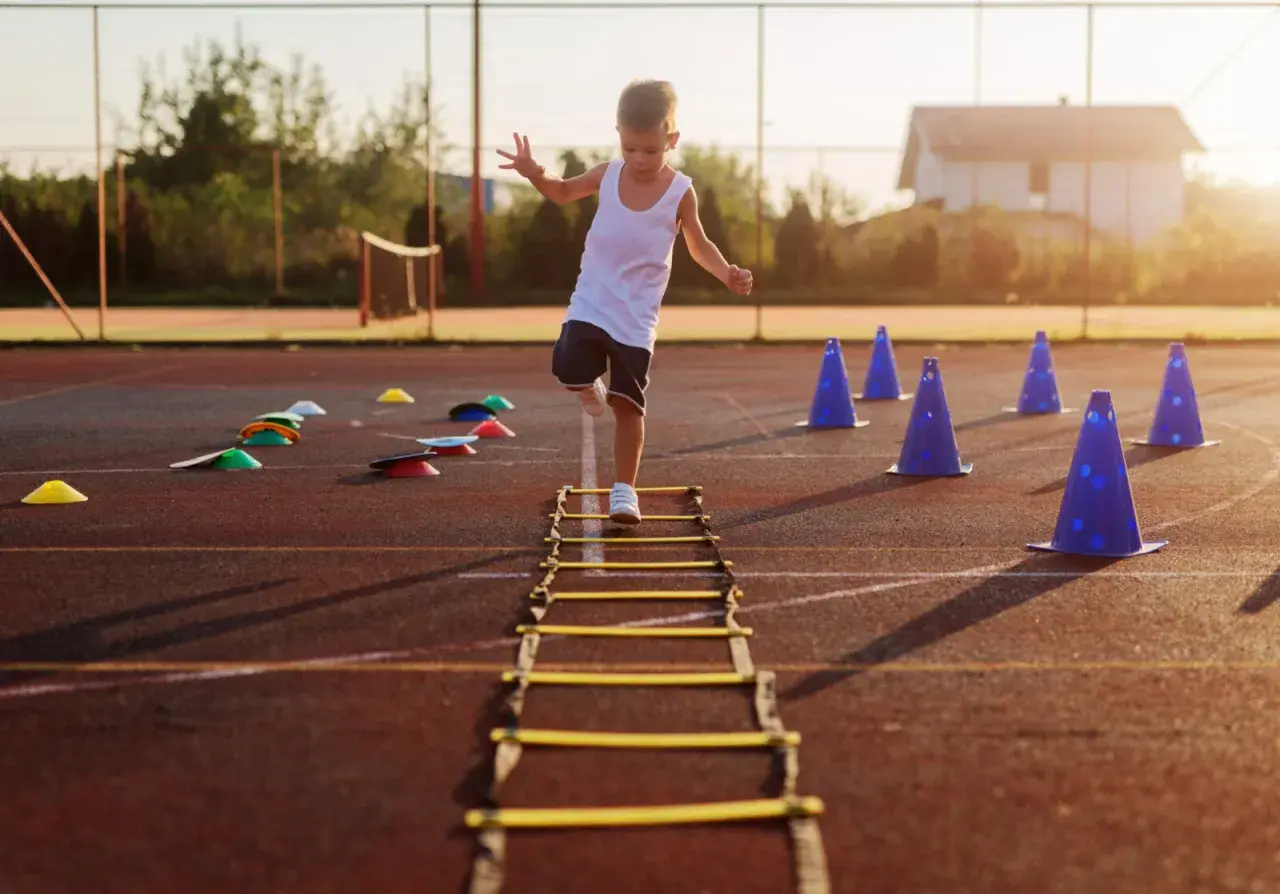
Key takeaways for busy parents and teachers
- At age five, the most useful movement play builds balance, hopping, climbing, throwing, catching, and quick changes of direction.
- Short bursts work better than long drills; I like 10 to 15 minutes of active play several times a day.
- Simple tools like tape, chalk, balls, and cones can create better practice than expensive equipment.
- The right challenge should feel a little hard, but still end in success most of the time.
- Persistent trouble with hopping, climbing, balance, or frequent falls is worth mentioning to a pediatrician.
What five-year-olds are usually ready to do
At five, movement is no longer just about burning energy. It is how children practice balance, learn to stop and start on purpose, build core strength, and coordinate arms and legs in a way that makes school and playground play feel easier. HealthyChildren lists skills such as standing on one foot, hopping, swinging, and climbing as common at this age, which is a good reminder that the target is not athletic polish; it is control, confidence, and repetition. I treat that as a practical benchmark, then build games around it.
That matters because gross motor play feeds into more than sports. It supports the kind of body control a child needs to line up, carry a backpack, sit upright, climb playground steps, and keep up with friends without tiring out too quickly. Once you know the target, the next step is choosing activities that hit those skills without feeling like drills.

The best activities for real movement practice
I usually look for games that ask a child to jump, climb, throw, catch, balance, or change direction. The best ones are simple enough to set up in minutes and flexible enough to make easier or harder without starting over.
| Activity | Main skill focus | Simple setup | Why it works |
|---|---|---|---|
| Animal walks | Core strength, shoulder stability, coordination | Clear a short hallway or strip of floor | Bear walks, crab walks, and frog jumps build whole-body control without special gear. |
| Hopscotch | Balance, hopping, sequencing | Sidewalk chalk outside or painter’s tape indoors | It asks the child to plan foot placement, land safely, and keep rhythm. |
| Obstacle courses | Agility, planning, spatial awareness | Pillows, cones, a tunnel, a chair, or a taped line | The child practices starting, stopping, climbing over, crawling under, and turning. |
| Ball games | Throwing, catching, timing, hand-eye coordination | A soft ball, beach ball, balloon, or beanbag | Different ball sizes let you tune the difficulty quickly. |
| Dance freeze | Rhythm, braking, single-leg balance | Music and a pause cue | Children learn to control momentum instead of just running in circles. |
| Line walks and balance paths | Foot control, posture, focus | Tape on the floor, a curb, or a low balance beam | It is one of the easiest ways to practice steady movement with clear feedback. |
| Tricycle or balance bike rides | Leg strength, steering, endurance | A flat surface, helmet, and supervision outdoors | Pedaling and steering together build coordination in a way kids usually enjoy repeating. |
I like to mix one locomotion game, one balance game, and one ball skill in the same week. That gives a child enough variety to stay interested while still reinforcing the same movement patterns from different angles. From there, the main question becomes how to turn those ideas into a routine a real family can actually keep up with.
How I would build a simple weekly routine
For most families, I would keep sessions short and repeatable: 10 to 15 minutes, two or three times a day when possible, or one longer outdoor block if that fits better. The CDC guidance is simple here: children ages 3 to 5 should be active throughout the day, so the win is frequency, not perfection.
A structure that works well is warm up, challenge, finish. Warm up with marching, animal walks, or a few big jumps. Then move into the main activity, such as hopscotch or a ball toss. Finish with something calmer, like a line walk, slow balance pose, or a few deep breaths while stretching upward and down.
- Start with 1 to 2 minutes of easy movement to wake up the body.
- Pick one main skill and repeat it 3 to 5 times instead of switching every minute.
- Keep one rule at a time when introducing a new game.
- Use praise for effort and control, not just speed.
- Stop while the child still has enough energy to succeed on the last round.
The point is not to create a workout plan that feels adult-like. It is to make movement feel normal, familiar, and worth repeating. Once that rhythm is in place, the real difference comes from matching the challenge to the child in front of you.
How to keep the challenge at the right level
I want a child to work, but not to brace against failure. If the activity is too easy, it becomes background noise. If it is too hard, the child starts avoiding it, rushing it, or melting down. The sweet spot is a task that takes effort but still ends in a win.
| If it looks too easy | If it looks too hard | What I change |
|---|---|---|
| The child finishes instantly and gets bored. | The child refuses, freezes, or keeps asking for help. | I add distance, a target, or one extra rule. |
| There is no wobble, pause, or planning. | There are lots of trips, stiff movements, or frustration. | I widen the path, lower the jump, or slow the pace. |
| The child can do it with one skill and no focus. | The child loses the task as soon as another layer is added. | I keep the movement the same and change only one variable at a time. |
For example, if a child can hop through six squares without trouble, I do not immediately turn the game into a race. I might ask for quieter landings, a pause on one foot, or a target toss at the end. That keeps the activity useful instead of just faster. Once the level feels right, safety and setup are what keep the play from turning messy or frustrating.
Safety and the mistakes that slow progress
Most problems with movement play are not caused by the activity itself. They come from poor setup, too many instructions, or expectations that are bigger than the child’s current control.
- Do not use a slippery floor or a cluttered room for running and turning games.
- Do not ask for perfect form before the child understands the movement pattern.
- Do not stack too many rules into one game.
- Do not make movement feel like a test or a punishment.
- Do not keep going after fatigue shows up in sloppy landings, dragging feet, or more falls.
I also like simple safeguards: shoes with decent grip on hard floors, enough open space for arms and turns, and supervision that stays close during climbing, jumping, or anything involving speed. If a child is tired, upset, or clearly losing control, I stop early. Five good attempts are more useful than twenty messy ones. If the gap feels bigger than simple inexperience, that is the point to ask a professional.
When movement gaps deserve a pediatrician's attention
I would bring it up if a five-year-old consistently struggles with hopping, climbing, two-foot jumps, ball play, or balance despite regular practice, or if they seem unusually stiff, floppy, or tired during movement. I would also pay attention if they fall often, avoid playground equipment, or lose a skill they used to have. Milestone checklists are not tests, but they do give a useful signal when a child is consistently outside the usual range.
The goal is not to label a child too early. It is to avoid waiting too long when a small concern could be easier to address now than later. If you are unsure, a short conversation with a pediatrician is usually enough to decide whether the pattern looks normal or needs a closer look. From there, it helps to have a few go-to tools ready so movement practice stays easy to repeat.
The small play kit I would keep ready all week
If I had to keep only a few items on hand, I would choose pieces that can turn into many different games with almost no prep. That is usually better than buying a single toy that only does one thing.
- Painter’s tape for indoor lines, ladders, and hop paths
- Sidewalk chalk for hopscotch and target throwing outside
- A soft ball or balloon for catching practice
- Beanbags or rolled socks for tossing into baskets or boxes
- Cones or plastic cups for weaving and stop-start games
- A jump rope or a strip of floor tape for rhythm and foot control
If I had to keep only three items, I would choose tape, a ball, and chalk. That small kit can create almost endless movement games without turning your living room into a gym, and it makes it far easier to repeat the same skill until it sticks.
