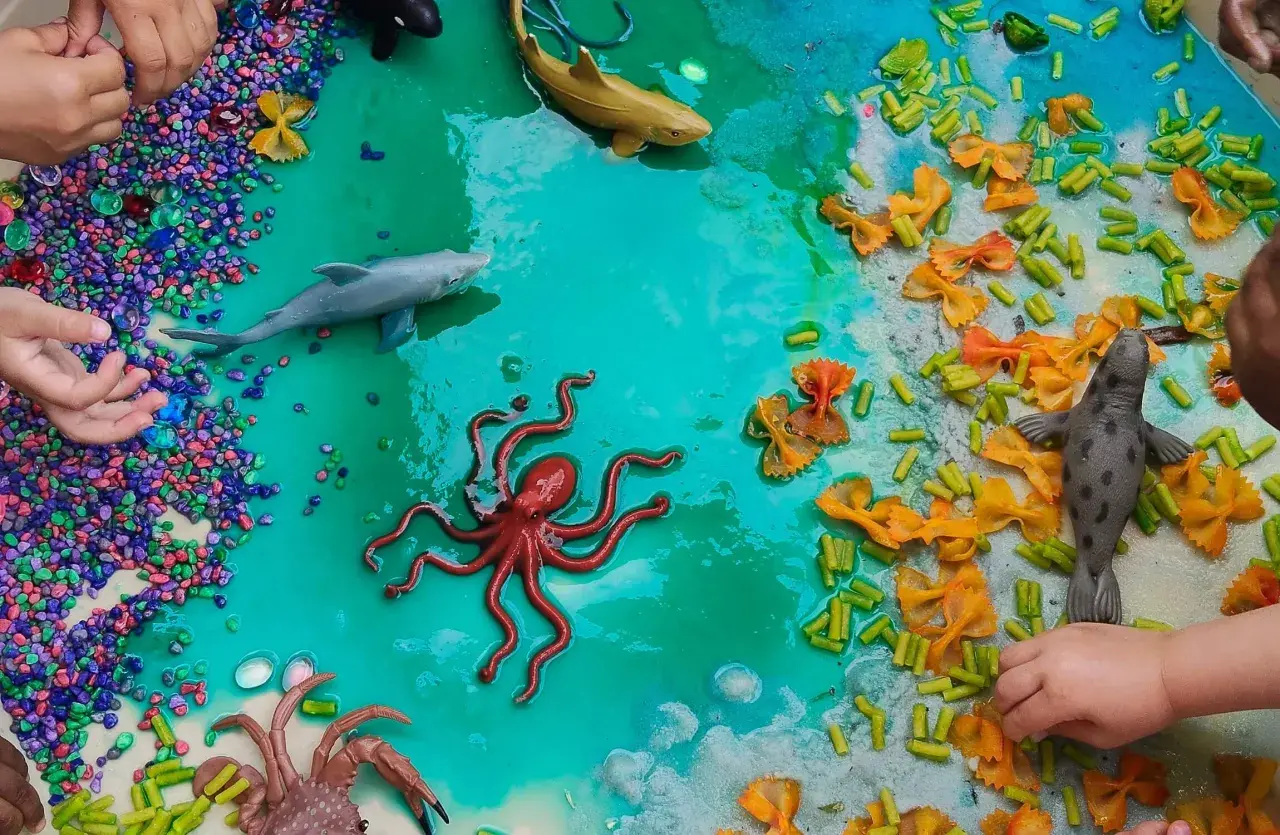
Play at this age works best when it is short, hands-on, and a little messy in the right way. In this guide, I break down sensory activities for 1 year olds that support touch, movement, sound, and early language without turning your home into a project zone. You will get practical ideas, a safety-first setup, and a simple way to choose activities that fit a child who is curious, cautious, or somewhere in between.
The essentials that make toddler sensory play work
- Keep sessions short and focused. For most one-year-olds, 5 to 10 minutes is enough before interest drops.
- Choose big, simple materials that can be explored with hands, feet, eyes, and ears.
- Real-world play usually beats fancy toys at this age. Ordinary objects are often the most engaging.
- Safety matters more than variety. Small parts, water beads, and anything easy to swallow are poor choices for this age.
- One sense at a time is often easier than trying to hit all five senses in one activity.
- The best activities leave room for repetition. Repeating the same play is how toddlers build confidence.
Why sensory play matters in the second year
The second year is a busy developmental stretch. The CDC describes toddlers at this stage as moving around more, exploring new objects, and becoming more aware of themselves and their surroundings. That is exactly why sensory play lands so well now: it gives that curiosity a place to go instead of asking a child to sit still and “learn” in a way that does not match their age.
In my view, sensory play matters for three practical reasons. First, it helps with language, because you can name what the child is touching, hearing, or seeing in real time. Second, it supports motor development, especially reaching, grasping, squeezing, walking, climbing, and balancing. Third, it helps with regulation; some children settle when they get tactile input, while others wake up and focus better after movement.HealthyChildren points out that even simple experiences like grass and bubbles count as valuable sensory input. That is the right mindset here: the goal is not elaborate stimulation, but rich everyday input that feels natural for a one-year-old. Once that is clear, the next question is how to keep the setup safe and calm enough for real use.
How to keep it safe, simple, and low-stress
I keep sensory play intentionally plain at this age. One-year-olds mouth things, dump things, throw things, and sometimes become overwhelmed without much warning, so the setup should assume that behavior rather than fight it.
- Use large items only. If it can fit fully in a child’s mouth, I do not want it in a sensory setup.
- Avoid water beads. HealthyChildren warns that they are a choking hazard for children younger than 3.
- Skip small loose fillers. Beans, popcorn, marbles, beads, and tiny craft pieces are not good choices for this age.
- Keep water shallow. A low tray, a bowl, or bath water under close supervision is enough.
- Stay close. Sensory play at 12 months should be supervised, not set up and forgotten.
- Watch for overload. Turning away, crying, frantic mouthing, or throwing everything usually means the activity needs to stop or shrink.
CDC guidance on choking hazards is useful here too: even after babies start eating independently, choking risks can still exist, so the way food or play materials are prepared still matters. I translate that into one rule: if I would hesitate to leave it on the floor alone with a toddler, it does not belong in a sensory bin.
With the safety frame in place, the activity ideas become much easier to choose and enjoy.

Simple sensory play ideas that work at home
The best activities at this age are usually the ones that look almost too simple. That is a feature, not a flaw. One-year-olds do not need complexity; they need repetition, movement, and something worth reaching for.
| Activity | What it gives | How I would set it up |
|---|---|---|
| Bubble chase | Visual tracking, movement, and cause-and-effect | Blow a few bubbles and let your child pop or follow them. Keep it short and playful. |
| Water cups and spoons | Pouring, splashing, and hand control | Use a shallow tray with two cups and one spoon. Warm or cool water can change the feel without extra effort. |
| Texture walk | Touch awareness and body awareness | Let your child feel grass, a towel, a rug, or a soft blanket with bare feet or hands. |
| Mirror play | Self-recognition and visual attention | Hold up a safe mirror and name body parts, expressions, and movements. |
| Pot-and-spoon music | Sound exploration and rhythm | Give one safe spoon, a pot, or a toddler instrument and let the child experiment with noise. |
| Box-and-basket pull-out play | Fine motor skills and object permanence | Use a basket with soft blocks, scarves, or larger stacking cups for taking items out and putting them back. |
| Leaf and outdoor touch play | Sight, touch, and movement together | Pick up leaves, touch bark, or walk on different ground textures during a supervised outdoor break. |
| Food-texture exploration | Taste, smell, and touch | Use age-appropriate soft foods such as yogurt, mashed fruit, or very soft cooked vegetables if your child is ready and supervised. |
I like this mix because it does not force every activity to be a craft. A bowl of water, a few bubbles, and a basket of safe objects often do more work than expensive sensory toys. The key is to narrate what is happening: “cold water,” “soft towel,” “big splash,” “round bubble.” That simple language links the physical experience to words.
If you want an even easier way to choose, think in terms of senses rather than products. That makes the next step much clearer.
How to match the activity to your child's temperament
Not every one-year-old wants the same kind of sensory input. Some are cautious and observe first. Others are constant movers who need active play to stay engaged. I adjust the activity to the child, not the other way around.
- For cautious children: start with watching, touching one item, or sitting beside you while you demonstrate. Mirror play and books with textures are good entry points.
- For movement seekers: choose activities with crawling, pushing, standing, or chasing. Bubble play, outdoor walks, and box-and-basket play usually work well.
- For children who mouth everything: use edible or large washable materials and keep the setup extremely simple. Food-based sensory play may be a better fit than tiny objects.
- For easily overwhelmed children: reduce noise, use one material at a time, and keep the session short. A single bowl of water is often enough.
- For children who lose interest quickly: rotate the same basic materials in different ways. A cup can become a scoop, a drumstick, a sorter, or a pouring tool.
This is where a lot of parents get tripped up: they think sensory play has to be impressive. In practice, the opposite is usually true. The more a child can predict the material and repeat the action, the more likely the play is to become useful rather than chaotic. That brings me to the difference between indoor, outdoor, and bath-time versions.
Indoor, outdoor, and bath-time versions
I think of sensory play as something that should fit into the day you already have. If it only works on a “perfect activity day,” it is not really practical.
Indoor play when you want low mess
Indoor sensory play works best when the materials are contained and the goal is calm focus. Good options include mirror play, blankets and scarves, stacking cups, soft blocks, board books with textures, and cup-and-spoon sound play. A kitchen mat or tray on the floor can make cleanup easier, but I would still keep the setup light.Outdoor play when a child needs more movement
Outside, the world does most of the work for you. Grass feels different from pavement. Leaves crackle. Wind moves hair and clothing. Bubbles travel farther. That is why outdoor sensory play often lasts longer without needing new toys. It also gives one-year-olds a better chance to move big muscles, which helps with balance and coordination.
Read Also: Beyond Parallel Play - Associative & Cooperative Stages
Bath time when cleanup matters
Bath time is one of the easiest places to build a sensory routine. Pouring cups, squeezing washcloths, floating toys, and moving water from one container to another all support hand control and curiosity. I keep the water shallow, stay within arm’s reach, and treat it as play only when I can watch the child fully.
Once you see how flexible the format is, the next question becomes what to keep around so you can repeat these activities without planning from scratch every time.
What I would keep in the toy basket for easy repeat play
If I were building a small sensory play kit for a one-year-old, I would not buy a lot. I would choose a few items that can be used in multiple ways and that survive rough handling.
- Stacking cups or nesting cups
- Soft blocks
- A shatter-safe mirror
- Board books with textures or flaps
- Two or three bath cups or small pouring containers
- A soft ball that rolls easily
- Scarves, washcloths, or a textured blanket
That list is intentionally small because one-year-olds do not need a crowded toy shelf. They need repeatable materials that invite touching, dropping, filling, shaking, and carrying. In other words, they need toys that can be used as tools, not just things to look at.
If I had to leave you with one rule, it would be this: keep the setup simple enough that your child can explore without you constantly rescuing the moment. When the materials are safe, the session is short, and the activity matches your child’s temperament, sensory play becomes one of the easiest ways to support development without forcing it.
