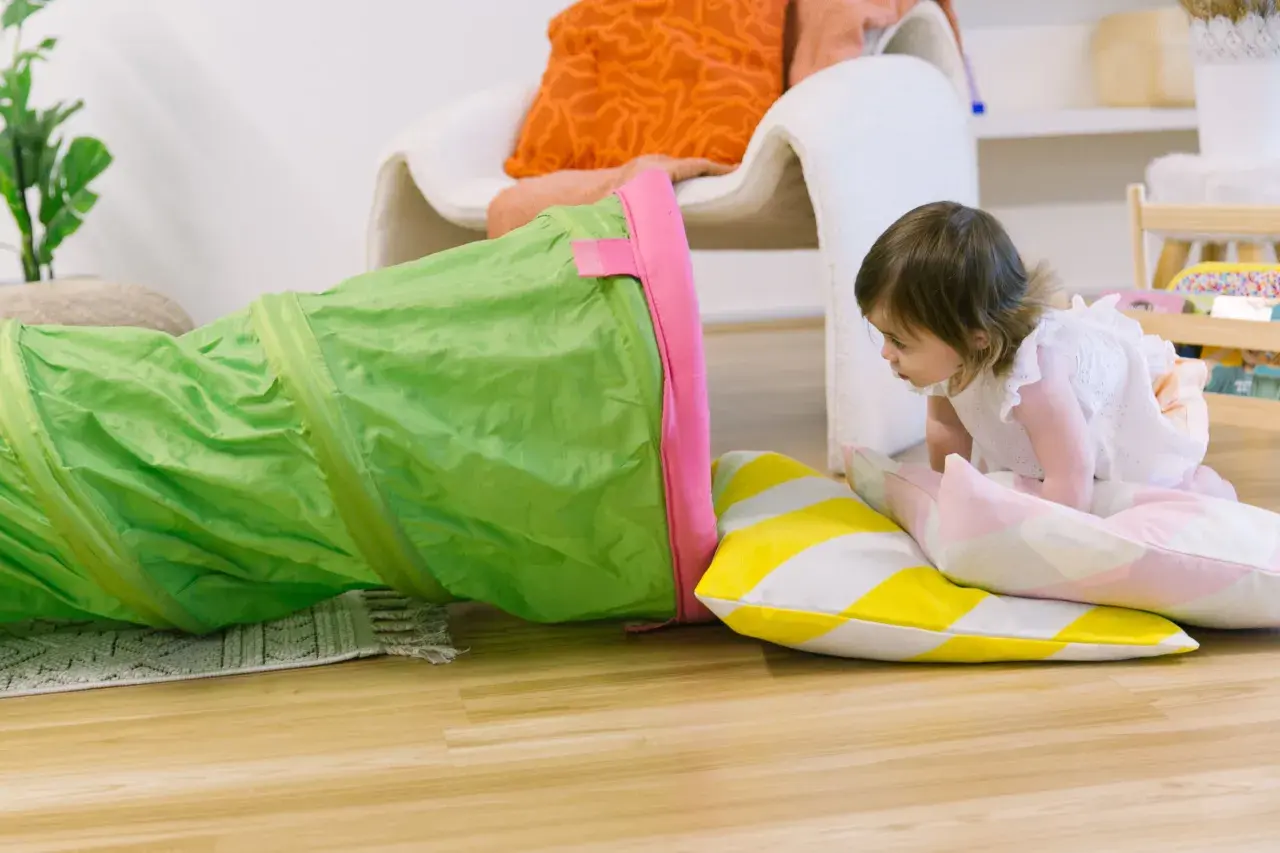
What matters most before you set up climbing play
- Keep it low and stable. Toddlers need success more than height.
- Match the challenge to the child. A 14-month-old and a 3-year-old need very different setups.
- Use climbing to build more than strength. It also supports balance, spatial awareness, planning, and confidence.
- Make the landing zone forgiving. Soft flooring, clear space, and close supervision matter more than fancy equipment.
- Start with simple household pieces. Cushions, low steps, boxes, and foam shapes can work well before you buy anything specialized.
- Choose gear that survives real life. Easy-clean covers, rounded edges, and a wide base make a bigger difference than extra features.
Why climbing is such a strong fit for toddler development
Climbing looks like play, but it is also a compact workout for the whole body. Toddlers are practicing gross motor control every time they pull up, shift weight, step higher, or lower themselves back down. That kind of movement builds leg strength, trunk stability, grip, balance, and the coordination needed to move both sides of the body together.
What makes it especially valuable is that climbing asks a child to solve small problems in real time. Should I put my foot here or there? Can I reach the top without rushing? Where is my body in space right now? That is why climbing play often improves spatial awareness and motor planning, not just muscle tone. I also see a confidence effect quickly: once a toddler realizes, “I can do this on my own,” the energy changes.
The American Academy of Pediatrics encourages varied movement in a safe environment, and climbing fits that idea well when the setup is age-appropriate. The U.S. Physical Activity Guidelines also stress active play throughout the day for children ages 3 to 5, which is a useful reminder that movement should be regular, not occasional. Once you know why climbing matters, the next question is how to scale it to the child you actually have in front of you.
Match the challenge to the child, not the birthday
There is no single “right” climbing level for all toddlers. I plan by ability first, then by age second. A cautious child may need more repetition on a low platform before moving on, while a bold child may need more structure so the play does not get chaotic or unsafe.
| Age range | Good climbing options | What to watch for | What it tends to build |
|---|---|---|---|
| 12 to 18 months | Low cushions, stable floor pillows, one-step climbs with help, tiny ramps | Wobbly balance, fast fatigue, climbing before the child is ready to come down safely | Pulling up, weight shifting, first balance work |
| 18 to 24 months | Foam blocks, short stairs, couch cushions arranged as a low path, mini indoor climbers | Speeding up without control, leaning too far forward, jumping from heights | Coordination, body awareness, controlled stepping |
| 2 to 3 years | Small ladders, playground steps, low climbing domes, stepping stones, short ramps | Overconfidence, racing, copying older kids, ignoring instructions when excited | Planning, sequencing, confidence, endurance |
I use one simple test: if the child can climb up but cannot reliably get down with control, the setup is too advanced for independent play. If the child is bored within seconds, the challenge is too easy. The sweet spot is a little effort with visible success, and that is where the real learning happens. From there, the easiest wins are usually the ones you can build indoors with things you already own.

Indoor climbing ideas that work in real homes
Indoor climbing does not need to look like a gym. Some of the best setups are simple, cheap, and easy to put away. I like indoor options that can be reset fast, because the best movement routine is the one adults will actually repeat on a Tuesday afternoon when everyone is tired.
- Cushion path. Place couch cushions or floor pillows in a low line so your toddler can step, climb, and balance from one to the next. This is useful because it teaches weight transfer without a big fall risk.
- Box mountain. Use sturdy cardboard boxes of different sizes to create a low climb-and-crawl course. It works well for problem solving because the child has to figure out how to move around, not just over, the obstacle.
- Foam climber. Soft modular shapes are one of the cleanest indoor solutions for toddlers who climb often. They are especially helpful if your child loves repetition, because the same piece can become a ramp, step, tunnel, or hill.
- Sturdy step practice. A low, stable step stool or a single bottom stair can be used for supervised step-up and step-down practice. This is not about speed; it is about controlled movement and confidence.
- Blanket tunnel plus climb. Drape a blanket over two stable chairs to create a crawl space, then place a low pillow or cushion at the exit. The combination of crawling and climbing keeps the activity interesting without needing much floor space.
When I set up indoor play, I think about three things before anything else: surface, stability, and sight lines. Hard floors need a buffer, chairs need to stay fixed, and the adult should be able to see the whole route without moving around the house. Once indoor play feels easy to manage, outdoor climbing opens a different set of benefits because the environment itself becomes part of the challenge.
Outdoor and playground options that build confidence
Outside, toddlers get more variety in slope, texture, and distance. That matters more than people sometimes realize. A short hill, a low platform, or a playground staircase all ask the child to adapt to small changes in footing, which is exactly the sort of real-world movement that builds confidence and coordination.
- Low playground steps. These are ideal for toddlers who are still learning how to place feet one at a time without rushing.
- Mini climbing dome. A low dome gives repeated opportunities to grip, step, and shift weight in different directions.
- Small slide with stairs. The climb up is often more valuable than the ride down, because it requires planning and control.
- Grassy mound or gentle slope. Natural terrain teaches balance in a less structured way than indoor equipment does.
- Log or balance beam close to the ground. This is useful when you want a little climbing-adjacent challenge without much height.
Outdoor climbing is also a good place to practice social habits. Toddlers have to wait, watch, and sometimes let another child go first, which can be harder than the physical part. On a practical level, I like outdoor setups because they often reduce the pressure to “do it right” and let the child repeat the movement in a looser, more natural way. That brings us to the question many parents eventually ask: what should you buy, if anything?
How to choose climbing toys and gear without overbuying
If you are shopping for climbing gear, do not start with the biggest or most expensive option. Start with the way your child already plays. A child who uses the couch as a jungle gym may need a soft climber or a stable triangle frame. A child who prefers careful stepping may do better with stepping stones or a low ladder. I usually recommend choosing one core item and then expanding only if the first piece gets used constantly.
| Option | Best for | Main strength | Trade-off |
|---|---|---|---|
| Foam climber | Indoor play, younger toddlers, repeat climbers | Soft landing, easy variation, broad age range | Takes floor space |
| Wooden triangle ladder | Children who like steady structure | Simple, durable, often foldable | Less forgiving if a child moves too fast |
| Stepping stones | Balance and foot placement practice | Flexible, easy to store, useful indoors or out | Not enough on their own for a child who craves a bigger climb |
| Small indoor slide with stairs | Kids who like repetition and cause-and-effect play | Clear up-and-down pattern, easy to understand | Needs careful supervision on the climb up |
| Outdoor climber or dome | Families with yard space or regular park access | More room for movement and varied challenge | Less useful if the child rarely plays outside |
When I inspect climbing gear, I look for a wide base, rounded edges, non-slip feet or backing, and materials that can handle real cleaning. If a product folds, check whether it locks open securely. If it has moving parts, look for pinch points. If it is meant for a specific age, treat that range seriously rather than stretching it because the item “seems fine.” Good gear should make safe play easier, not make you work harder to manage risk. That leads naturally into the mistakes I try to prevent before they start.
Safety mistakes I would avoid every time
Most climbing problems are not dramatic one-off failures. They are small setup errors that repeat until someone gets hurt or discouraged. The good news is that these are easy to fix once you know what to look for.
- Using unstable furniture. A chair, stool, or ottoman that shifts when weight lands on it is not a climbing surface.
- Putting climbing equipment on hard, bare flooring. Even a low fall feels very different on tile or wood than it does on a soft mat or rug.
- Leaving too little open space around the setup. Toddlers need room to wobble, step back, and regain balance.
- Turning climbing into a race. Speed changes the task from controlled movement to impulse.
- Forcing a child higher than they want to go. Hesitation is not failure; it is often good judgment.
- Ignoring footwear and socks. Slippery socks can make a low step unexpectedly risky.
- Assuming the same setup works forever. A structure that was challenging at 18 months may be too easy, or too tempting to jump from, a few months later.
I also pay attention to the child’s mood. If a toddler is overtired, hungry, or frustrated, climbing can go from productive to messy very quickly. That does not mean the activity is wrong; it means the timing is wrong. A short, calm session is far more useful than a long one that ends in tears. Once those risks are under control, the last step is building a routine that keeps the play fresh without turning your home into a permanent obstacle course.
What I would set up first if I were building this from scratch
If I had to begin with the simplest useful setup, I would choose one low indoor climber or a cushion-based course, one outdoor place to practice stairs or a short ladder, and one soft landing area that makes falling less intimidating. That mix gives a toddler enough repetition to learn, enough variation to stay interested, and enough safety margin for the inevitable wobbles.
I would also keep the routine short and predictable. A few minutes of climbing before bath time, a quick playground loop after lunch, or a weekend living-room obstacle course is usually enough. The goal is not to exhaust the child; it is to give the body repeated chances to practice new movement patterns until they start to feel normal. A few well-chosen climbing activities for toddlers can do more for balance, confidence, and coordination than a room full of passive toys ever will.If you are deciding where to start this week, choose one low climb, one soft surface, and one way to supervise closely, then watch how your child uses it before adding more.
