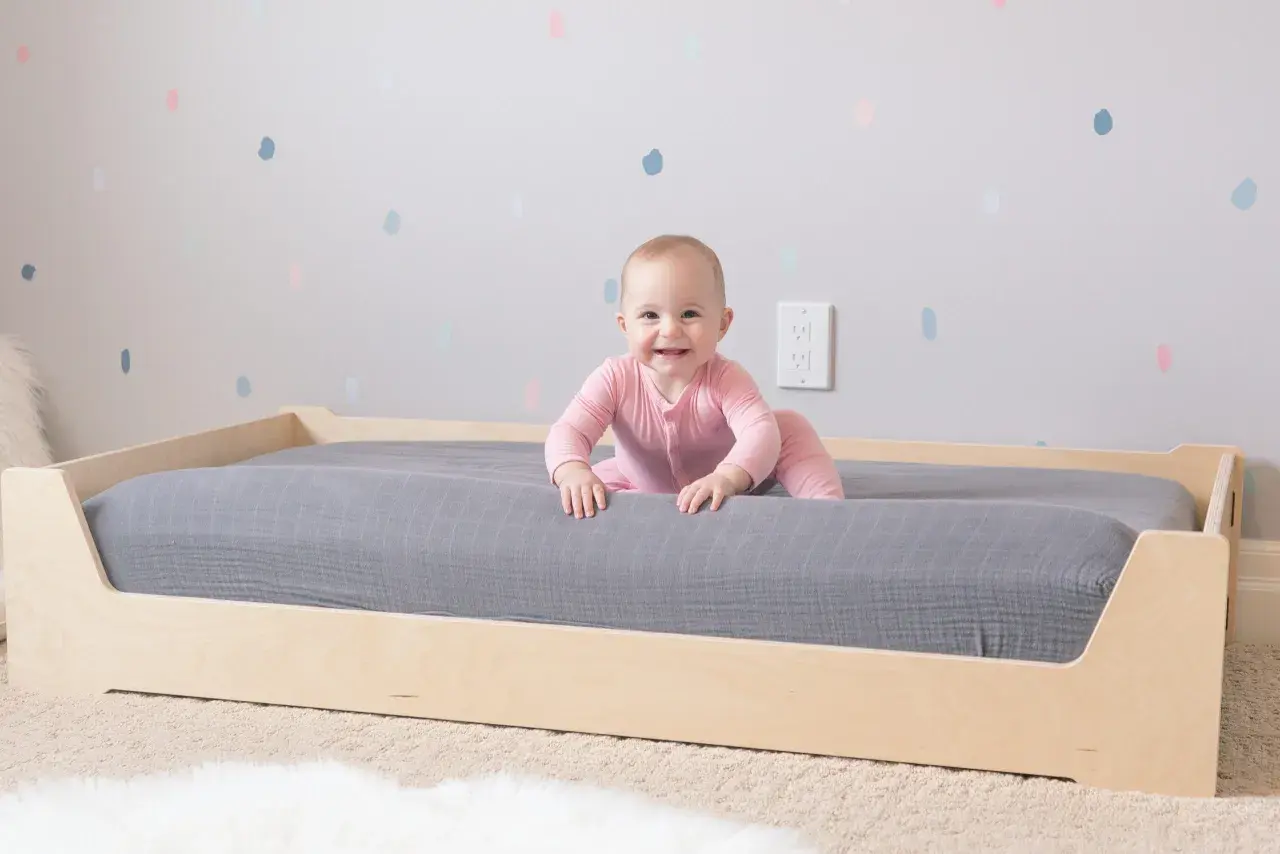
A Montessori bed mattress is less about a trendy label and more about three things: a safe height, firm support, and a fit that makes the child’s room easier to use. In a nursery or toddler room, the right choice depends on age, bed frame, and how much independence you actually want to give the child. I focus on the details that matter in U.S. homes: size, firmness, materials, ventilation, and the safety rules that change the answer for babies versus toddlers.
Key points to get right before you buy
- For babies under 12 months, a CPSC-compliant crib or bassinet with a firm, tight-fitting mattress is the safer choice.
- For a floor bed, low profile and firm support matter more than plush comfort or decorative quilting.
- If the mattress sits in a crib, the fit should be exact; more than a two-finger gap is too loose.
- For many families, a twin-size mattress is the simplest long-term option once the child is old enough for a floor bed.
- Breathability, easy cleaning, and stable edges usually matter more than premium-sounding marketing claims.
What this mattress needs to do in a Montessori setup
I treat the bed style and the mattress as one system. The job is not just to provide a place to sleep, but to support independent in-and-out movement, keep the sleep surface low enough for a child to use safely, and avoid the kind of softness that turns a bed into a sinkhole.
That is why I do not think of this as a special category of mattress. In practice, it is a regular sleep surface chosen for a very specific use case: a child’s room where the child can access the bed without climbing, and where the mattress still holds its shape after daily use. The best options tend to be firm, low-profile, easy to clean, and not overly heavy.
Once you think of it that way, the next question becomes straightforward: what size actually fits the room and the child’s stage? That is where most buying mistakes start.

Which size makes sense for the room
The right size depends on whether you are setting up a crib-based sleep space, a compact floor bed, or a room that needs to grow with the child. For infants, the mattress has to match the crib exactly. For toddlers, I usually look at low floor-bed setups in crib, twin, or sometimes full size, depending on room dimensions and how long the family wants to keep the setup.
| Size | Typical dimensions | Best for | What to watch |
|---|---|---|---|
| Full-size crib mattress | 52 3/8 x 28 inches, with a small manufacturing tolerance | Infants and younger babies in a safety-approved crib | It must fit the crib tightly; gaps are a safety problem |
| Mini crib or non-full-size crib mattress | Varies by model | Small nurseries, travel-friendly rooms, temporary setups | Measure the crib itself, not just the product listing |
| Twin mattress | 38 x 75 inches | Toddler floor beds and rooms that should last for years | Needs clear floor space and a hazard-free room layout |
| Full mattress | 54 x 75 inches | Older toddlers, siblings sharing a room, or a long-term bed | Works only if the room is large enough to keep the path clear |
For a crib, the fit test is simple: if the mattress shifts, bows, or leaves obvious gaps, it is the wrong match. For a floor bed, the tradeoff is different. Bigger gives you a longer runway, but it also takes more room and can make the bed feel less toddler-friendly. I usually lean twin when the child is moving out of a crib and the room can handle the footprint without crowding every other piece of furniture.
That size decision leads directly into firmness, because a mattress can be the right dimensions and still be wrong if it is too soft or too deep.
Firmness and thickness are where most mistakes happen
If I had to simplify the whole topic to one rule, it would be this: firm beats plush. The American Academy of Pediatrics is clear that infants should sleep on a firm, flat surface, and that advice still shapes the way I think about toddler beds. A surface that indents deeply under body weight is usually the wrong direction for a child’s sleep space.
For Montessori-style floor beds, thickness usually lands in a practical range of about 4 to 8 inches. Thinner can work if the bed frame is low and the child needs easy access. Thicker can work if the mattress still stays stable, but once a mattress starts looking and feeling like a pillow-top, it is usually the wrong choice for this setup.
- Too soft means the child sinks in, the edges collapse, and climbing in and out gets harder.
- Too thick can make a low bed sit higher than intended and reduce the independence the setup is supposed to support.
- Too thin can feel harsh, bottom out, or simply become uncomfortable after a short time.
I also pay attention to edge support. A mattress with weak edges tends to curl or flare, which makes the sleep surface feel unstable. A mattress that recovers quickly after pressure is usually a better fit than one that stays compressed. If the child is old enough to move around freely, that steady response matters as much as raw softness.
From there, the material choice becomes more than a comfort preference. It affects heat, cleanup, weight, and how long the mattress stays usable.
Materials that hold up in daily use
For a nursery or toddler room, I care less about labels and more about behavior. Does the mattress stay flat? Does it trap heat? Can I clean it quickly after a spill? Will it still look and feel stable after a year of use?
- Innerspring or hybrid builds tend to offer the most responsive support and decent airflow. I like them when the child needs a firmer feel and the room gets warm.
- Firm foam is usually lighter and easier to move. It can be a good value, but I avoid versions that feel mushy or sleep hot.
- Latex or latex-blend constructions often feel resilient and breathable. They can be a strong option if you want durability, though they are often heavier and more expensive.
- Cotton or wool-style futon builds can work well for a low-profile bed if they are dense enough to stay supportive. The upside is a very low, simple look; the downside is that they need more attention to airing and moisture control.
Whatever the construction, I prefer a removable cover or a wipeable surface, especially in a toddler room where spills are not occasional, they are routine. A waterproof protector can help, but I do not want one so crinkly or hot that it ruins the feel of the mattress. The best version is the one you forget about until cleanup day.
In the U.S., I also expect a mattress sold for home use to meet the basic federal flammability requirements. That is table stakes, not a premium feature. The part families usually overlook is that the mattress choice affects safety only when the whole sleep setup is considered, which brings me to the part that matters most.
Safety details around the mattress and bed
For infants, the answer is simple and not negotiable: the sleep surface should be firm, flat, and bare except for a fitted sheet. The AAP’s guidance also makes one point especially relevant here: if a baby falls asleep somewhere that is not designed for sleep, they should be moved to an approved sleep surface as soon as possible. A floor bed is not a shortcut around that rule.
The CPSC adds a useful practical test for crib use: the mattress should fit so tightly that you cannot leave a meaningful gap between the mattress and the crib sides. If you can fit more than two fingers between the mattress and the frame, the combination is not right.
- Use only a fitted sheet that matches the mattress size.
- Keep pillows, bumpers, loose blankets, and stuffed items out of infant sleep spaces.
- Remove and discard plastic wrap immediately after delivery.
- Keep the mattress away from wall gaps that could trap a child.
- If the mattress sits directly on the floor, air it out and clean underneath it regularly.
- Skip toppers and soft add-ons that make the bed plusher than it should be.
For toddlers, the safety conversation shifts from suffocation risk to room design. That means cords, furniture edges, window coverings, and open shelves matter more than decorative bedding. A good mattress is only part of the system, and I would rather have a plain, well-sized mattress in a safe room than a premium one in a room full of hazards.
Once those basics are in place, the buying decision becomes much simpler than most product pages make it sound.
What I would buy first if the room has to last
If the child is under 12 months, I would not treat a floor-bed mattress as the goal. I would buy a crib mattress that matches the crib exactly, keep it firm, and leave the sleep space bare. That is the cleanest answer for infant safety and the least complicated path for parents.
If the child is a toddler and the room is modest in size, I would usually choose a firm twin mattress on a very low frame or a floor-bed base with some ventilation underneath. That gives the child room to grow without forcing a second mattress purchase soon after the transition.
If the room is small, I would resist the urge to overbuy. A compact, well-fitting mattress with a clean cover is better than a large one that crowds the room and creates clutter around the bed. If the room is larger and the family wants a longer runway, full size can be smart, but only if the layout still leaves safe walking space and easy access on all sides.
My shortcut is simple: choose the correct size first, then the firmness, then the material. The order matters because a beautiful mattress that is too soft or too bulky will not work in a Montessori-style room. A plain, stable, easy-to-clean mattress usually wins, and it keeps winning long after the marketing claims fade.
That is the version I trust: a mattress that fits the bed, supports the child, and does not ask the rest of the room to work harder than it should.
