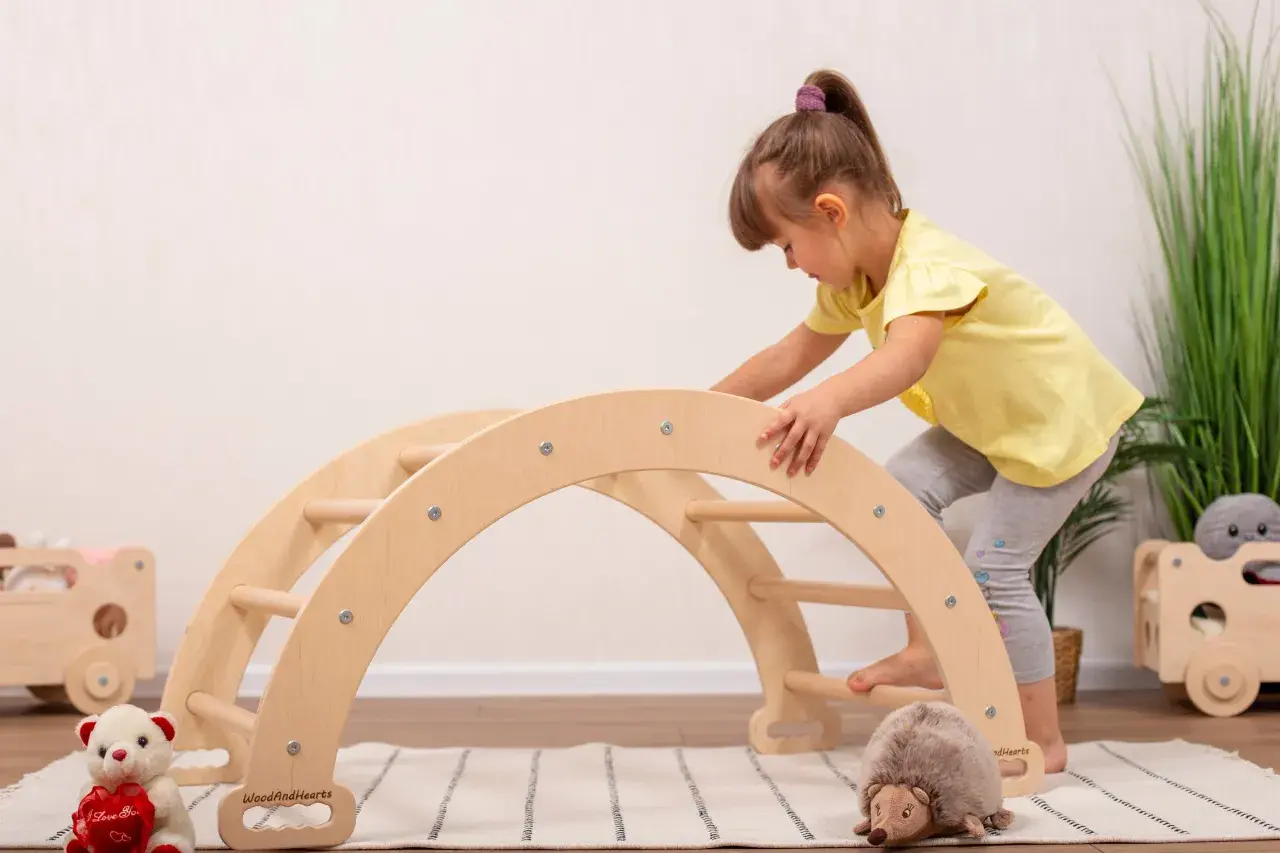
Big-muscle play builds strength, balance, and coordination in everyday movement
- Gross motor play works the large muscles in the trunk, legs, shoulders, and arms.
- Locomotor, stability, and object-control skills cover most of the useful movement patterns.
- The best activity is the one that is safe, slightly challenging, and easy to repeat.
- Short bursts of play usually work better than long formal drills.
- Indoor space, outdoor room, and toy choice all change what works best.
What gross motor play actually builds
I usually divide movement skills into three buckets because it keeps the choices honest: locomotor skills, stability, and object control. Locomotor means moving the body from place to place; stability is the ability to control the body while it is still or shifting; object control is throwing, catching, kicking, hitting, or rolling something with purpose.
| Skill area | What it looks like | Simple example |
|---|---|---|
| Locomotor | Traveling through space | Walking, running, hopping, jumping, skipping |
| Stability | Keeping the body steady | Balancing on one foot, squatting, stopping cleanly |
| Object control | Managing a ball or other item | Throwing, catching, kicking, rolling, striking |
| Bilateral coordination | Both sides of the body working together | Climbing stairs, pedaling, jumping jacks, crawling |
That mix matters because real movement is rarely one skill at a time. A child chasing a ball has to run, stop, turn, judge distance, and often balance on one leg for a split second. The CDC and HealthyChildren both treat those movements as part of broader developmental milestones, which is the right lens: you are building a pattern of control, not chasing a perfect performance. Once those buckets are clear, it becomes much easier to choose examples that fit a child’s age and attention span.
Age-by-age examples that fit real homes
I like to organize examples by what a child can do today, not by what a toy box suggests. The table below keeps the focus on realistic play, with enough stretch to matter but not so much challenge that the child gives up in ten seconds.
| Age band | Good examples | What they develop |
|---|---|---|
| 0 to 12 months | Tummy time, rolling, reaching, crawling through a tunnel, pulling to stand, cruising along furniture | Head and trunk control, early weight bearing, coordination, early balance |
| 1 to 2 years | Marching, bubble chasing, pushing a ride-on, climbing low steps with help, kicking a large ball, dancing to music | Balance, gait, leg power, directional changes, rhythm |
| 3 to 4 years | Hopping, jumping off a low step, tricycle riding, throwing overhand, catching a bounced ball, animal walks | Timing, object control, bilateral coordination, body awareness |
| 5 years and up | Hopscotch, jump rope, scooter rides, relay games, obstacle courses, trail walks | Stamina, rhythm, planning, faster reactions, stronger coordination |
If a child only manages the first half of a row, that is still useful. I would rather see twenty good repetitions of a simple movement than two dramatic attempts at something too advanced. The next question is where those repetitions will happen most naturally.
Indoor movement ideas that work in a small space
I like indoor movement best when it needs one patch of floor and very little setup. That keeps the activity repeatable on a rainy day, after school, or in a nursery room where furniture cannot disappear.
- Tape-line balance walk. A strip of painter’s tape becomes a beam for heel-to-toe walking, sideways steps, or tiptoe marching.
- Pillow path. Stepping from pillow to pillow builds planning, balance, and leg strength without needing a full playroom.
- Animal walks. Bear crawls, crab walks, and frog jumps turn core work into something children will actually repeat.
- Balloon volleyball. The slower pace gives beginners time to track the balloon and reach across the body.
- Freeze dance. This adds stopping, starting, and self-control, not just wiggling around.
- Push-and-carry chores. Carrying laundry, pushing a toy bin, or helping move light boxes gives real-world strength work.
Indoor play works well because it strips out a lot of friction. If the setup is fast, the child gets more practice and you get less resistance from the room itself. Once the weather opens up, the same basic skills can stretch much further outdoors.

Outdoor play gives children the widest motor practice
Outdoor play is where gross motor development usually gets the broadest workout. Children can change speed, travel farther, climb higher, and use uneven ground, which asks more of the body than a hallway ever will.
- Playground climbing. Ladders, low walls, and stepping platforms build upper-body strength, grip, and confidence with height.
- Swings and slides. These are not just fun extras; they challenge balance, timing, and body control in motion.
- Running games. Chase, tag, and simple relay races teach speed changes, stopping, and direction control.
- Ball play. Kickball, soccer with a soft ball, and catch games improve object control and coordination.
- Chalk trails and hopscotch. These add stepping patterns, jumping, and visual targets without needing special equipment.
- Scooters, tricycles, and balance bikes. These add propulsion, steering, and rhythm, which is why they are so useful for older toddlers and preschoolers.
I especially like outdoor games that switch between fast and slow, because that is where balance and self-control meet. A child who can run, stop, turn, and start again is practicing much more than speed. Good outdoor play is obvious once you see it, but the real trick is matching the challenge to the child instead of forcing every child into the same game.
How to choose the right challenge without overcoaching
The best activity is the one that sits in the narrow zone between “too easy” and “too hard.” If a child can do it instantly every time, it may not be offering much practice; if the child avoids it after one or two tries, it may be too hard or uncomfortable.
| Signal | What it usually means | What I would do |
|---|---|---|
| Succeeds instantly and gets bored | The task is too easy | Add a turn, a target, a balance pause, or a rule change |
| Avoids it quickly | The task is too hard or feels awkward | Simplify the route, slow the pace, or shorten the round |
| Repeats it with a grin | The challenge is in the sweet spot | Keep going and vary only one piece at a time |
| Gets clumsy when tired | Fatigue is taking over | Stop before form falls apart |
The usual mistakes are predictable. Adults overtalk the game, overcorrect every movement, choose only one kind of activity, or make the challenge look impressive instead of age-appropriate. I also watch the environment: slippery socks, hard landings, and cluttered floors turn movement into a safety problem fast. If a child regularly struggles with rolling, sitting, standing, or walking, or seems unusually stiff or floppy, I would bring that up with a pediatrician instead of trying to solve it through more play alone. The right toy can make the safe, repeatable version much easier to keep in rotation.
Toys and everyday items that keep movement easy to repeat
For a site that covers toys and nursery essentials, this is where the topic gets practical. I look for items that invite movement without demanding that the child understand a rule book first.
| Item | Good uses | Why it works |
|---|---|---|
| Soft ball or beach ball | Roll, throw, kick, bounce | Flexible across ages and easy to scale up or down |
| Pop-up tunnel | Crawl through, scoot, hide-and-seek | Builds core strength, spatial awareness, and confidence |
| Ride-on toy or scooter | Push, steer, propel | Trains leg power, coordination, and direction control |
| Foam blocks or stepping stones | Step paths, balance games, small jumps | Supports foot placement, planning, and controlled landings |
| Beanbags | Toss into buckets, carry on a head or hand, pass side to side | Gives object-control practice without the pressure of catching a fast ball |
| Jump rope or chalk | Jump patterns, hopscotch, line games | Builds rhythm, timing, and bilateral coordination |
I prefer open-ended pieces over single-purpose gadgets. A ball, a tunnel, and a few stepping markers can cover far more movement patterns than a toy that only lights up and makes noise, and they tend to stay useful as the child gets stronger. That is the kind of purchase that earns its space in a family room or play corner.
A simple weekly rhythm that keeps progress moving
If I were building a home routine from scratch, I would keep it simple: one locomotor game, one balance task, and one object-control activity, repeated often enough that the child starts to feel the pattern. Five to 15 minutes is usually enough for those bursts, especially when the child is young or easily distracted.
The point is not to create a perfect schedule. The point is to make movement ordinary enough that it shows up in daily life: hallway races after dinner, scooter time before the park closes, one song of freeze dance while the kettle boils.
If movement remains unusually hard, painful, or far outside what seems typical for the child’s age, I would stop treating it as a play-only issue and get a pediatric opinion. Otherwise, the best answer is still the simplest one: keep the games short, varied, and worth repeating.
