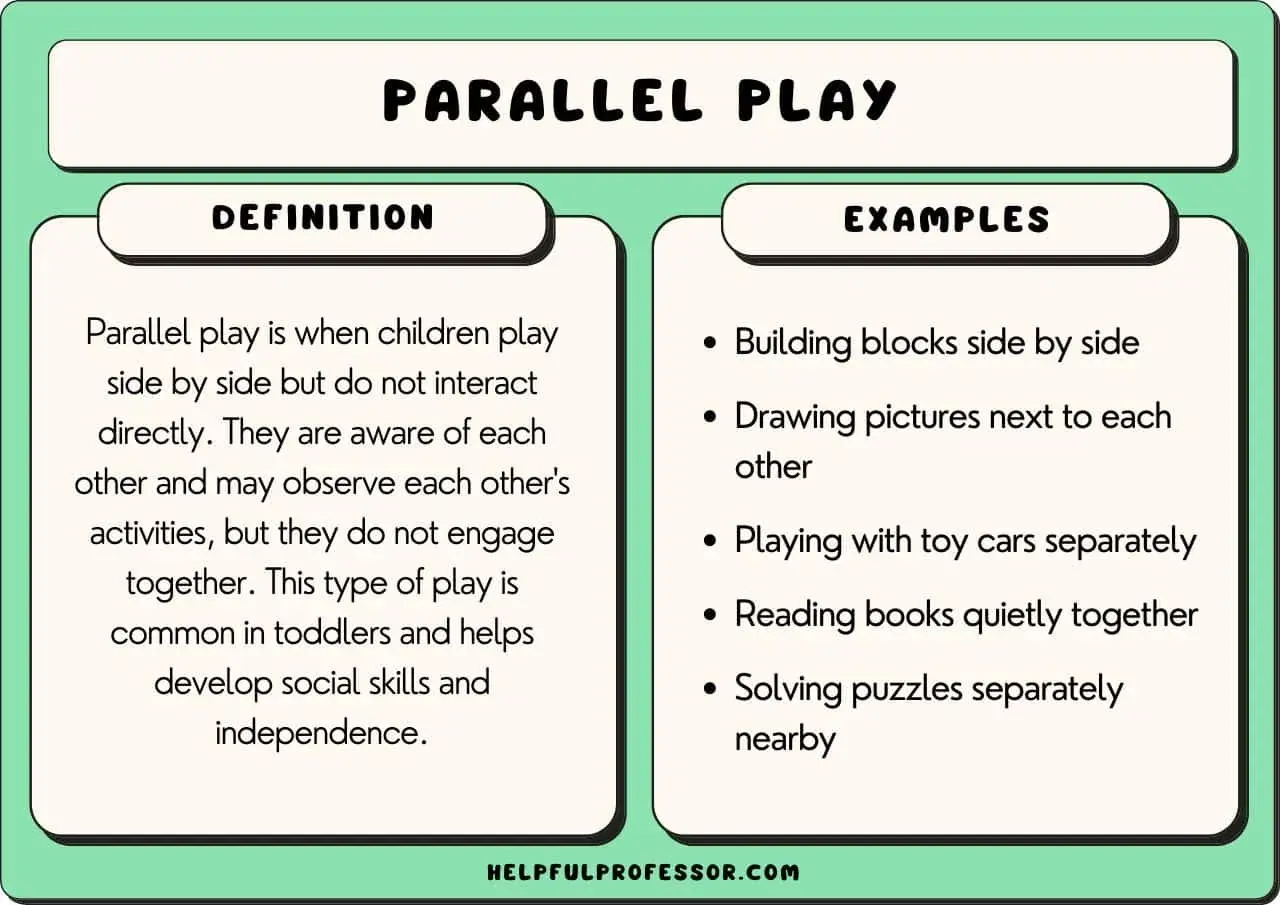
Parallel play is one of those early childhood stages that looks simple from the outside but does a lot of work underneath. The short answer to when does parallel play start is around age 2, although the range is wider than many parents expect. In practice, it is the stage where children play alongside others without direct interaction, building comfort, observation skills, and the first real bridge toward social play.
The quick read on parallel play
- Most children start showing parallel play around age 2, with a normal window that can begin a little earlier or later.
- It means children are playing beside each other, not really with each other.
- This stage usually sits between solitary or onlooker play and the more interactive stages that follow.
- It is normal for a child to seem focused on their own toy while still watching nearby peers.
- Forcing sharing usually backfires; calm proximity and simple setup changes work better.
- By the time children are around 3 to 4, many begin moving toward more social, loosely coordinated play.
What parallel play is and why it matters
Parallel play is not a sign that a child is antisocial, detached, or “behind.” It is a normal stage in which a child is comfortable being near other children but is not yet ready to coordinate a shared game. I think of it as social practice without pressure: the child gets used to peer presence, watches what others are doing, and often copies actions without needing direct interaction.
This stage matters because it helps children build the basics that later make cooperation possible. They learn to tolerate nearby movement, notice routines, observe turn-taking from a distance, and experiment with the idea that other children can occupy the same space safely. That may sound small, but it is a big developmental step. The next question is timing, because the window is broader than a single birthday.
The age range that is most typical
In most children, parallel play shows up around age 2. The CDC’s 30-month milestone checklist includes playing next to other children and sometimes with them, while HSE places parallel play most often between 2 and 3 years old. That is the practical range I would keep in mind: not a hard cutoff, but a broad window where side-by-side play becomes common.
Some children lean into it a little earlier, especially if they spend time around siblings, cousins, or other toddlers. Others stay in solitary or onlooker play longer and then move into parallel play later. Temperament matters. So do language development, the size of the group, the setting, and whether the child feels comfortable. A quiet child in a new room may cling to solo play even if they are perfectly on track. Once you know the age range, the real skill is spotting it in everyday play.What it looks like in everyday play
Parallel play is easiest to recognize when you stop looking for direct interaction and start looking for shared space with separate goals. Two children might sit near each other with blocks, each building a different tower. They may both be drawing at a table, using different colors and making separate pictures. In a sandbox, one child may shovel, another may pour, and neither one is trying to organize the other’s game.
I also watch for small signs of awareness. A child may glance over, imitate a motion, move closer, or choose the same toy type. That is still parallel play. The point is not absence of social awareness; it is the absence of coordinated play. Children at this stage often look busy, not unconnected. That difference becomes clearer when you compare it with the other play stages.
How it differs from the other play stages
Parents often mix up parallel play with solitary, onlooker, associative, and cooperative play. The boundaries are not always sharp, but the differences are useful.
| Stage | Typical age | What you usually see | Social meaning |
|---|---|---|---|
| Onlooker play | Around 2 years | The child watches other children but does not join in | Observation comes before participation |
| Parallel play | Around 2 to 3 years | The child plays beside others with little or no direct interaction | Comfort with peers and shared space begins to build |
| Associative play | Around 3 to 5 years | Children talk, borrow materials, and loosely influence each other’s play | Interaction starts, but the play is still not fully organized |
| Cooperative play | Around 4 to 6 years | Children work toward a shared goal, follow roles, and take turns | True group play becomes possible |
These ages overlap because children do not climb a ladder in perfect order. A child can show parallel play at home, associative play at daycare, and revert to quieter side-by-side play when tired or shy. Once you can tell the stages apart, supporting the right one becomes much easier.
How to encourage it without forcing it
My advice is usually simple: make side-by-side play easy, and stop trying to rush it into group play. Children at this age do not need constant coaching to share every toy. They need a setup that lets them feel safe near other children without unnecessary friction.
- Use duplicate toys when possible, especially blocks, crayons, play dough, toy cars, and pretend-food sets.
- Choose open-ended toys that can be used in many ways, so children are not fighting over one fixed “right” use.
- Keep playgroups small at first. Two toddlers often manage parallel play better than six.
- Stay nearby and narrate lightly: “You both have trucks,” or “You’re building next to each other.”
- Let children watch before joining. Observation is part of the process, not wasted time.
- Skip the pressure to share on command. At this stage, many children are still learning what sharing even means.
What tends to work best is calm proximity, not adult enthusiasm that keeps trying to manufacture teamwork. A toddler will usually move toward interaction when they are ready, not when an adult keeps insisting on it. Even with good support, there are moments when the pattern deserves a second look.
When I would pay closer attention
I would not worry about parallel play by itself. A child who prefers side-by-side play at 2 or even 3 is usually showing normal development. What I do watch for is the broader picture: whether the child ever notices peers, imitates others, tolerates group settings, or gradually moves toward more interaction over time.
It is worth bringing up with a pediatrician if a child seems to avoid all peer presence, shows very little imitation, has limited interest in what others are doing, or seems to lose social or language skills they previously had. I would also pay attention if there is little change by preschool age, especially if communication is delayed too. One stage alone does not diagnose anything, but the pattern across several areas matters. That brings us to the stage that usually follows, and why many children do not move through it in a straight line.
What comes after side-by-side play
After parallel play, many children begin to shift toward associative play. This is where the social pieces get a little richer: children talk more, share materials occasionally, and let one another influence the game. They may still have different ideas, and that is normal. The important change is that the play is no longer only happening next to someone else; it starts to become connected.
From there, cooperative play grows in. That is the stage where children can manage a shared goal, whether they are building a tower together, playing house, or taking turns in a simple game. I like to think of parallel play as a rehearsal space. It gives children a low-stakes way to learn that other people can be nearby, interesting, and safe before they are ready to coordinate, negotiate, and collaborate. If you keep that lens, the stage feels less like a delay and more like a useful foundation.
For parents, the most practical takeaway is this: parallel play usually starts around age 2, it often looks quieter than people expect, and it becomes much easier to support when you stop forcing interaction and start shaping the environment. Side-by-side play is not the end goal, but it is an important step on the way to real peer connection.
