Choosing between a mini crib and a regular crib is mostly a space-and-timeline decision. I look at footprint, how long the crib will actually be useful, how easy the mattress and sheets will be to replace, and whether the model fits safe-sleep rules without compromises. This guide breaks down those tradeoffs so you can pick the right setup for a nursery, bedroom, or apartment without buying twice.
The right crib is the one that fits your room, your routine, and your timeline
- Mini cribs save space, but many models are still nursery furniture, not true travel gear.
- Regular cribs give you more room for growth and usually make mattress shopping easier.
- Safety depends on a firm, tight-fitting mattress and a crib that meets current standards, not on size alone.
- At the common sizes, a mini crib uses about 37% less floor area than a full-size crib.
- If travel is the main goal, a play yard often makes more sense than either crib.

What a mini crib and a regular crib actually are
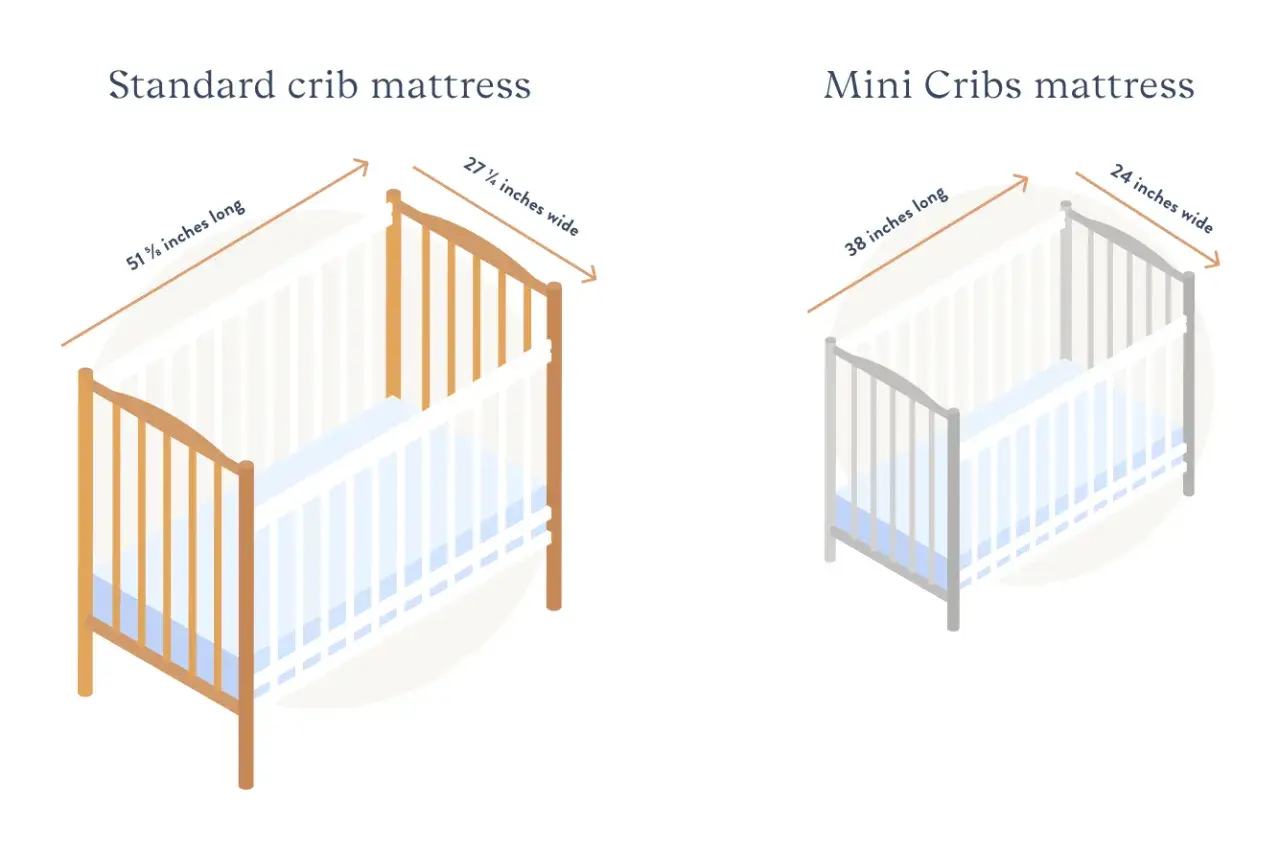
A mini crib is a smaller infant crib, often built around 24 by 38 inches, while a regular crib is the full-size version most people picture first, usually around 28 by 52 inches. The important detail is that a smaller crib is not automatically a portable crib. Some fold or roll, some do not, and that difference changes how useful they are in a real home.
I also keep one distinction clear: a mini crib is not the same thing as a play yard. If the bed needs to move often, the folding mechanism, wheel locks, and overall weight matter as much as the footprint. Once that is clear, the next question is how much floor space you can actually spare.
How much space each one really takes
This is where the decision gets practical. At the common sizes, a mini crib covers about 912 square inches of floor area, while a regular crib covers about 1,456 square inches. That means the smaller crib uses roughly 37% less floor space, which is a real advantage in a bedroom, apartment, or shared nursery.
| Criterion | Mini crib | Regular crib | What it means |
|---|---|---|---|
| Typical size | About 24 x 38 in | About 28 x 52 in | The standard crib gives a baby more stretch-out room. |
| Floor space | Smaller footprint | Larger footprint | The mini version is easier to fit beside a bed or dresser. |
| Mobility | Some models fold or have wheels | Usually heavier and stays put | Portability depends on the model, not just the name. |
| Budget | Often lower upfront | Often higher upfront | The cheaper sticker price can be misleading if you replace it sooner. |
| Shopping for bedding | More model-specific | More standardized | Regular crib bedding is usually easier to find and replace. |
When I measure a room, I do not stop at the crib itself. I leave space for walking around the bed, changing sheets, opening drawers, and reaching the mattress height adjustment without knocking into furniture. From there, safe fit matters more than whether the crib looks compact in photos.
Safety, mattress fit, and the rules that matter
I trust current CPSC and AAP safe-sleep guidance more than any product photo. The mattress should be firm, flat, and designed for that exact crib, with no gaps along the sides or ends. Use a fitted sheet only, and keep pillows, blankets, bumpers, and stuffed items out of the sleep space.
- Slat spacing should not exceed 2 3/8 inches.
- If you can fit more than two fingers between the mattress and crib sides, the fit is too loose.
- Do not assume a mini crib mattress will fit another mini crib.
- Never use a broken crib, a crib with missing hardware, or one with cracked slats.
- If the crib is secondhand, check recall status before you use it.
This is where mini cribs can be slightly trickier. The larger crib size is standardized, so replacement mattresses and sheets are easier to source. Mini crib mattresses are more model-specific, which means "close enough" is not good enough. After safety, the next real divider is how long the crib will still make sense.
How long each crib usually stays useful
As a rule of thumb, many families get about 18 to 24 months out of a mini crib, sometimes less if the baby is tall or starts pulling up early. A regular crib usually lasts longer, and many full-size models convert into a toddler bed or daybed, which can stretch the purchase much further. I would not shop by age alone, though; once the child starts climbing or the rail height becomes awkward, the crib has outlived its safe stage.
That extra runway is the main reason standard cribs often win for families who have the space. Some mini cribs also convert, but that is a model-by-model bonus, not something I would assume. That naturally leads to which home setup each crib serves best.
Which crib works best in real homes
My rule is simple: start with the room, then the routine, then the furniture. If the crib has to live in your bedroom for the first six months, a mini crib can be the easier fit. If you have a separate nursery and want fewer transitions, a regular crib usually gives better long-term value.
- Small apartment or shared bedroom: mini crib.
- Average nursery with no space pressure: regular crib.
- Grandparents' house or secondary sleep space: mini crib only if it will stay set up there.
- Frequent travel: play yard is often the smarter buy.
I like to separate "compact" from "portable" because they are not the same thing. A compact crib can be excellent in one room and awkward to move; a true portable crib makes sense only if you will actually shift it around. Before you click buy, it is worth avoiding the mistakes that make a good crib feel expensive.
Mistakes that make the wrong crib feel worse than it is
Most bad crib purchases come from avoidable decisions. The biggest one is buying before measuring the room, doorway, and nearby furniture. The second is assuming every smaller crib folds or rolls just because it is small. The third is forgetting to check mattress and sheet availability until after the crib arrives.
- Buying on looks instead of footprint.
- Ignoring whether the mattress is easy to replace.
- Using a mattress that leaves gaps or feels soft.
- Buying secondhand without checking the hardware, instructions, and recall history.
- Choosing a mini crib when what you really need is a long-term sleep setup.
The cheapest crib is not the one with the lowest sticker price. It is the one that still works when the baby gets bigger, the room gets busier, and bedtime becomes a daily routine instead of a nursery project. That leaves the simplest real-world rule for choosing.
The crib choice that works best in three common setups
| Setup | Better fit | Why |
|---|---|---|
| Small apartment or shared bedroom | Mini crib | It saves space and makes room-sharing easier. |
| Regular nursery with enough space | Regular crib | It lasts longer and is easier to outfit with bedding. |
| Grandparents' house or extra sleep space | Mini crib or play yard | Choose mini only if you want a real crib to stay in place; choose a play yard if portability matters more. |
If I had to reduce the whole decision to one line, I would say this: choose the smallest crib that still gives you a tight mattress fit, enough room to use it comfortably, and enough growth runway to avoid an unnecessary second purchase. When space is tight, the mini crib earns its keep fast; when space is not the problem, the standard crib usually wins on convenience over time.
