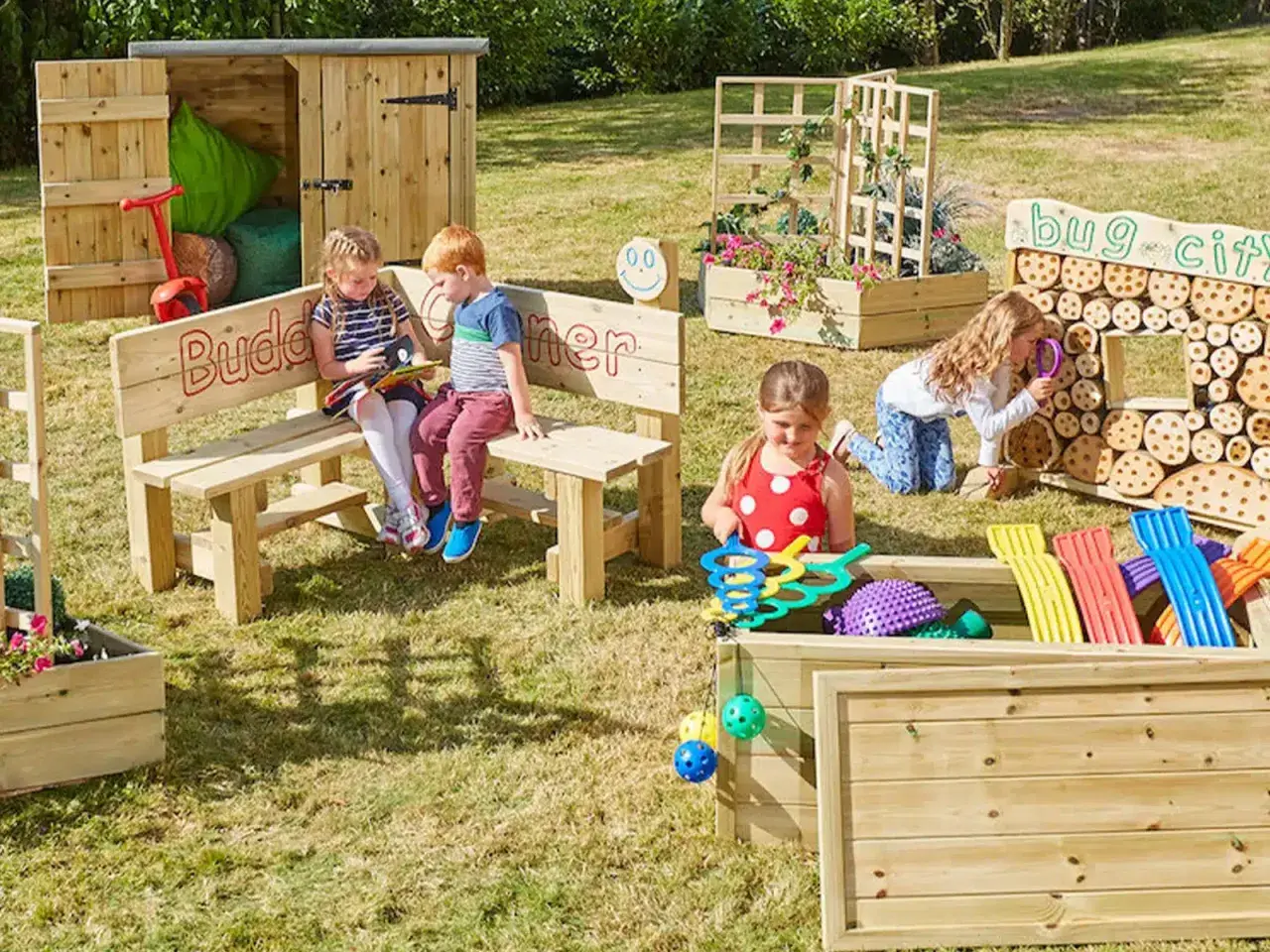
A Montessori garden works best as a prepared outdoor environment, not as decorative landscaping. It gives children real work to do: carrying water, planting seeds, watching growth, cleaning tools, and learning how to care for something living. In this guide, I focus on the practical decisions that matter in a nursery or playroom setting, especially when space, safety, and day-to-day maintenance all matter.
The essential idea in one place
- Keep the space child-sized, ordered, and purposeful, not packed with random toys.
- Use real tools, natural materials, and a small number of reliable plants.
- Design for independence first: clear paths, reachable water, and simple storage.
- Offer activities that match age and motor skill, from scooping and watering to pruning and harvesting.
- Plan for the realities of a U.S. yard or patio, including sun, heat, drainage, and seasonal changes.
- Expect the space to evolve as children grow; the best version is the one they can actually use.
What a Montessori garden is really for
A Montessori garden is not about making a backyard look perfect. It is about giving children a place where they can do meaningful, repeatable work and see the results with their own eyes. That is why the strongest versions of this idea usually include watering, planting, harvesting, sweeping, and observing rather than passive decoration or oversized playground equipment.
When I think about the purpose of this kind of space, I think in four layers. First, it supports practical life, because children learn best when their hands are busy with real tasks. Second, it supports sensory development through soil, water, leaves, textures, scents, and movement. Third, it builds responsibility because plants do not respond to shortcuts. Fourth, it gives children a place to practice independence in a setting that still feels calm and manageable.
That is also why the outdoor area matters so much in nursery and playroom contexts. The indoor room can prepare the child for the work, and the garden can become the place where the work becomes concrete. Once that purpose is clear, the layout decisions become much easier.
The principles that shape the layout
Good Montessori design is disciplined, but not rigid. I always start with a few principles that keep the space usable instead of cluttered.
- Freedom with order means the child can choose, but only from a space that makes sense. A watering station, a digging area, and a place to sit are more useful than ten loosely defined zones.
- Real materials matter because children can feel the difference. Wood, metal, stone, soil, and living plants create a stronger sense of reality than bright plastic pieces that serve no job.
- Child-sized tools are not optional. If a tool is too large, too heavy, or too awkward, the adult ends up doing the work, and the learning disappears.
- Observation comes before correction. I would rather watch how a child uses the space for a week than redesign it too quickly.
- Natural consequences are useful when they are safe. If a child forgets to water seedlings, the plant droops. That is a better lesson than a lecture.
The strongest outdoor Montessori spaces are calm, repeatable, and easy to reset. That makes them especially effective for young children who need predictability as much as they need freedom. From here, the next question is how to adapt those principles to an actual home or nursery setting.

How I would adapt it for a nursery, patio, or small backyard
Most families in the United States do not have a large backyard that can be turned into a full outdoor classroom. That is fine. I would rather see a small, well-used space than a big one that is too complicated for a child to manage. The trick is to scale the setup to the space you actually have.
| Space type | Best use | What to include | What to watch |
|---|---|---|---|
| Patio or balcony | One child or one small group | One large pot, a small watering can, a tray for tools, and a stool or low bench | Heat, drainage, and keeping materials from scattering |
| Side yard | Daily family use | Two or three planting zones, a path, a hand-washing or wipe station, and storage | Clutter and narrow access |
| Backyard | Broader age range | Raised beds, a sensory corner, a harvest basket, and a place to sit or observe | Overbuilding too fast |
| Nursery courtyard | Rotating group activities | Durable surfaces, shade, clear boundaries, and repeatable work stations | Supervision and easy cleanup |
For a nursery or playroom, I usually treat the outdoor area as an extension of the indoor shelf work. That means the indoor room holds the preparation, and the outdoor space holds the action. A basket for gloves, a low hook for hats, and a wipeable tray for seed packets can make the transition feel natural instead of chaotic.
I also prefer to break the space into simple jobs rather than themed decor. One child-sized watering station, one place to dig, one place to carry or sort, and one place to wash up is often enough. When the layout is this clear, children spend less time wandering and more time actually working. That leads naturally into the kind of activities that belong there.
Activities that match each age group
The best outdoor tasks are the ones children can repeat without help, or with only a small amount of help. I try to match the activity to the child’s motor control, attention span, and tolerance for mess.
| Age range | Good activities | What the child is learning |
|---|---|---|
| 18 months to 3 years | Carrying a small watering can, scooping soil, washing leaves, placing stones in a tray, brushing dirt from tools | Grip strength, coordination, order, and repetition |
| 3 to 6 years | Sowing seeds, transplanting seedlings, pulling a few weeds, harvesting herbs, labeling pots, measuring water | Concentration, sequencing, responsibility, and care for living things |
| 6 years and up | Planning planting rows, tracking growth, comparing seed types, composting, recording weather, rotating crops | Observation, planning, cause and effect, and basic scientific thinking |
For toddlers, I keep the work very narrow. A small can of water and a single plant bed are usually enough. For preschoolers, I add more choice, but I still limit the number of open invitations so the space does not become a playground of half-finished ideas. Older children can handle more complexity, but only if the routine stays visible and manageable.
If the child needs to run, climb, or jump, I would not force the garden to do that job. A Montessori outdoor space should support movement, but it should not be overloaded with every possible kind of play. The garden works best when each activity has a clear purpose, which is why the next design choice is so important: the plants and tools themselves.
Plants and tools I would choose first
I always start with a small, durable plant palette. Three to five dependable choices are better than a long list of species that all need different care. In most U.S. homes, that means choosing plants that fit your sun exposure, climate zone, and the amount of attention you can realistically give them.
| Plant type | Why it works | Good fit for | Watch-out |
|---|---|---|---|
| Herbs such as mint, basil, rosemary, and thyme | Strong scent, easy harvesting, fast feedback | Sensory work and simple cooking connections | Mint spreads quickly, so keep it contained |
| Leafy greens such as lettuce or spinach | Fast growth and visible change | Young children who need quick results | Heat can make them bolt in summer |
| Strawberries or cherry tomatoes | Exciting harvest and high child interest | Small edible gardens | Need regular watering and sun |
| Texture plants such as lamb’s ear or ornamental grasses | Useful for touch, movement, and sensory observation | Sensorial exploration | Choose non-thorny, non-irritating varieties |
| Easy flowering plants such as marigolds or sunflowers | Clear growth stages and bright visual payoff | Observation and pollinator interest | Needs enough sun to perform well |
For tools, I would keep the list short and real: a 1 to 2 quart watering can, a child-sized trowel, a small rake, a hand broom, a shallow basket, a spray bottle for seedlings, and a pair of gloves if the child tolerates them. In a nursery, a low shelf or hook installed at about child height makes a bigger difference than most people expect.
I would also avoid anything spiky, toxic, or difficult to manage. That includes thorn-heavy plants and common ornamentals that should never be within easy reach, such as oleander, foxglove, or lily of the valley. The point is not to eliminate beauty; it is to make the environment trustworthy. Once those basics are in place, the biggest risk is not the plants. It is the way adults accidentally take over the space.
Common mistakes that make the space feel adult-led
The most common failure I see is overdesign. Adults build something pretty, then wonder why children do not use it. Usually the problem is not the child. It is the setup.
- Too many stations. When every corner has a different purpose, younger children do not know where to begin.
- Tools that look nice but do not work. A decorative mini shovel that bends on first use teaches frustration, not independence.
- Plants that are all delayed payoff. If nothing changes for weeks, children lose interest. I like at least one fast-growing option.
- No reset routine. If the area never gets cleaned and replaced, it stops feeling intentional.
- Storage that is too high or too hidden. If the child cannot help put things away, the work never becomes theirs.
- Using the garden as overflow storage. Buckets, sports gear, and random toys do not belong in a prepared environment.
My rule is simple: if a child cannot understand the job in ten seconds, the job is too complicated. That does not mean the area has to be bare. It means every object should earn its place. Once you avoid these mistakes, the remaining question is how much this actually costs and how much upkeep it demands.
Budget, upkeep, and safety that keep it usable
A realistic setup does not have to be expensive. In the U.S., I would think about it in levels rather than a single price tag, because much depends on whether you already have containers, a yard, or secondhand materials.
| Setup level | Typical DIY budget | What it can cover |
|---|---|---|
| Starter | $40 to $120 | One planter or bed, basic tools, seeds, and a small watering can |
| Balanced | $150 to $400 | Multiple containers or beds, storage, a wash station, and better-quality tools |
| More complete | $400 to $1,000+ | Raised beds, shade, fencing or edging, compost support, and a broader plant mix |
The real maintenance cost is time. I would budget about 5 to 10 minutes a day for watering checks and quick resets, then 20 to 30 minutes once a week for pruning, cleaning, and tool rotation. Seasonal changes take longer, but they also create some of the best learning moments because children can see the environment changing in a deliberate way.
Safety should stay practical, not paranoid. I would keep the space shaded where needed, make sure water does not pool where children walk, avoid unstable pots, and use clear boundaries if the area is near a driveway, street, or open yard. In a nursery setting, I would also make sure cleanup tools, hand-washing supplies, and storage are all visible enough for adults to supervise efficiently without turning the area into a locked-down zone.
Those practical trade-offs are what keep the space alive over time. The final decision is not whether the garden looks complete on day one. It is whether it still works when the weather changes, children grow, and routines become busier.
What I would keep flexible as children grow
The best outdoor Montessori spaces are never finished in the decorative sense. They are finished in the functional sense, and then they keep changing. I would rotate what is planted, adjust the height of the work, and let the child’s current interests shape the next version of the space.
That might mean swapping seed trays for herb harvests in late spring, adding a composter when a child is ready to understand waste and renewal, or moving from shallow scooping to more precise planting tasks. In a nursery or playroom context, I would also keep a few indoor supports nearby, such as a tray for sorting seeds, picture cards of plant stages, or a small basket for outdoor gear. Those little bridges make the whole experience feel continuous instead of seasonal.
If I were starting from zero, I would begin with one bed, one watering tool, one plant that changes quickly, and one clear place to put everything back. That is enough to build real engagement. The rest can grow with the child.
