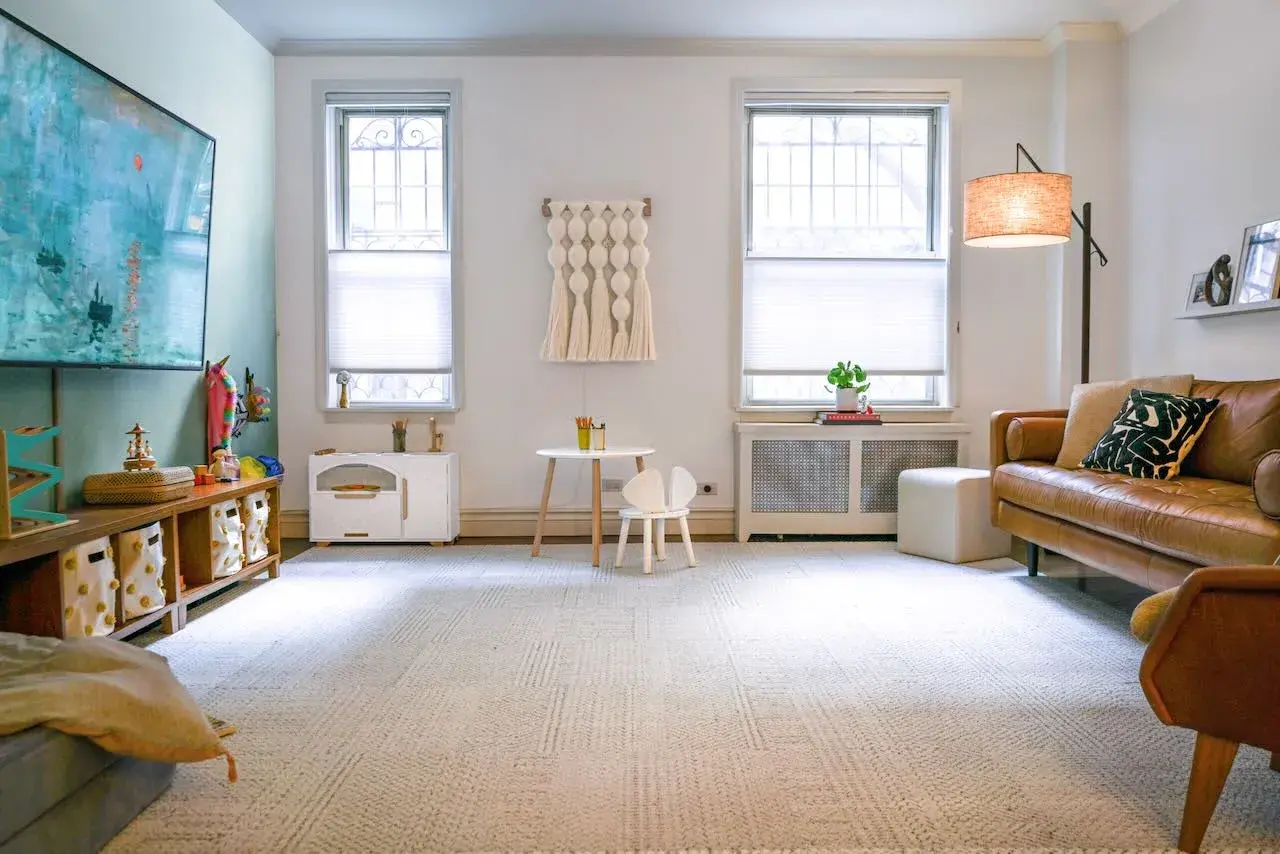
A well-planned DIY playroom should do more than hold toys. It needs to help children play independently, make cleanup realistic, and keep the rest of the house from becoming a daily obstacle course. In this guide, I focus on the parts that matter most: layout, safety, storage, useful projects, budget choices, and the mistakes that make a room feel chaotic even when it looks finished.
What matters most when building a playroom that lasts
- Start with zones for movement, quiet play, art, and storage so the room resets faster.
- Anchor tall furniture, manage cords, and keep climbing temptations out of reach.
- Use open shelves, labeled bins, and toy rotation so kids can clean up without help.
- Spend on the pieces that get used every day, not on decoration that only looks good in photos.
- Keep the room flexible so it can grow from toddler play into early elementary use.
Design the room around how kids actually play
I usually start with zones, not decor. A child’s play space works best when the room clearly answers four questions: where do they move, where do they sit, where do they create, and where does everything go when play is over. If those answers are obvious, the room feels calmer almost immediately.
For most homes, I like a simple layout with four parts: an open floor area for active play, a soft corner for reading or quiet time, a low table or tray for art and puzzles, and one storage wall that collects the visual clutter. In a small room, two of those zones can overlap. A bench can hold books and doubles as seating. A rug can mark the movement area and soften the whole room.
Keep the layout age-friendly
For toddlers, the room should stay mostly low and open. That means fewer obstacles, more floor access, and storage within reach. For mixed ages, I like to separate the “easy mess” toys from the “small parts” toys so younger children are not constantly pulled into materials they are not ready for. That one decision makes cleanup faster and reduces conflict.
Once the room has a shape, the next step is making sure it is safe enough to use without constant supervision.
Build safety in before the first toy lands on the floor
This is the part I never skip. A child’s play space should feel relaxed, but not careless. CPSC’s Anchor It! guidance is blunt for a reason: bookcases, dressers, and TV stands should be secured to the wall, because tip-overs happen fast and often involve children climbing on furniture. HealthyChildren.org makes a similar point, especially about drawer stops, wall anchors, and keeping tempting items out of reach.
- Anchor tall furniture such as bookcases, dressers, and cube units.
- Keep cords out of the room’s traffic path, especially blind cords and charging cables near windows.
- Use cordless window coverings when possible, or secure cords so they cannot form loops.
- Add a non-slip rug pad under any large rug that might slide on wood or tile.
- Store adult supplies separately, including scissors, batteries, paints, glue, cleaners, and craft knives.
- Skip top-heavy displays that invite climbing or can fall if a child pulls on them.
If the playroom also sits near a nursery or nap area, I am even stricter about small parts, loose cords, and anything that could become a choking or entanglement hazard. The room does not need to look sterile, but it does need to be boring in the ways that keep children safe. Once that is handled, storage becomes much easier to design well.
Choose storage children can actually maintain
The best storage is the kind a child can use without negotiation. If cleanup requires adult intervention every single time, the system is too complicated. I prefer storage that makes the “right” choice the easiest choice, especially for younger kids or siblings who share the room.
| Storage type | Best for | Why it works | Tradeoff |
|---|---|---|---|
| Open cubbies | Books, blocks, puzzles, baskets | Kids can see what belongs where and put it back fast | Looks messy if you overfill it |
| Lidded bins | Dress-up pieces, loose parts, bulk toys | Hides visual clutter and keeps sets together | Needs labels, or children forget what is inside |
| Rolling cart | Art supplies, sensory items, small craft materials | Moves between zones and can be parked out of the way | Not ideal for heavy toys or rough handling |
| Closed cabinet | Adult tools, fragile games, backup supplies | Keeps dangerous or delicate items out of sight | Children cannot reset it alone |

Add a few DIY features that carry the room
This is where the room starts to feel intentional. I do not love overbuilding a play space, because children use it hard and often. The smartest projects are the ones that do at least two jobs and can survive spills, climbing, and repeated cleanup.
Build a bench that hides clutter
A low bench with cube storage underneath is one of the highest-value DIY projects in a children’s room. It gives kids a place to sit, helps define a reading corner, and hides bulky toys or extra blankets. If you add a cushion on top, it becomes a soft landing spot instead of just another storage unit.
Mount books where kids can see the covers
Face-out book ledges work better than spine-out shelves for younger children because the covers pull them in visually. That matters more than people think. If the goal is independent play or a quiet reset corner, a visible book display gets used far more often than a formal bookshelf tucked in the corner.Create a small art zone with wipeable surfaces
A little art station does not need to be elaborate. A durable table, a washable mat, a pencil cup, and one drawer or bin for paper are enough to start. I like projects that reduce friction: no hunting for markers, no scattering paper across the floor, no permanent fear of mess. A wall-mounted paper roll or clip strip can be useful too, as long as it is easy to refill and easy to clean around.
Read Also: Paced Bottle Feeding for Newborns - Calm Feeds & Happy Baby
Use one soft corner for quiet play
Floor cushions, a thick rug, or a small tented corner can give a child a place to decompress without leaving the room. This is especially helpful in homes where siblings share the same space. It lowers the volume of the room without turning it into a no-play zone.
Once the room has a few custom pieces, the budget question becomes much clearer, because you can see what is worth paying for and what can stay simple.
Use a budget that leaves room for the next stage
A playroom does not have to be expensive to be good. In fact, the best ones often start with what the family already owns and improve only the weak points. In the United States, I usually think in ranges rather than exact numbers, because existing furniture, room size, and secondhand finds change the total quickly.
| Budget range | What it can cover | Best use of money | What to avoid |
|---|---|---|---|
| $150 to $400 | Paint, baskets, labels, a rug pad, basic shelving, one or two bins | Storage first, then a soft floor area | Matching decor sets that do not improve function |
| $400 to $900 | Better shelving, a craft table, upgraded rug, wall anchors, a reading nook | One strong DIY feature and better organization | Overspending on theme items that children outgrow quickly |
| $900 to $1,500+ | Custom built-ins, bench storage, flooring updates, lighting changes, larger room refreshes | Durable pieces that can last through multiple age stages | Finishes that are hard to clean or repair |
If the budget is tight, I would spend in this order: safety, storage, floor softness, then visual upgrades. Paint and bins do more for daily life than trendy wall decals or a perfectly styled shelf. A good room should still work when every toy is out and the day has gone sideways. That leads straight into the mistakes I see most often.
Avoid the mistakes that make a good room stop working
Most playrooms fail for predictable reasons. The room is not too small. It is just designed around an ideal version of family life instead of the real one. Once you fix that gap, the whole space becomes easier to use.
- Too many toys visible at once. Fewer choices usually mean deeper play and faster cleanup.
- Storage that only adults can manage. If kids cannot reset it, the room will drift back into clutter.
- Decor that is too fragile at child height. Save delicate objects for higher shelves or another room.
- Pretty bins with no labels. They look tidy on day one and become mystery boxes by week two.
- No place for adults to sit. If caregivers cannot comfortably stay in the room, they usually stop using it well.
- Ignoring cable and window clutter. It is both a safety issue and a visual one.
The fix is usually not more stuff. It is fewer categories, clearer storage, and one or two surfaces that can take a beating. When I strip those mistakes away, the room immediately feels more livable for both children and adults. From there, the final step is deciding what to build first if the room has to work right away.
What I would build first if the room had to work this weekend
If I had to set up a playroom quickly, I would start with three things: anchor the furniture, create one open shelf with the toys used every day, and add one soft, washable floor zone. Those three moves solve the biggest problems first. They reduce risk, make cleanup possible, and give children a clear place to start playing.After that, I would add a reading corner and one simple DIY feature, usually a bench or a book ledge, because those two upgrades change how the room feels without making it harder to maintain. Everything else can come later. The strongest play spaces are not the most decorated ones. They are the ones that still feel calm after a week of real use, when the room has already been tested by mess, noise, and everyday family life.
