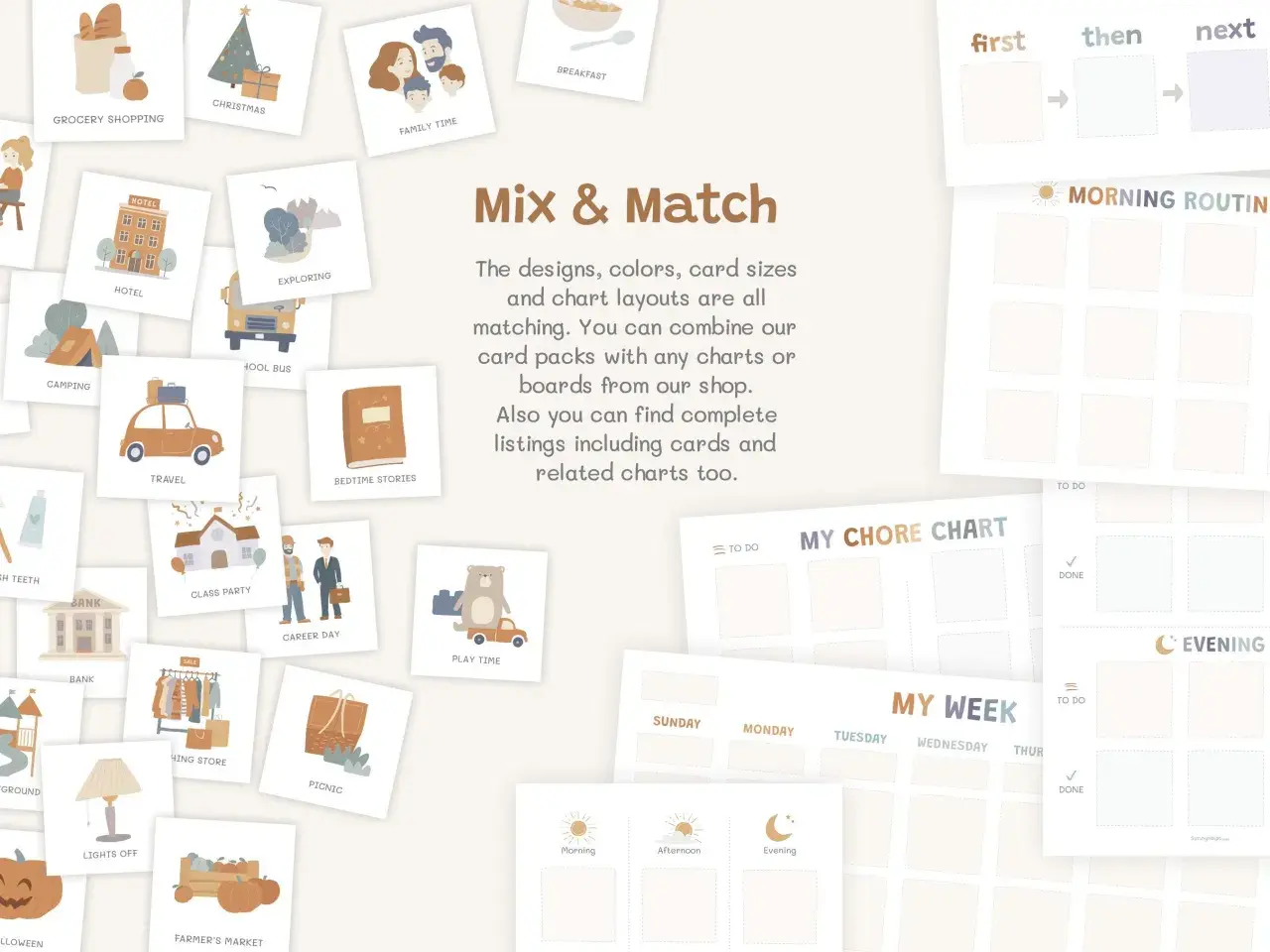
Visual routine cards are one of the easiest ways to make daily life feel calmer for young children. In Montessori homes, they work because they turn abstract instructions into a sequence a child can see, follow, and eventually own. This guide looks at what they do well, which routines to start with, how to choose the right format, and where the method falls short if the adults around it are inconsistent.
The essentials before you build a routine board
- Start with one routine, not the whole day. Morning or bedtime usually gives the fastest payoff.
- Keep the set short. Four to six steps is enough for most toddlers and preschoolers.
- Use photos when you want precision and illustrations when you want flexibility.
- Place the cards where the child already goes every day, such as the bathroom door, kitchen counter, or entryway.
- The cards are a support, not a substitute for modeling, repetition, and calm adult follow-through.
Why visual routine cards fit Montessori so well
In Montessori practice, order is not about being rigid. It is about helping a child understand what happens next so they can move with less friction and more confidence. That is why visual routine cards fit the method so naturally: they support practical life skills, reduce the need for repeated verbal prompting, and make the day feel predictable without turning it into a punishment chart.I like them most when they are used as a quiet part of the environment, not as a reward system. A child is not "earning" breakfast or bedtime by completing the board; the board simply shows the sequence. That small distinction matters, because Montessori aims for cooperation and independence, not compliance through pressure.
The real payoff is usually less dramatic than parents expect, but more useful: fewer power struggles, smoother transitions, and a child who can begin to manage a familiar routine with less hand-holding. Once that idea clicks, the next step is deciding which routines deserve a card set first.
Which daily routines deserve cards first
If I were building a home setup from scratch, I would not start with every possible activity. I would start where friction is most common. Morning, bedtime, and leaving the house are usually the best candidates because they repeat daily and involve a predictable sequence of steps.
| Routine | Good first steps | Ideal number of cards | Why it works |
|---|---|---|---|
| Morning | Wake up, bathroom, get dressed, breakfast, brush teeth, shoes on | 4-6 | Gives the child a visible runway before the day starts |
| Bedtime | Tidy toys, bath, pajamas, teeth, book, lights out | 4-6 | Slows the evening and reduces negotiation |
| Leaving the house | Put on shoes, grab bag, coat, water bottle, check door | 3-5 | Prevents the usual "we forgot one more thing" loop |
| After school | Shoes off, wash hands, snack, play, homework or quiet time, tidy up | 4-6 | Helps children decompress before the next demand |
For toddlers, fewer steps usually work better than a perfectly complete list. For older preschoolers, you can add one or two more cards, but only if the child can already do the sequence with minimal help. The key is not quantity; it is whether the board mirrors the real rhythm of your home.
If a routine changes often, keep the card set flexible and avoid loading it with unnecessary detail. That leads directly to the next decision, which is how visual the cards should be in the first place.
How to choose between illustrated, photo, and editable sets
A good set of Montessori routine cards should match the child's level of reading, attention, and independence. That is why the format matters as much as the routine itself. Here is the simplest way I would compare the common options:
| Format | Best for | Strengths | Trade-offs |
|---|---|---|---|
| Illustrated cards | Most toddlers and preschoolers | Clean, durable-looking, easy to reuse across routines | Less precise for house-specific tasks |
| Photo cards | Children who need exact visual cues | Very clear for real-life objects, rooms, and clothing | Takes more effort to make or customize |
| Editable printable sets | Families who change routines often | Flexible, cheap to test, easy to expand | Can become clutter if you print too many at once |
| Laminated magnetic or Velcro boards | Daily use in high-traffic spaces | Durable, easy to rearrange, child-friendly | Needs a little setup and storage |
As a rough buying range, I usually see printable packs at about $0 to $15, ready-made laminated or magnetic sets at about $10 to $35, and wooden or larger curated boards at about $20 to $50 or more. That spread is useful because it reminds you that the most expensive option is not automatically the most effective one.
My rule is simple: if the child can identify the step instantly, the format is working. If the card looks beautiful but the child still needs a long explanation, the design is not doing its job. Once the format is settled, the implementation matters more than the product.
How to introduce the system without turning it into another chore
The fastest way to make routine cards useful is to introduce them as part of everyday life, not as a special project. I usually recommend a short rollout that looks like this:
- Pick one routine that causes the most friction.
- Choose only the steps that truly need visual support.
- Place the cards at the child's height in the same spot every day.
- Walk through the sequence once or twice while naming each step simply.
- Let the child move, flip, or point to each card after completing the step.
- Review the routine at the same time each day so the sequence becomes familiar.
The whole process should feel calm and ordinary. For many families, a two-minute review before breakfast or before bed is enough. If you turn it into a lengthy lesson, it starts to feel like another demand, which defeats the point.
I also like to pair the cards with the actual environment: a low hook for the backpack, a basket for shoes, a small caddy for toothbrushes, or a bench by the door. That is classic Montessori logic. The visual support is stronger when the child can see both the step and the object tied to it. With the setup in place, the next risk is not the child's ability. It is the adult's habits.
The mistakes that usually make the cards lose their power
Most problems with routine cards come from overcomplication, not from the idea itself. I see the same mistakes again and again:
- Too many steps. A board with 12 tiny tasks is hard to follow and easy to ignore.
- Mixed messages. If one adult wants the child to use the board and another keeps giving verbal instructions, the system never stabilizes.
- Decorative but unclear visuals. Beautiful art is not helpful if the child cannot tell whether the card means brushing teeth or washing hands.
- Using the board as a threat. Montessori works better when children feel guided, not monitored.
- Changing the setup every few days. Predictability is part of the tool.
- Expecting instant independence. Children still need modeling, especially at the beginning.
The biggest misconception is that the cards do the teaching by themselves. They do not. They simply reduce the amount of verbal load and make the routine visible long enough for repetition to do its work. That is also why age matters so much, which is where I would focus next.
What a realistic setup looks like at different ages
A realistic home setup changes with age. The goal is not to use the same board for every child, but to match the amount of support to the child's stage.
| Age range | Best step count | Best format | What independence looks like |
|---|---|---|---|
| About 18 to 36 months | 3-5 steps | Large photos or very simple illustrations | Pointing, matching, and following with close adult guidance |
| About 3 to 5 years | 4-7 steps | Photo or illustrated cards with clear labels | Moving through the sequence with reminders instead of constant instruction |
| About 6 to 8 years | 5-8 steps | More streamlined visual checklist or schedule | Using the board to self-correct and manage time without being chased |
For younger children, the cards should support action, not reading. For older children, they can start to function like a planning tool. That shift is important in Montessori, because independence grows from doing, then recognizing the sequence, and only later naming it. If you keep that progression in mind, the whole system becomes easier to keep alive, and the only thing left is the small practical details that make it stay visible day after day.
Small details that make the routine stick
The best routine boards are rarely the prettiest ones. They are the ones that survive real family life. I would keep a few practical details in mind: use durable material if the board will stay in a bathroom or kitchen, keep a spare set for travel, and store extra cards out of sight so the child is not choosing from a pile of distractions. A small ring, a strip of Velcro, or a narrow magnetic board is usually enough.
It also helps to keep the language consistent. Say "brush teeth," not three different versions of the same instruction. That repetition is not boring; it is what helps a child connect the picture, the words, and the action. If you later expand the system beyond morning and bedtime, add only the routines that genuinely need support, such as snack prep, packing a bag, or cleanup after play.
- Laminate only the cards you actually use.
- Keep duplicates for travel, grandparents, or daycare bags.
- Store the board where the routine starts, not where it ends.
- Use the same visual style across home routines so the child does not have to relearn the symbols.
For most families, the real win is not a perfectly organized wall display. It is a calmer transition, a child who knows what comes next, and one less argument over ordinary parts of the day. If you build the board around that goal, the cards stay useful long after the novelty wears off.
