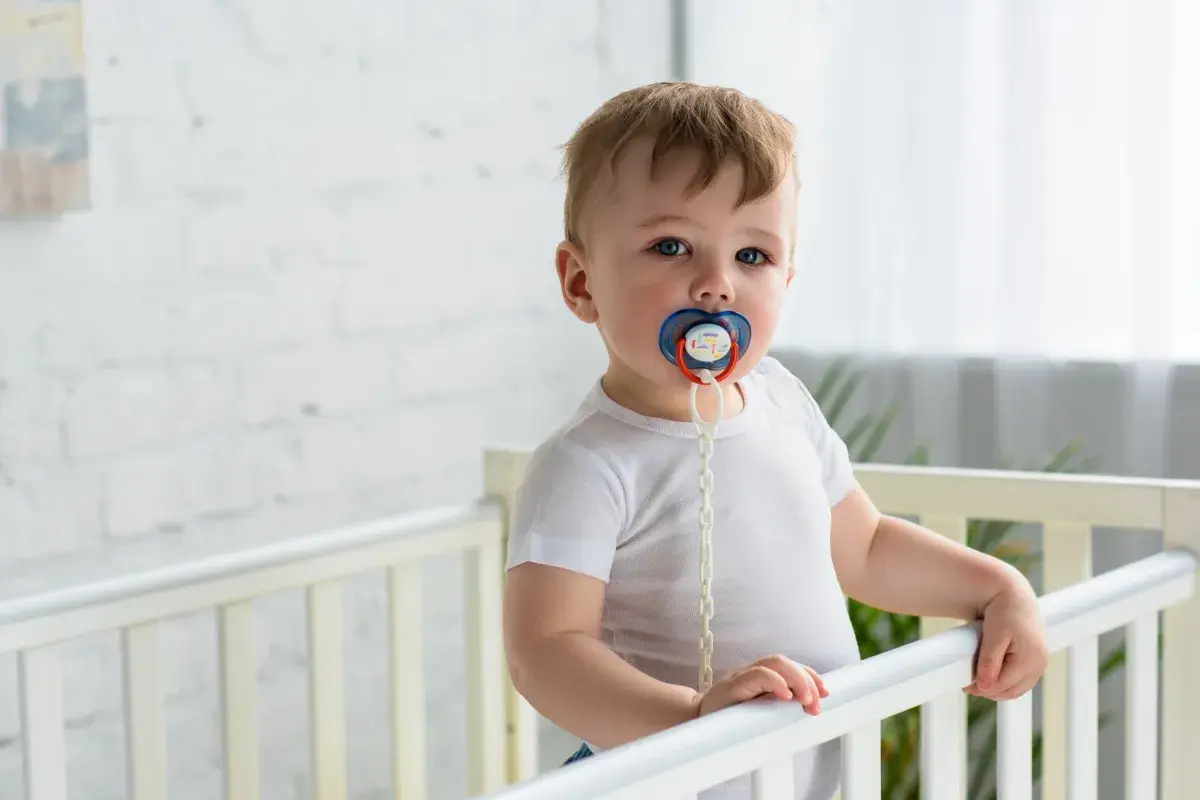
Pacifiers can be useful for soothing, sleep, and short moments of comfort, but they can also get in the way when they become an all-day habit. The short answer is that a pacifier can contribute to speech delay in some children, especially when use is frequent and prolonged, but it is rarely the only factor behind a language problem. What matters most is the child’s age, how many waking hours the pacifier is in the mouth, and whether the child still has plenty of chances to babble, imitate, and talk.
The practical answer for parents
- Bedtime-only pacifier use is usually less concerning than use during the day.
- The biggest risk shows up when a child keeps the pacifier in most of the time and misses normal talking practice.
- Pacifiers are more likely to affect speech sounds and practice time than cause a true language disorder by themselves.
- If a toddler is far behind on words, understanding, or clarity, hearing and development should be checked, not just the pacifier.
- The goal is not panic. It is enough free-mouth time for talking, eating, and play.
What the evidence actually says
My read of the evidence is cautious. Pacifier use does not reliably cause a speech delay on its own, and the link is not strong enough to treat every pacifier as a problem. Still, prolonged day-to-day use has been associated with smaller vocabularies in some research and with atypical speech errors when children rely on it for long stretches. I think of pacifiers as a habit that can reduce practice time rather than a single switch that breaks language development.
That distinction matters because speech and language grow through repetition. If a pacifier is there while a child should be babbling, imitating, asking, and experimenting with sounds, the child simply has fewer chances to practice. A pacifier used for sleep or brief soothing is a different story, especially in infancy when comfort tools can help. That balance leads naturally to the more useful question: how much use is too much?
Why total mouth time matters more than the pacifier brand
I care much more about how often the pacifier is used than which shape it has. A child who uses one only to fall asleep is in a very different situation from a child who keeps it in through breakfast, car rides, playtime, and conversations. From a speech perspective, the problem is not just sucking itself; it is the lost practice time for vocal play, turn-taking, and clear sound production.
Oral-motor patterns are the coordinated movements of the lips, tongue, jaw, and palate used for both feeding and speech. When a pacifier is in the mouth for long stretches, those movements are constrained. That can matter for speech clarity, for how a child chews and swallows, and for whether the child is fully participating in mealtime conversation.
| Pacifier pattern | What I usually think | Why it matters |
|---|---|---|
| Bedtime and naps only | Usually low concern | The mouth is still free for talking and play during the day. |
| Short soothing breaks during the day | Mild to moderate concern | Worth watching the total awake time, especially after the first year. |
| Used during meals or most conversations | Higher concern | It can interfere with feeding cues, speech practice, and vocal imitation. |
| Used for long stretches after toddlerhood begins | Highest concern | This is where I would start thinking about speech, bite changes, and weaning. |
If I had to choose one rule, it would be this: protect the child’s awake talking time first. That is where language grows, and it is the easiest place to lose ground without noticing.

The signs I would not ignore
Not every child who uses a pacifier too long will have a speech problem, but there are some patterns that should make you pay attention. If the pacifier is only one small part of the day and your child is steadily adding words, that is one thing. If the pacifier seems to replace vocal play, meal-time interaction, or conversation, I would take that seriously.
| What you notice | What it may point to |
|---|---|
| Very few new words over time | A broader language delay, hearing issue, or another developmental concern |
| Speech is hard to understand only when the pacifier is in the mouth | Speech is being distorted by the habit, not necessarily delayed in a deeper way |
| Child avoids babbling or talking when awake because the pacifier stays in | Too little practice with sounds, turn-taking, and imitation |
| Frequent ear infections or not responding well to sound | Hearing may be part of the problem |
| Mouth shape or bite looks off | Longer-term oral effects that can also affect speech sound placement |
By around 30 months, many children are using about 50 words and starting to put two or more words together. If a child is nowhere near that, I would not spend months blaming the pacifier alone. I would treat it as one factor in a bigger picture and move on to an actual evaluation if needed. That is where weaning and support both become useful.
How I would wean a child without turning it into a battle
The cleanest approach is usually gradual, predictable, and boring. I would start by removing the pacifier from the moments that matter most for language: meals, play, books, and conversation. If the child still needs it for sleep, that is the last place I would tackle, not the first. The idea is to preserve comfort while reclaiming the hours where speech and feeding should be active.
- Drop daytime use first and keep the pacifier for nap and bedtime only.
- Replace the soothing function with something else, such as a stuffed animal, a blanket, rocking, or a short routine.
- Use praise and small rewards when the pacifier stays out during the day.
- Keep the rule consistent. Mixed messages make the habit stronger.
- Do not use the pacifier to delay meals or silence normal talking time.
- Avoid punishment or shaming. That usually creates more resistance, not less.
If a child is older and very attached, a set transition date can work better than endless bargaining. For younger toddlers, a simpler rule like “pacifier stays in the crib” is often enough. The key is to make the change feel predictable, not emotional. Once the routine is clear, most children adjust faster than parents expect. That leads into the next question: when does a pacifier habit need professional attention?
When to call a pediatrician or speech-language pathologist
I would not wait if speech is clearly lagging, especially if the child is also hard to understand, not responding to sound, or losing skills they once had. A hearing issue can look a lot like a speech delay, so hearing is part of the conversation early. If a child is struggling with communication, a speech-language pathologist can separate a speech sound issue from a broader language problem and suggest next steps.
Get help sooner if you notice any of these:
- No meaningful words by the toddler stage
- Little or no progress in new words over several months
- No two-word combinations when other signs of development suggest they should be emerging
- Speech that is unusually hard to understand for age
- Repeated ear infections or concern about hearing
- Changes in bite, palate shape, or tongue posture
- Regression, where words or social communication skills disappear
That part is important: a pacifier issue is usually not the whole story if a child is truly behind. The sooner you check the full picture, the easier it is to choose the right fix instead of guessing.
A realistic pacifier routine that still protects speech development
If I had to simplify the whole topic into a practical habit, I would say this: keep pacifiers in the comfort lane, not the communication lane. In plain terms, that means sleep, short soothing moments, and maybe travel for younger babies, but not meals, play, or long stretches of awake time. In early infancy, pacifiers can still have a place, but once a child is clearly moving into talking, the mouth needs more open space.
- Use the pacifier mainly for sleep or true calming, not as background noise.
- Keep mealtimes and book time pacifier-free.
- Watch the total hours it stays in the mouth, not just how often you hand it over.
- Start phasing it out earlier if your child is already showing speech or feeding concerns.
- Think of the goal as preserving talking opportunities, not winning a pacifier fight.
The clearest takeaway is this: a pacifier is rarely the sole cause of a speech delay, but it can make an existing risk harder to ignore. If your child is using one often and speech is not moving forward, I would reduce the habit and check development at the same time.
