The quick answer most parents need
- About 12 to 18 months is when many children begin experimenting with a fork, usually with lots of mess and some help.
- By around age 2, many toddlers can spear soft foods more reliably, especially if the fork is toddler-friendly.
- By age 3, fork use is usually much more consistent, and many children can handle most parts of a meal on their own.
- By age 4, grip and control often look more mature, with a fork held more like an adult’s.
- The exact timing depends on hand strength, hand-eye coordination, attention, and how often the child gets to practice.
What the fork-use timeline usually looks like
There is no single moment when a child suddenly “gets” the fork. I think of it as a progression: first curiosity, then clumsy attempts, then real self-feeding, and finally a steadier preschool grip. The CDC places fork use among the skills many 3-year-olds can do, and HealthyChildren notes that many toddlers can use a fork by about 18 months, even though they are often still messy eaters.
| Age range | What you may see | What it usually means |
|---|---|---|
| 10 to 12 months | Child grabs the fork, taps food, or brings it to the mouth with help | Interest is there, but control is still very limited |
| 12 to 18 months | Starts poking soft food, misses often, and may switch back to fingers | Early practice stage; consistency is not the goal yet |
| 18 to 24 months | Can spear soft pieces more often and may eat part of the meal with a fork | Basic coordination is improving, though spills are still normal |
| 2 to 3 years | Uses the fork more independently and with fewer failed attempts | The skill is becoming dependable in everyday meals |
| Around 4 years | Fork grip looks more adult-like and movements are more refined | Fine motor control is usually much more mature |
So if a 15-month-old can stab pasta but not manage peas, that is still within the normal range. The bigger question is whether the child is gradually improving, because that pattern tells me much more than one messy lunch ever could. That leads directly to the motor skills that make fork use possible in the first place.
The motor skills behind fork use
Fork use looks simple from the outside, but it depends on several skills working together. A child has to grab the utensil, aim it, judge distance, control pressure, and get the food to the mouth without dropping everything halfway there. In other words, the fork is a tiny coordination test disguised as dinner.
- Pincer grasp lets a child pick up small objects between the thumb and index finger. That same precision helps with holding and steering a fork.
- Hand-eye coordination helps the child line up the fork with the food instead of jabbing at the plate randomly.
- Motor planning is the brain’s ability to figure out the sequence of actions, such as stab, lift, turn, and bring to mouth.
- Wrist rotation matters because the hand has to adjust the fork angle while moving between plate and mouth.
- Two-hand coordination often shows up when one hand steadies the plate or bowl while the other does the eating.
- Sensory tolerance helps a child handle the feel of food on the fork, on the fingers, or occasionally on the face without completely losing focus.
These skills do not arrive all at once. A toddler may be able to hold the fork but not aim it, or aim it well but not keep the food on the tines. Once those pieces are in place, the practical question becomes how to practice without turning dinner into a standoff.

How to teach fork use without turning meals into a battle
I usually advise parents to treat fork practice like any other skill-building habit: small, predictable, and low pressure. The fork should be available, but the child should not feel tested at every bite. If meals become tense, many toddlers simply retreat to fingers, which is not failure; it is a very normal self-protection move.
- Start with one meal or snack a day. A calm snack is often easier than a full dinner, especially if your child is tired.
- Choose one or two easy foods. Soft foods are better than slippery, hard, or crumbly ones. The child needs early wins.
- Preload the fork when needed. Let the child hold the utensil and bring it to the mouth, even if you help with the loading part at first.
- Model the motion slowly. Children learn a lot by watching a deliberate, boringly simple demonstration.
- Let mess happen. Spills are part of the learning process, not a sign that the skill is off track.
- Keep pacifiers out of the meal itself. If a child still uses one, meals go better when the mouth can focus on chewing, swallowing, and utensil control rather than soothing.
- Stop before frustration peaks. If the child is exhausted or angry, the lesson is usually over for that sitting.
I also like to keep the tone matter-of-fact. “You can try the fork now” works better than “Why aren’t you using it yet?” That small difference matters more than most parents expect. Next, it helps to make sure the foods and utensils themselves are set up for success.
The foods and utensils that make practice easier
A child can only learn fork use efficiently when the food cooperates. Some foods practically stay on the fork by themselves; others slide, squish, or fall apart the second they are lifted. I want early practice to feel manageable, not like a physics experiment.
| What to offer | Examples | Why it helps |
|---|---|---|
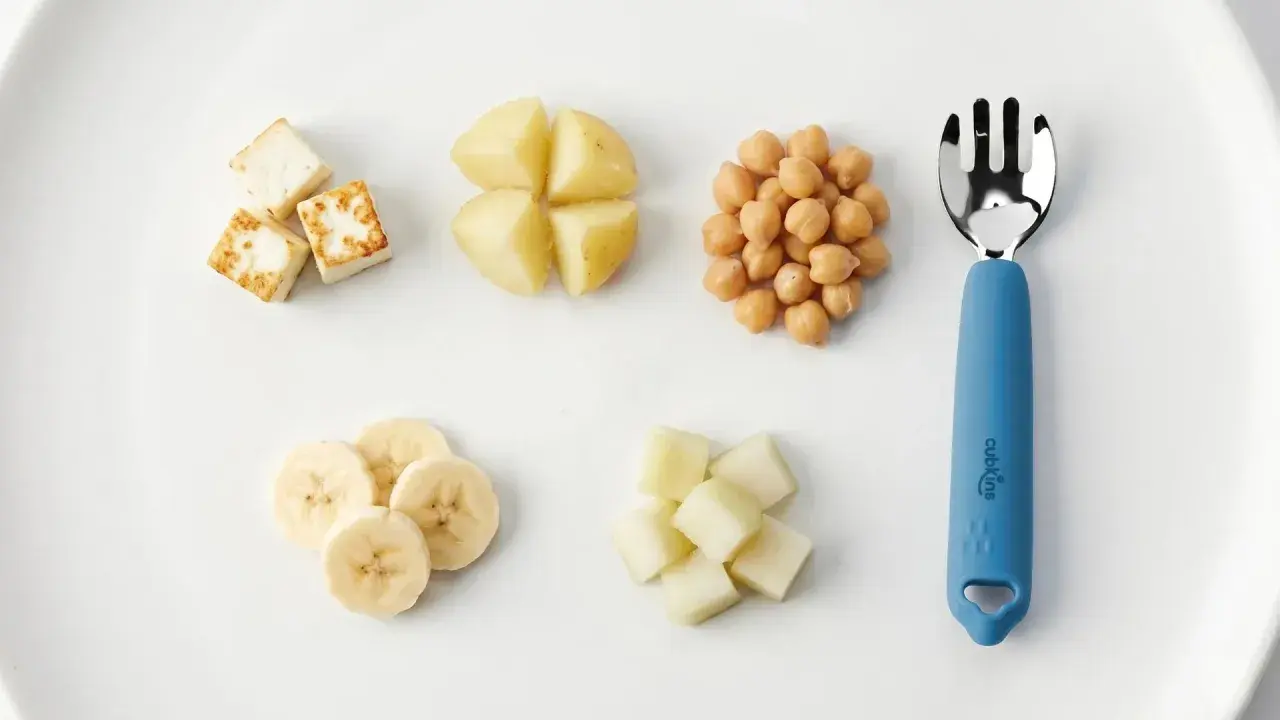
| Soft, easy-to-spear foods | Banana pieces, avocado chunks, steamed carrots, pasta, scrambled eggs, omelet squares, soft tofu, ripe pear | They stay on the fork better and require less force |
| Foods to save for later practice | Peas, corn, grapes, raw carrots, hard apple slices, tough meat, very slippery noodles | They are harder to pierce, harder to hold, or raise choking concerns |
| Better fork choices | Lightweight toddler fork, short handle, wider grip, slightly rounded or blunt tines | More control, less fatigue, and a safer feel in small hands |
| Less helpful fork choices | Long adult fork, very heavy metal fork, sharp tines, awkwardly slippery handle | Harder for a beginner to steer and easier to drop |
If I had to pick the single most useful trick, it would be this: start with food that is easy to spear and hard to roll away. A child who gets food on the fork quickly is far more motivated to keep trying. Once that feels routine, the next issue is deciding when slower progress is normal and when it deserves attention.
When slower progress is normal and when to ask for help
Not every child follows the same timeline. Prematurity, lower muscle tone, limited practice, strong sensory preferences, and general temperament can all slow utensil use without indicating a real problem. Some children are simply more interested in eating fast with their hands, and they need repeated exposure before the fork becomes their preferred tool.
I would be less concerned about a child who is messy but improving than about a child who shows almost no progress at all. A toddler who can use fingers, watch you demonstrate, and slowly get better from month to month is usually doing fine. The pattern matters more than the pace.
- Usually normal if the child is between 12 and 24 months, experiments with the fork, and gradually becomes more accurate.
- Usually normal if the child prefers fingers but can still bring some food to the mouth with a utensil when encouraged.
- Worth mentioning at a checkup if a child around 3 years old still cannot use a fork at all, especially if other fine motor skills also seem delayed.
- Worth mentioning sooner if there is loss of skills, clear one-sided weakness, frequent coughing or choking with meals, or extreme distress with textures and utensils.
The CDC also reminds parents that developmental milestones are broad markers, not a substitute for individual screening, which is exactly how I think about fork use. If something feels off, it is better to mention it early than to wait and hope it sorts itself out on its own. That brings me to the final details I watch when a child is nearing real independence at the table.
What I would watch over the next few meals
When fork use is settling in, the signs are usually small but obvious once you know what to look for. I am watching for fewer failed stabs, a steadier wrist, and more confidence moving the fork from plate to mouth. A child does not need to look graceful yet; I just want to see that the skill is becoming repeatable.
- The child reaches for the fork without prompting.
- Soft foods stay on the fork more often than they fall off.
- The grip shifts from a full-fist hold toward a more controlled finger hold.
- There is less frustration when a bite misses the target.
- The child can switch between fork and fingers without losing interest in the meal.
The real milestone is not perfect table manners. It is steady progress toward control, comfort, and independence. If your child is slowly getting better, that is the answer I would trust most. If there is little or no progress by the preschool years, bring it up at the next pediatric visit and use the mealtime pattern itself as part of the discussion.
