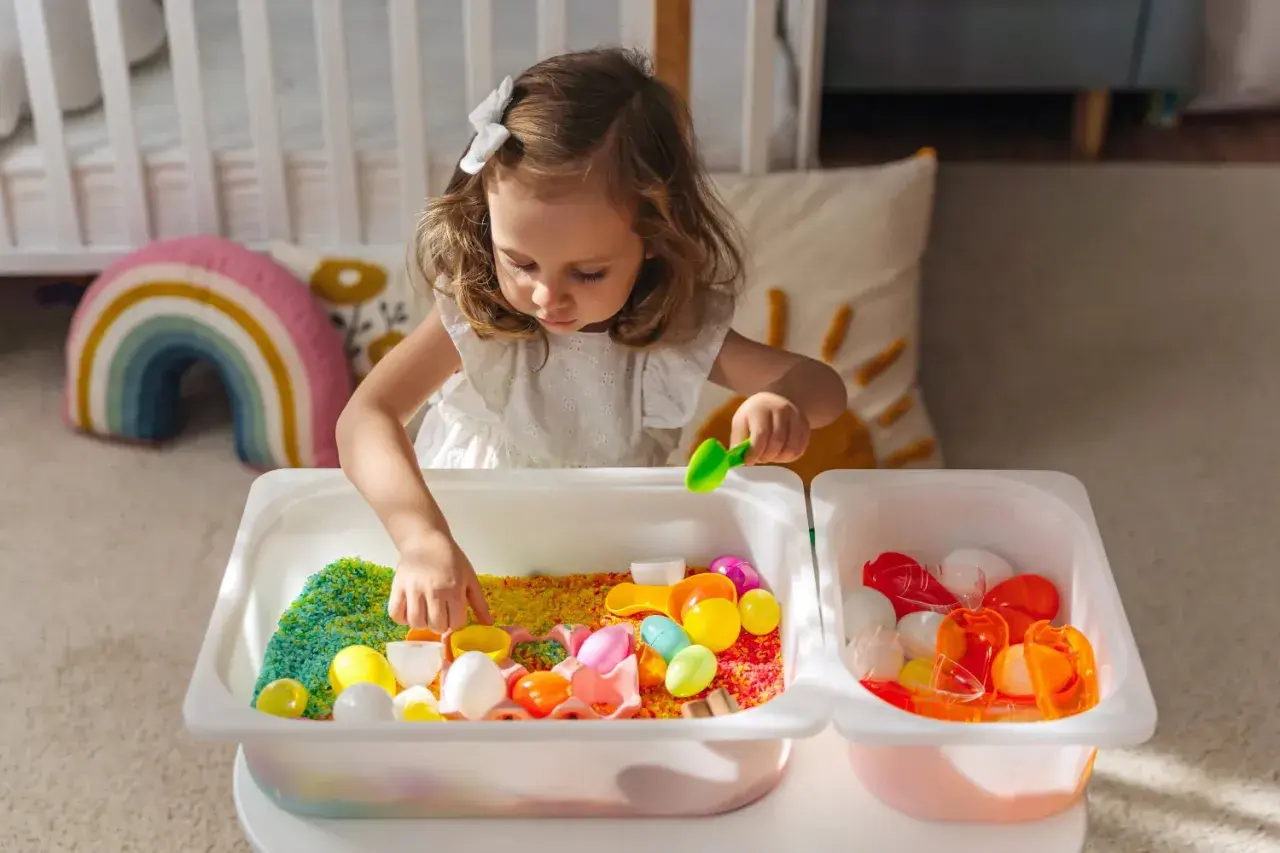
When people ask why are sensory bins important, I look first at what children do inside them: scoop, pour, sort, compare, narrate, and repeat. A well-made bin gives them a low-pressure way to build fine motor control, language, attention, and early problem-solving while they are still having genuine fun. In this article, I break down the developmental value, what belongs in a good bin, how to match it to age, and the safety rules that matter most.
The quick take on sensory bins and child development
- They make learning physical, which is useful for children who understand best by touching, moving, and testing.
- They strengthen hand strength, finger control, and hand-eye coordination without feeling like a lesson.
- They can support language, sorting, comparing, counting, and early science thinking when adults add simple prompts.
- They can help some children settle, but they are not a magic fix for dysregulation or sensory overload.
- The best bins are open-ended, age-appropriate, easy to clean up, and free of choking hazards for young children.
Sensory bins turn play into visible learning
In practice, I think of a sensory bin as a small, controlled environment for exploration. Instead of asking a child to sit still and absorb information, it gives them a reason to touch, move, repeat, and notice patterns. That matters because young children learn through their bodies first; the sensory and movement systems work together, and that is where a lot of early understanding gets built.
A bin also creates a softer entry point for children who are cautious, shy, or easily overwhelmed. Some children settle when they can sift or pour slowly; others become more alert and curious. Either way, the value is the same: the child is practicing regulation, attention, and decision-making in a playful setting. That is the kind of learning that makes the next section worth unpacking in detail.
The skills they strengthen most
Sensory bins are useful because they do not train just one skill. A child may be strengthening hand muscles, building vocabulary, and solving a tiny problem in the same five minutes. I like tools that do that efficiently, because children rarely develop in neat, isolated boxes.
| Skill | What the child does in the bin | Why it matters |
|---|---|---|
| Fine motor control | Scoops, pinches, pours, transfers, and uses tongs or tweezers | Supports everyday tasks like buttoning, eating, drawing, and writing later on |
| Language | Names textures, describes actions, and answers simple prompts | Builds vocabulary, narration, and back-and-forth conversation |
| Problem-solving | Figures out how to move, sort, stack, or hide objects | Practices trial and error, cause and effect, and flexible thinking |
| Early math and science | Compares volume, counts pieces, and notices sinking, floating, or texture changes | Introduces measurement, sorting, prediction, and observation |
| Self-regulation | Stays with a task, slows down, or resets after a busy day | Helps some children manage energy and attention in a calmer way |
| Social skills | Shares tools, takes turns, or plays alongside another child | Gives practice with cooperation, waiting, and joint attention |
That mix is the real reason sensory play keeps showing up in strong early-childhood classrooms: it is simple, but it touches several developmental systems at once. Once you see that pattern, the next question becomes what the bin should contain to make those skills show up naturally.

What belongs in a bin that actually works
The best bins are not crowded. I would rather build around one clear base material and a few purposeful tools than throw in a dozen random objects. The job of the bin is to invite repetition and experimentation, not to look impressive on a shelf.
| Bin part | Good choices | What it adds |
|---|---|---|
| Base material | Rice, dry pasta, oats, shredded paper, kinetic sand, water, fabric scraps | Provides the main tactile experience |
| Tools | Spoons, cups, funnels, scoops, tongs, small bowls | Encourages pouring, transferring, and hand control |
| Hidden objects | Large letters, blocks, animal figures, shells, pom-poms, natural items | Adds sorting, searching, naming, and pretend play |
| Container | Low tub, baking tray, storage bin, or sensory table | Keeps the play contained and easier to reset |
If I were setting one up at home, I would start with a texture that matches the child’s tolerance. Dry rice or pasta is often easier to manage than sticky or wet materials, while kinetic sand or water can be better for children who want a stronger sensory response. The theme matters less than the interaction, so a bin full of a few large scoops and simple objects usually teaches more than a bin packed with decorations. That balance becomes even more important when you match the setup to the child’s age.
How to match the bin to a child's age and temperament
Not every child needs the same level of complexity. Age, attention span, and sensory profile all affect what will feel engaging rather than frustrating. I would also say this plainly: if a child is still exploring everything with their mouth, the material choice has to be much stricter.
| Age or stage | Best setup | Why it usually works |
|---|---|---|
| Under 3 | Large, simple items with close supervision and no tiny loose pieces | Reduces choking risk and keeps the play manageable |
| 3 to 4 | Sorting bins, scoop-and-pour materials, and a few hidden objects | Supports vocabulary, hand control, and simple counting |
| 4 to 5 | Themed bins with letters, patterning pieces, measuring tools, or pretend-play items | Adds richer language, comparison, and story-making |
| Sensitive or hesitant children | One texture, one tool, and a very small setup | Lower stimulation makes it easier to enter the play without shutting down |
| Highly active children | More opportunities to dump, fill, and move objects quickly | Gives the body enough work to stay engaged instead of wandering |
The practical rule I use is simple: start smaller than you think you need to, then add complexity only if the child stays engaged. That keeps the bin aligned with the child instead of forcing the child to adapt to the bin. The same logic applies to safety, and that is where many adults get too casual.
Safety and limits that matter more than novelty
Good sensory play is safe play. For children under 3, I would avoid any tiny object that could fit fully into the mouth, because small parts create a real choking risk. I would also be careful with anything that becomes slippery, splinters, breaks apart, or turns into a hidden hazard once the play gets enthusiastic.
- Keep the setup age-matched, especially for toddlers and younger preschoolers.
- Use close supervision whenever the child is young, mouthy, or still learning the rules.
- Avoid mixed-age bins where older siblings can add tiny pieces that younger children can reach.
- Check for allergies before using food-based fillers like oats, wheat, or cooked sensory materials.
- Watch for overstimulation; if the child becomes frantic, the bin is too intense or too complex.
- Skip materials that are tempting to swallow, shove into ears, or scatter beyond easy recovery.
Safety is not just about preventing accidents. It also protects the emotional quality of play, because a child who feels pressured, unsafe, or overwhelmed will not learn much from the experience. That leads directly into the mistakes I see most often when people try to make bins more interesting than they need to be.
The mistakes that make sensory play less useful
Most weak sensory bins fail for the same few reasons. They are either too busy, too directive, or too advanced for the child using them. When that happens, the bin stops feeling like open-ended exploration and starts feeling like a project with too many rules.
- Using too many fillers at once, which makes the texture chaotic instead of inviting.
- Loading the bin with tiny themed objects that create more risk than learning.
- Expecting one setup to work for every child, every day, and every mood.
- Turning the bin into a lesson with constant correction instead of natural conversation.
- Leaving the same materials out forever, so the child stops noticing them.
- Ignoring the child’s signal that they are done, overloaded, or just not interested.
I find that a simple bin, used well, beats a complicated bin every time. The final piece is knowing how to keep the activity fresh without making it harder than it needs to be.
The habits I would keep if I were setting up bins every week
If I were building sensory bins on a regular basis, I would keep three habits: change one variable at a time, narrate what the child is doing, and watch for the level of effort that actually fits the child. That might mean swapping rice for sand, adding a spoon instead of a shovel, or introducing a few new words like pour, sift, and compare while leaving the rest of the setup alone.
I would also treat the child’s response as data. If they calm down, stay focused, and return to the bin, the setup is probably working. If they avoid it, rush through it, or become upset every time, I would simplify first rather than push harder. Sensory bins are most effective when they respect the child’s pace, and that is the detail that usually separates a nice activity from a genuinely useful one.
