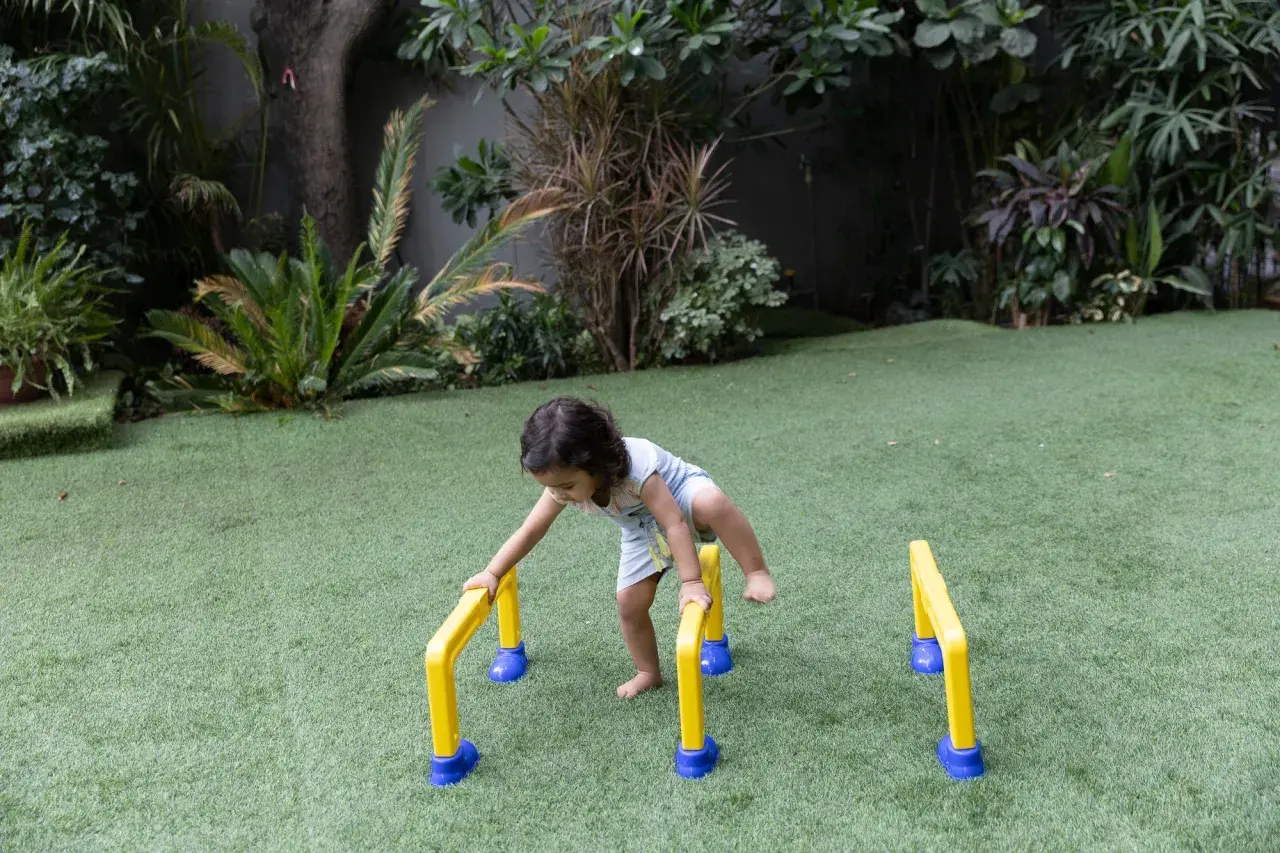
The best outdoor play for toddlers is simple, repeatable, and easy to scale up or down
- Toddlers learn best from short bursts of movement they can repeat, like chasing, climbing, kicking, pushing, and jumping.
- Big-body play supports balance, body awareness, leg strength, coordination, and confidence.
- A practical daily target is several active outdoor sessions rather than one long, forced workout.
- You do not need special equipment; bubbles, chalk, a soft ball, a bucket, and a low step cover a lot of ground.
- Safety improves when the space is predictable, the surface is checked, and the challenge matches the child’s current skill level.
Why outdoor movement matters more than perfect play gear
When I think about toddler development, I start with repetition. A child who walks up and down the same low step, kicks the same ball, or runs the same short path is not “doing nothing new”; that repetition is exactly how motor patterns get cleaner and more automatic. Outdoor play also gives toddlers more space to move with less pressure, which usually means better balance, more confidence, and fewer battles over sitting still. Gross motor play is not just about energy burn. It feeds the vestibular system, which helps with balance and movement, and proprioception, the body’s sense of where arms and legs are in space. That is why a simple game like walking over a curb, pushing a wagon, or climbing a small mound can do more developmental work than a noisy toy that keeps the child in one spot.As a practical benchmark, I like the CDC’s childcare guidance: 2 to 3 outdoor active-play periods and 60 to 90 minutes of moderate-to-vigorous movement across an 8-hour day. I treat that as a useful target, not a rigid rule. What matters most is consistency, because toddlers usually do better with several short movement bursts than with one long, structured session. Once that foundation is clear, the next step is choosing activities that give those muscles something useful to do.

The outdoor activities I reach for first
These are the activities I would keep in rotation if I had to choose only a few. They are easy to set up, easy to repeat, and flexible enough to fit a backyard, driveway, park, or apartment courtyard.
| Activity | What it builds | Best setup | Why it works |
|---|---|---|---|
| Bubbles and chase | Sprinting, stopping, tracking movement | Open flat space | It gives toddlers a clear target and a natural reason to run without feeling coached. |
| Sidewalk chalk paths | Stepping, jumping, balance, direction changes | Driveway, patio, or sidewalk | You can redraw the course in seconds, so the child gets variety without needing new equipment. |
| Ball kicking and rolling | Coordination, timing, bilateral movement | Soft ball and open space | It is one of the easiest ways to practice control, and toddlers can play alone or with an adult. |
| Low climbing and step-ups | Leg strength, planning, balance | Low curb, safe playground step, or gentle slope | Controlled risk matters here; toddlers learn by solving a small physical problem over and over. |
| Push and pull play | Core stability, shoulder strength, walking rhythm | Push toy, wagon, or sturdy bucket | Movement feels purposeful, which helps children stay engaged longer. |
| Simple obstacle courses | Body awareness, sequencing, agility | Cones, cushions outdoors, tape lines, or small boxes | It combines several movement patterns into one game, which is ideal for older toddlers. |
The pattern is simple: short bursts, visible goals, and enough variation to stay interesting. If a toddler keeps asking for the same game again and again, I see that as a strength, not a problem. It usually means the activity is hitting the right level of challenge, and from there the real question becomes how to match the game to the child’s age and the space you actually have.
How to match the activity to the child and the space
Not every toddler needs the same challenge. An early walker needs different support from a 3-year-old who already likes to race, jump, and climb. I usually think in three layers: the movement pattern, the amount of space, and the amount of supervision the game needs.
For early walkers, keep it low and predictable. Bubble chasing, pushing a small stroller, walking over chalk lines, and stepping onto a single low surface are excellent because they build confidence without asking for perfect coordination.
For 2-year-olds, you can add more turning, stopping, and carrying. Rolling or kicking a ball toward a target, climbing a short hill, stepping over tape lines, or dropping pinecones into a bucket all work well because they combine movement with a simple task.
For older toddlers, I like games with a little sequence: follow-the-leader, a mini obstacle course, pretend deliveries with a wagon, or simple tag with clear boundaries. These are useful because they ask the child to plan the next movement instead of just reacting.
The space matters just as much as the age. A small patio can still support chalk trails, bubble play, and bucket carries. A backyard opens up running, climbing, and short races. A park gives you slopes, longer paths, and playground structures, but it also demands more attention because there are more distractions and more hard edges. The best match is not the fanciest setting; it is the one where the child can move freely without constant correction. That leads straight into safety, which is where a lot of outdoor play either gets easier or gets ruined.
How to keep it safe without shrinking the fun
I do not think outdoor play should feel fragile, but I do think it should be predictable. Toddlers take physical risks fast, so the adult job is to reduce the hazards that do not teach anything and keep the ones that do.
- Check the surface first. Look for holes, slick spots, sharp gravel, broken sticks, and heat on pavement or metal.
- Keep climbing low enough to manage. A toddler should be able to explore, wobble, and recover without a dangerous drop.
- Use flexible, closed-toe shoes when the ground is rough. That gives better grip and more protection than sandals for most active play.
- Stay away from driveways, streets, and water unless the activity is fully supervised. That is where the risk changes from playful to urgent very quickly.
- Offer water before the child asks. In warm weather, short breaks are easier than waiting for a meltdown.
- Use shade, hats, and sunscreen when the sun is strong. Sun fatigue can end a session long before the child is done moving.
The goal is not to remove every wobble. Small stumbles are part of learning balance. The real line is between a safe challenge and a preventable hazard. Once that line is clear, the next thing that helps is knowing which mistakes make outdoor play feel harder than it needs to be.
Common mistakes that make outdoor play less useful
Most outdoor play problems come from making the activity either too busy or too advanced. I see the same few patterns again and again, and they are easy to fix once you notice them.
- Too many instructions. Toddlers do better with one clear idea, not a long explanation. “Jump to the chalk mark” works better than a five-step speech.
- Too much equipment. A pile of toys can slow movement down. One ball, one bucket, or one path is usually enough.
- Activities that are too hard. If the child keeps failing, the game becomes about frustration instead of movement. Lower the height, shorten the distance, or make the target bigger.
- Turning movement into a test. If every attempt gets corrected, the child stops experimenting. I prefer to let the child repeat a movement before I refine it.
- Expecting long attention spans. Toddlers often give you better work in 5- to 15-minute bursts. That is normal.
The better approach is to keep one movement goal at a time and let it be playful. A toddler who is happily throwing a ball badly is still learning more than a toddler who has been talked out of moving. From there, the easiest way to keep progress going is to build a small outdoor kit that removes friction for you.
The small outdoor kit I would keep on hand all season
If I wanted repeatable outdoor play without overthinking it, I would keep a tiny kit ready to go:
- Bubbles for chasing, reaching, and sprinting in short bursts.
- A soft ball for kicking, rolling, catching, and target practice.
- Sidewalk chalk for paths, circles, jump marks, and pretend roads.
- A small bucket or tote for carrying, sorting, and simple “delivery” games.
- A push toy or ride-on toy for steady walking, steering, and leg strength.
That small set covers most of the movement patterns toddlers need: run, stop, carry, climb, push, pull, kick, and jump. I would rather have those five tools ready all the time than own a large collection that stays in a closet. The real value is not in the objects themselves; it is in how quickly they help you turn an ordinary outdoor space into a place where movement feels easy, safe, and worth repeating.
