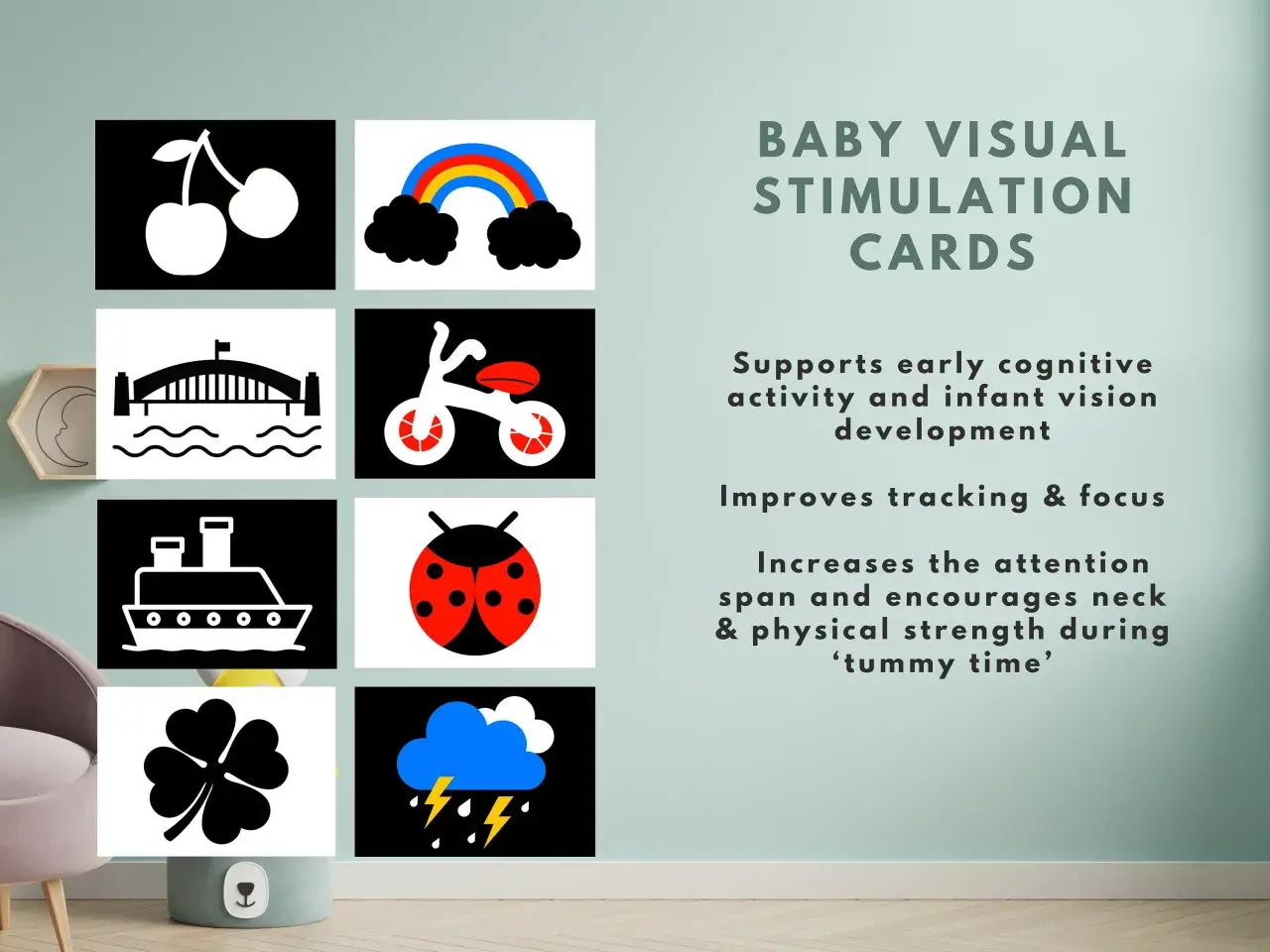
The best visual stimulation for babies is simple, responsive, and matched to what their eyes can actually process. In this article, I focus on the kinds of play that build focus, tracking, depth perception, and early visual processing, plus the toys, room setup, and warning signs that matter most.
The simplest visual play is usually the most effective
- Newborns respond best to faces, strong contrast, and slow movement at close range.
- Short, repeated play moments are more useful than long, flashy sessions.
- High-contrast books, mirrors, and floor play do more than bright gadgets or screens.
- Too much clutter, too much movement, and too much screen time can work against attention.
- Persistent eye turning, weak tracking, or a strong head tilt deserve a pediatric check.
What a baby’s vision can handle in the first year
When I talk about infant vision, I try to keep one idea front and center: babies are not processing the world the way adults do. Their early visual system is still learning how to lock onto a face, follow movement, and combine input from both eyes into one clear picture. Contrast sensitivity, which is the ability to pick out a shape against a background, develops before fine detail does, so bold shapes and clear edges matter more than tiny patterns.
For preterm babies, I use corrected age, not birth date, when I think about these milestones. That matters because a baby born early may be developing visual skills on a different timetable, even when everything is going well.
| Age range | What the eyes are mostly doing | What helps most |
|---|---|---|
| Birth to 2 months | Seeing best at close range, reacting to light, and beginning to lock onto faces | Faces at about 8 to 12 inches, black-and-white patterns, slow voice-driven interaction |
| 2 to 4 months | Following movement better and starting to coordinate both eyes more smoothly | Slow side-to-side tracking with one toy, mirrors, bright single-color toys |
| 4 to 6 months | Better hand-eye coordination, more interest in reaching, more stable tracking | Toys at eye level during tummy time, cloth books, safe reaching games |
| 6 to 12 months | Stronger depth perception, more active looking, more visual memory | Peekaboo, simple hide-and-find games, picture books, crawling around objects |
I usually tell parents to think in short cycles, not long sessions. A baby does not need a visual marathon; a few clean moments of looking, tracking, and reaching are enough to build the next layer of skill. Once you see that timeline, it becomes much easier to choose the right kind of play.

The play routines I reach for first
When parents ask where to start, I keep coming back to a small set of activities that are easy, low-cost, and genuinely useful. They work because they match how babies naturally look: briefly, intensely, and then they look away when they are done.
| Routine | Best age | Why it helps | How long to try |
|---|---|---|---|
| Face-to-face talking | Birth onward | Builds attention to human faces, which are the most important visual target early on | 1 to 3 minutes at a time |
| Slow toy tracking | 2 to 4 months | Trains the eyes to follow one object without losing it | 2 to 5 passes |
| Mirror play | Around 4 to 6 months and up | Supports visual attention, recognition, and later self-awareness | Short bursts, repeated daily |
| Tummy-time reaching | 4 months and up | Connects vision with head control, reaching, and body position | Several minutes spread through the day |
| Picture book pointing | 6 months and up | Builds visual memory and helps babies match words to pictures | 1 or 2 pages before the baby moves on |
My favorite pattern is simple: hold your face close enough for the baby to focus, pause, then add one toy with a clean shape and a slow movement path. If you want to go beyond toys, a quiet walk near leaves, windows, or shifting shadows can be surprisingly rich visual input. The key is not volume, it is clarity.
Toys and nursery setups that support visual development
I prefer toys that do one job well instead of toys that try to do everything at once. In practice, that usually means strong contrast, a simple shape, and a safe size the baby can look at or eventually grasp. The nursery does not need to look like a toy store; in fact, a calmer room often gives the baby’s visual system a better chance to focus.
| Item | Why it works | What to watch for |
|---|---|---|
| High-contrast board books | Easy for young eyes to separate from the background | Keep sessions short; one or two pages are enough at first |
| Baby-safe mirror | Encourages attention to faces and reflected movement | Use an unbreakable mirror and keep it clean and secure |
| Play gym with 1 or 2 hanging toys | Supports tracking and reaching without overloading the view | Too many dangling items create visual clutter |
| Simple cloth books | Good for close-range looking and early page-turning interest | Choose bold pictures, not busy backgrounds |
| Plain play mat and open floor space | Gives the eyes a clean field and makes objects easier to isolate | Keep the area free of constant flashing lights and loud visuals |
A small nursery setup usually beats an expensive one. I would rather see one sturdy mirror, one good mat, and a few simple books than a room full of gadgets the baby cannot really use yet. Those are the kinds of tools I keep reaching for, but the setup around them matters just as much.
The mistakes that look stimulating but usually aren’t
Some things feel visually “busy” without actually helping a baby learn. That is where parents get tricked by product marketing or by the idea that more light, more movement, and more sound must mean more development. In reality, babies often learn better from a clean target than from a chaotic one.
- Using screens as background noise - infants do not learn visual skills from passive TV the way they learn from people and real objects.
- Moving toys too quickly - if the toy darts around, the baby cannot lock on long enough to practice tracking.
- Overcrowding the nursery - too many colors and patterns make it harder for a young baby to isolate one object.
- Playing too long - once a baby looks away, arches, fusses, or rubs their eyes, the session is usually over.
- Keeping babies in containers for too long - swings, seats, and strollers are useful in moderation, but they do not replace floor time and active looking.
- Chasing stimulation instead of interaction - eye contact, talking, and responsive pauses matter more than flashy toys.
I follow the same basic principle the AAP emphasizes for infants: people are the best teachers, and TV is not a substitute for real interaction. That does not mean you need a perfect house or a strict script; it means the baby needs chances to look, respond, and then rest. When the session starts to feel forced, it usually has already done enough.
When a visual concern deserves a pediatric visit
Most babies develop vision skills gradually and unevenly, so I am cautious about overreacting to every off day. Even so, there are a few signs I would not brush off. If the pattern looks wrong, early evaluation is always better than waiting to see whether the baby “catches up.”
- The baby does not begin to follow faces or objects by about 2 to 4 months.
- One eye consistently turns in or out after the newborn period.
- The baby avoids looking at faces or seems unable to hold a brief gaze.
- There is a strong or repeated head tilt, or the baby often closes or covers one eye.
- The eyes seem unusually sensitive to light, or the baby reacts very strongly to brightness.
- You notice a cloudy look in the pupil or a sudden change in how the eyes appear.
Prematurity deserves extra attention here, because corrected age matters when you judge what is expected. If your baby was born early and the visual milestones seem off, I would not try to self-diagnose the delay; I would ask for a pediatric exam and, if needed, a pediatric ophthalmology referral. The next step after a good check is usually not more intensity but a calmer, repeatable rhythm.
A simple daily rhythm that fits real life
My practical rule is to build the day out of small visual moments instead of one long “development session.” For most families, 5 to 10 total minutes of intentional visual play spread across the day is enough for a young infant, especially when it is paired with feeding, talking, tummy time, and cuddling.
- Start with your face. Hold your baby 8 to 12 inches away and talk slowly for a minute or two.
- Later, place one bright toy in view and move it slowly from side to side.
- Use tummy time when the baby is awake and supervised, and put one object at eye level.
- End with a mirror, a cloth book, or a quiet walk where the baby can simply look around.
That routine is enough to build attention, tracking, and early visual memory without turning the house into a stimulation lab. If I had to leave parents with one idea, it would be this: watch the baby’s cues, keep the input clean, and let the eyes work in short, successful bursts. That is usually where the real progress happens.
