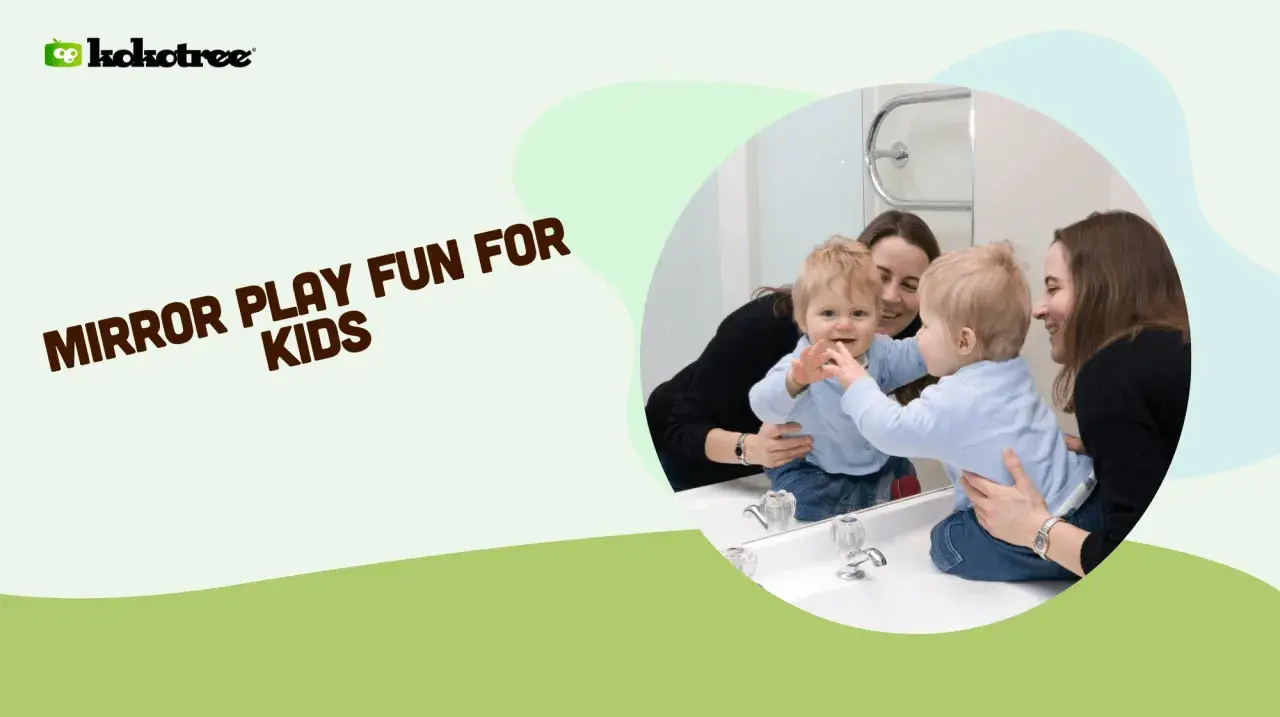
I like using mirrors with infants and toddlers because the payoff is immediate and surprisingly rich. A few minutes in front of a safe reflective surface can turn into face tracking, early imitation, body awareness, and little bursts of social back-and-forth that tell you a lot about development. In this article, I focus on what this kind of play reveals, how to set it up safely, and which activities actually make sense at each stage.
The quick version for parents and caregivers
- Use an unbreakable mirror for babies and a securely mounted mirror for toddlers.
- For young infants, the goal is attention, tracking, and interaction, not self-recognition.
- Clear mirror self-recognition usually emerges in the second year, often somewhere between 15 and 24 months.
- Short, repeated sessions work better than long ones; a few minutes is enough for most young children.
- The best mirror sessions include your voice, facial expressions, and simple labels like “nose,” “eyes,” and “smile.”
- Interest, imitation, and social smiles matter more than whether a child “performs” on cue.
How mirror play supports early development
At its best, mirror-based play is a compact developmental workout. Babies practice looking at faces, following movement, and linking what they do with what they see. Toddlers begin to connect the image in the mirror with their own body, which is a small but important step toward self-awareness. I also like mirrors because they naturally invite conversation, and conversation is where language, attention, and social learning start to overlap.
There is a practical reason mirrors show up so often in early-childhood guidance: they work. The AAP includes an unbreakable plastic or mylar mirror among appropriate toys for very young babies, which fits how early infants explore the world with their eyes and hands. Mirrors also help children notice cause and effect, because a movement, a smile, or a hand wave produces an immediate response in the reflection.
For parents, the value is not just “entertainment.” A mirror gives you a simple window into how a child is processing people, movement, and self versus other. That becomes especially useful once toddlers begin to shift from simply noticing the image to recognizing themselves in it, which is why the next section matters.
What children tend to do at different ages
Development is uneven, so treat these ages as practical guideposts rather than rigid checkpoints. Some children engage earlier, some later, and both can be normal. What matters is the pattern of response over time.
| Age range | Typical response to a mirror | What it may tell you | Best adult response |
|---|---|---|---|
| Birth to 4 months | Brief looking, face tracking, calming with a familiar voice | Early visual attention and social interest | Keep sessions short and talk softly while holding or supporting the baby |
| 4 to 8 months | Smiles, vocalizing, hand regard, repeated staring at faces or hands | Growing curiosity about body movement and social feedback | Copy the baby’s sounds and expressions; label what you see |
| 8 to 12 months | Reaching toward the image, touching the mirror, bouncing, vocal experiments | Cause-and-effect learning and stronger imitation | Make it interactive and add simple games like “Where is your nose?” |
| 12 to 18 months | Pointing, touching facial features, more directed self-touch, stronger interest in names and body parts | Emerging body awareness and early self-other distinction | Use body-part labels and simple imitation games |
| 18 to 24 months | More obvious self-recognition, self-directed actions, and interest in marking or fixing appearance | Developing mirror self-recognition | Keep the play conversational and use the mirror for pretend routines and naming emotions |
The pattern above is helpful because it keeps expectations realistic. A younger baby does not need to recognize “me” in the mirror for the activity to be worthwhile. In the first year, the value is mostly in attention, emotion, and interaction. In the second year, the mirror starts to become a tool for identity, language, and imitation.
Simple activities that grow with the child
The easiest sessions are usually the best ones. I would rather see a child engaged for two focused minutes than overstimulated for ten. The trick is to match the activity to the child’s stage and keep your role active rather than passive.
Birth to 6 months
For very young babies, think “notice and respond.” Lay the baby on a blanket near a low, safe mirror or hold a small mirror within view during supported time. Point out what is happening in simple language: “There’s your face,” “I see your eyes,” “That’s a big smile.”
- Use the mirror during tummy time to make head lifting more interesting.
- Move your face slowly near the reflection so the baby can compare you and the image.
- Repeat coos, smiles, and tiny pauses so the baby has a chance to answer back.
This stage is less about the mirror itself and more about the exchange it creates. If the baby lights up when you speak, that is the point.
7 to 12 months
At this stage, children usually become more active explorers. They may lean in, pat the mirror, or watch their own hands move. I like to make this phase playful and predictable.
- Play “copy me” with hand waves, claps, and open-mouth smiles.
- Hide a toy just outside the mirror’s view and help the child notice where it went.
- Use songs with body parts, then point to the matching feature in the reflection.
Here, the mirror helps a child notice that actions have visible consequences. That is a small cognitive leap, but it is a meaningful one.
Read Also: Best First Puzzle for Kids - Choose Right, Build Skills
12 to 24 months
This is where mirror sessions become more obviously social and self-directed. Toddlers often enjoy spotting body parts, testing expressions, and watching themselves move around. Some begin pretending they are brushing hair, making faces, or “checking” how they look.
- Ask simple questions like “Where is your nose?” and pause for the child to respond.
- Use the mirror for grooming routines: brushing hair, wiping faces, or applying lotion.
- Try emotion games such as “happy face,” “surprised face,” and “sleepy face.”
This is also the age when a child may begin to recognize that the reflection is theirs. When that happens, I see the mirror shift from toy to tool. It becomes a place for naming, pretending, and building a sense of self.
How to set up a safe mirror area
Safety is not the boring part here; it is the foundation. A good setup lets the child explore without turning the environment into a hazard. For babies and toddlers, I would treat any glass mirror as off-limits unless it is firmly installed and protected. An acrylic or other shatter-resistant mirror is the easier choice for home use.
- Choose an unbreakable mirror or a child-safe reflective panel.
- Mount wall mirrors securely and keep them low enough to be useful, not climbable.
- Check edges, fasteners, and nearby furniture so there is nothing sharp, loose, or top-heavy.
- Place the mirror where an adult can stay within arm’s reach.
- Keep the area uncluttered so the child can focus on the reflection, not on objects to grab and pull.
Light matters too. Natural daylight or a soft lamp makes faces easier to read than harsh glare. I also prefer a spot that is easy to supervise during real life, not just in a perfect setup for five minutes on a weekend. Once the space is safe, the activity becomes much easier to repeat, and repetition is where the learning happens.
What to watch for when you're observing development
The mirror is useful because it shows you more than “cute reactions.” It can reveal how a child is developing attention, imitation, body awareness, and social response. I pay attention to a few consistent signs:
- Does the child look at faces longer than at objects?
- Do they smile back, vocalize, or copy your expressions?
- Do they notice hands, feet, nose, eyes, or other body parts in the reflection?
- Do they begin to touch or point to themselves when they see the image?
- Do they seem interested in matching what they see with what they feel on their own body?
By the second year, more children start to show mirror self-recognition, which is one reason a simple reflective surface can be surprisingly informative. If a toddler seems puzzled at first, that is not a problem. Confusion is often part of the process. I only become concerned if a child consistently avoids face contact, rarely responds socially, or shows very limited interest in people and shared play across many settings. In that case, it is worth raising the topic with a pediatrician.
Common mistakes that make mirror time flatter than it should be
Most mirror activities fail for the same few reasons, and none of them are complicated. The good news is that they are easy to fix once you notice them.
- Turning it into a test. If you ask “Who is that?” before the child is ready, the session becomes pressure instead of play.
- Using too much stimulation. Loud toys, flashing lights, and multiple adults can distract from the mirror itself.
- Expecting a milestone on schedule. Self-recognition does not appear on command, and it does not need to.
- Leaving the child alone with it. The adult interaction is what gives the activity developmental weight.
- Choosing the wrong mirror. A wobbly, fragile, or awkwardly placed mirror creates more risk than value.
My rule is simple: if the child is calm, curious, and interacting, the setup is working. If the child is fussy, distracted, or trying to escape, the activity is probably too long, too loud, or too ambitious for that moment. The best response is usually to simplify, not to push harder.
Why the simplest sessions often work best
The most effective mirror sessions are usually the ones that look almost too basic from the outside. A baby on the floor, a caregiver naming facial features, a toddler making silly faces, a few repetitions, then a break. That is enough. You do not need special equipment, elaborate prompts, or a long checklist of “outcomes.”
What I value most is the combination of observation and interaction. The mirror lets you see where a child is developmentally, but your voice, timing, and attention are what turn the moment into learning. If you keep the setup safe, stay responsive, and let the child lead, you get a small activity with a lot of developmental value.
And if you want the shortest version to remember later, it is this: use a safe mirror, keep the session brief, talk to the child, and follow their cues. That approach works far better than trying to make the reflection do all the work.
