The best starter puzzle is the one that matches hands, attention, and safety
- Choose oversized pieces and a durable build before you chase piece count.
- Match the format to the child's current stage: knob puzzles, peg puzzles, or very simple jigsaws.
- Look for one clear image, strong contrast, and pieces that are easy to grasp and rotate.
- Keep frustration low enough that the child can finish with light help, not constant rescue.
- For children under 3, avoid small or detachable parts and check every piece for choking risk.
Why puzzle play matters in early development
When a child turns a piece, tests a fit, and tries again, several skills are working at once. Fine motor control is the small-muscle work of the fingers and hands; spatial reasoning is the ability to judge shape, position, and rotation. A puzzle also quietly trains persistence, because the child learns that effort, not speed, is what gets the picture finished.
I like puzzle play for one simple reason: it feels like play to the child, but it behaves like a workout for the brain. Early puzzle play has been linked with stronger spatial skills later on, and that matters far beyond the toy box because spatial skill supports drawing, building, and later math thinking. That is why size and shape matter more than a clever theme, which leads to the more practical question of what fits which age.

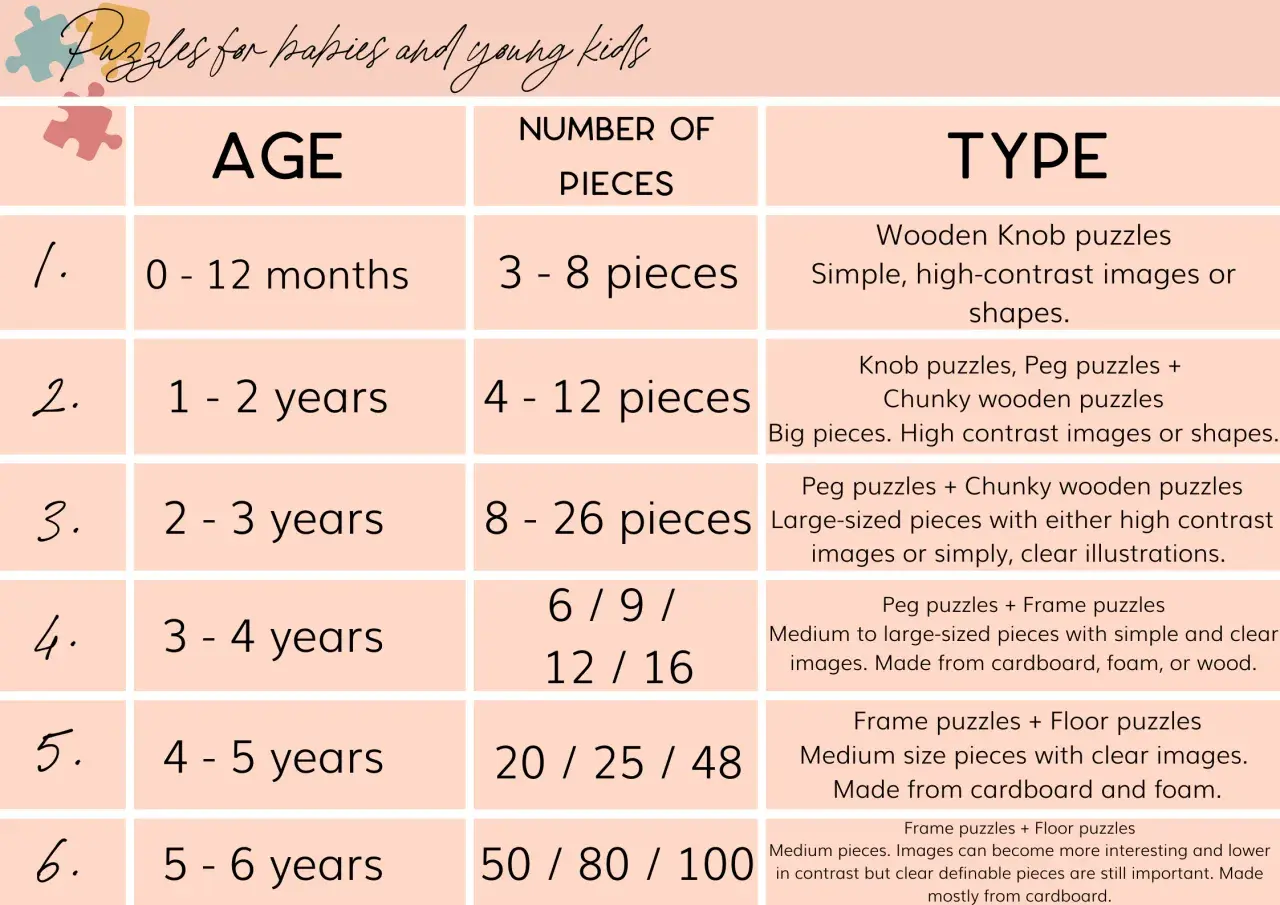
How to match a puzzle to age and hand skills
I treat age labels as a starting point, not a verdict. A child who pinches well, rotates objects confidently, and enjoys matching games may be ready sooner than the box suggests; another child may need a simpler stage even if the printed age looks right. For many children, the sweet spot is not about the highest piece count they can survive, but the one they can finish with a little effort and no collapse at the end.
These ranges are practical guidelines, not hard rules. I use them to narrow the field, then I watch how the child actually handles the pieces.
| Child's stage | Best starter format | Typical piece range | What I look for |
|---|---|---|---|
| 12-18 months | Chunky knob or inset puzzle | 1-3 pieces | One obvious match, thick pieces, easy grasp |
| 18-24 months | Chunky inset puzzle or shape matcher | 2-4 pieces | Clear contrast, oversized handles, simple image |
| 2-3 years | Peg puzzle or beginner jigsaw | 4-5 large pieces | Enough challenge to require turning, but not guessing |
| 3-4 years | Simple jigsaw | 6-12 pieces | Clear border, familiar subject, not too busy |
| 4+ years | Early floor or tabletop jigsaw | 12-24 pieces | More sorting, more planning, still readable artwork |
That 4- or 5-piece large-jigsaw range lines up with the simple guidance HealthyChildren gives for many 3-year-olds, and it is a good example of how the best fit is usually boringly practical. Once the format matches the child's stage, the next filter is safety, because a good fit is useless if the pieces are wrong for the child's age.
Safety checks I would not skip
In the United States, the CPSC small-parts ban is the reason I refuse any puzzle with tiny detachable pieces for children under 3. HealthyChildren makes the same basic point in simpler language: think large, and make sure pieces are bigger than the child's mouth. For toddlers, that usually pushes me toward chunky wood, large inset boards, or puzzles with knobs that are firmly attached.
- Test the size with a toilet-paper tube or similar choke-tube check if you are unsure.
- Check the seams for loose layers, peeling corners, or pieces that can split.
- Avoid weak extras such as small beads, loose buttons, magnets, or decorations that can pop off.
- Look for smooth edges and a finish that can survive chewing, bending, and floor drops.
- Match the label to the child you actually have, not the child you expect in six months.
Safety clears the way, but the puzzle still has to be pleasant to use, so the next question is what makes a starter set genuinely playable.
What makes a starter puzzle actually playable
The easiest mistake is buying a puzzle that looks pretty on the shelf but gives the child too much visual noise. I want one clear subject, strong contrast, and pieces that make sense when a child sees them out of order. Animals, vehicles, familiar foods, and simple scenes usually work better than crowded artwork because the brain has less to sort through before the hands get involved.
Material matters too. Wood usually wins for toddlers because it is thicker, easier to grip, and less likely to curl; thick cardboard is better once the child is past the rough-handing stage and wants more variety. If I am choosing between a flashy theme and a durable build, I take durability every time, because repeated use is what turns a toy into a skill builder.
- Choose a picture the child can name.
- Prefer large, distinct pieces over tiny details.
- Pick a board or tray that holds the pieces in place.
- Avoid puzzles that depend on reading or fine color shading.
- Keep the challenge just above easy, not far above it.
That keeps the puzzle inviting instead of frustrating, and it sets up the way you should actually sit down and use it.
How to use puzzle time so it builds more than patience
How an adult handles puzzle time changes the value of the toy. If I take over too quickly, the child gets entertainment but loses the chance to think, turn, compare, and correct. If I stay completely hands-off when the puzzle is too hard, the child usually quits before any learning sticks. The middle path is short, calm, and a little repetitive.
- Start with one obvious piece, or with the border if the puzzle has a clear edge.
- Name what the child is doing: "That one needs a turn," "This piece is flat," or "The dog belongs here."
- Let the child make the final move whenever possible.
- Stop before fatigue shows up. For many toddlers, 5 to 10 minutes is enough; for preschoolers, 10 to 20 minutes often works well.
- Repeat the same puzzle several times instead of treating each attempt like a one-time test.
I like puzzle time best when it feels like a small ritual. The child gets a predictable challenge, and I get a better read on when the next level is appropriate, which brings me to the mistakes that most often throw parents off.
The mistakes I see most often
Most puzzle problems are not really about intelligence; they are about mismatch. A child can be bright, curious, and determined and still hate a puzzle that is too busy, too small, or too advanced for their current hand control. When that happens, the adult often assumes the child is not into puzzles, when the real issue is that the puzzle asked for a skill the child had not built yet.
- Buying by age label alone instead of watching how the child actually handles pieces.
- Jumping from a 3-piece board straight to a 24-piece jigsaw.
- Choosing a visually crowded design that gives no clear starting point.
- Helping so much that the child never has to rotate, compare, or problem-solve.
- Expecting the child to sit still longer than their age and attention span allow.
The fix is usually modest: make the puzzle easier in the right way, not easier in every way. Once that balance is right, you can tell when the child is ready for the next level, and that is where the real payoff shows up.
What comes after the starter stage
I look for a few simple signs before I move up: the child finishes without stress, uses the picture for clues, turns pieces without help, and stays engaged long enough to try again after a mistake. When those things are happening, I move from chunky boards to simple jigsaws, then to larger piece counts in small steps. The jump should feel like progress, not a personality test.
- From 1-3 pieces to 4-5 large pieces
- From 4-5 pieces to 6-12 pieces with clearer borders
- From 6-12 pieces to 24+ pieces only when sorting and rotation are already easy
I also keep one easy puzzle in rotation even after a child has outgrown it, because quick success still matters. Confidence is part of development, not a bonus, and the best toy shelf usually has one option that is comforting, one that is stretching, and one that is just right for today.
