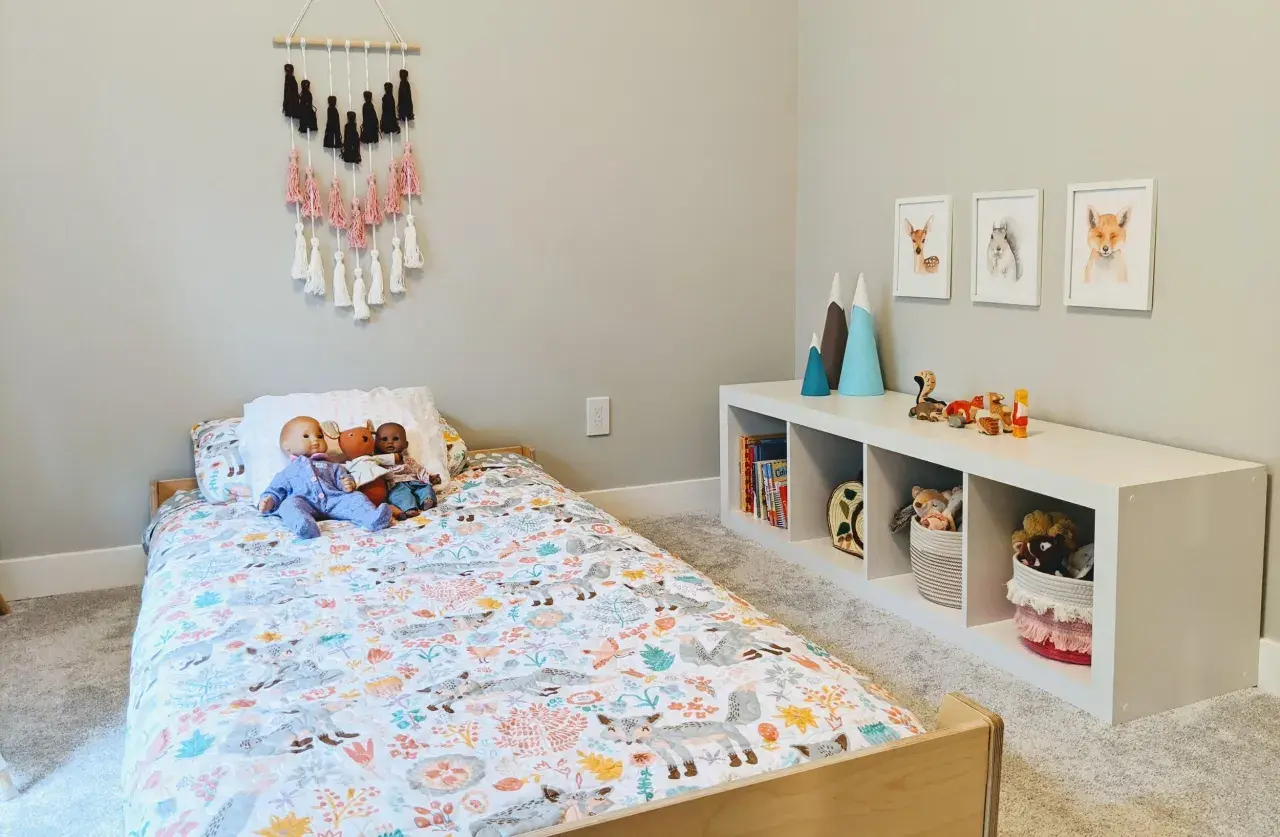
What matters most before the first night
- Use a floor bed for a child who is developmentally ready, not as a shortcut for infant safe sleep.
- Keep the mattress firm, flat, and properly sized, with no soft add-ons that can trap or cover a child.
- Anchor furniture, cover hazards, and clear cords, windows, and climbable items before the mattress goes in.
- Let the room support movement with low lighting, a simple path to the door, and very little clutter around the bed.
- For toddlers, the setup works best when bedtime stays predictable and the room is easy to reset every day.
Know when a floor bed makes sense
I always start here because timing matters more than aesthetics. For babies under 1 year, the AAP still recommends a separate sleep surface in the parents’ room, ideally for at least the first 6 months and preferably up to 1 year. That means a crib, bassinet, or play yard is still the right call for infant sleep, even if a low bed looks appealing.
For toddlers, the picture changes. A floor bed can support independence, reduce the climb-out drama, and make bedtime easier to navigate once a child is ready to get in and out safely. CPSC defines a toddler bed as a bed intended for a child at least 15 months old and no more than 50 lbs., which is a useful benchmark when you are comparing your options.
| Stage | What I recommend | Why it usually fits best |
|---|---|---|
| Under 1 year | Crib, bassinet, or play yard | AAP safe sleep guidance calls for a firm, flat, separate sleep space |
| Ready toddler | Floor bed or toddler bed | Lower fall risk than climbing out of a crib and easier independent access |
| Climbing, resisting, or outgrowing the crib | Transition now | The crib is no longer the safer or easier option |
Once the child is truly ready, the next decision is the sleep surface itself, because a low bed only works when the mattress supports it properly.
Choose a mattress that stays firm and flat
The mattress is the part I am least willing to compromise on. A floor bed should still feel like a real sleep surface, not a cushion pile, and it should not indent heavily under a child’s weight. If the mattress feels plush enough to sink into at the store, I usually pass.
My practical rule is simple: firm, flat, cleanable, and boring. A standard crib mattress is often the most straightforward option for a younger child because it is designed to be firm and sized for small bodies. For older toddlers, a low-profile mattress can work too, but I avoid thick toppers, deep pillow-top styles, and anything that creates a soft hollow around the body. If the room is humid, a very low slatted base can improve airflow, but only if it stays genuinely low and does not become a climbing point.
If you are setting this up for a child who is still in the infant phase, keep the AAP rule in mind: the sleep surface should be firm and flat, and anything over a 10-degree incline is not considered safe for infant sleep. That is another reason I do not try to make a floor bed do a crib’s job.
- Use a fitted sheet that stays tight and smooth.
- Skip mattress toppers unless a pediatrician or sleep specialist has a specific reason.
- Choose a mattress size that does not leave awkward gaps at the edges.
- Avoid fluffy padding that makes the bed look inviting but feel unstable.
Once the mattress is right, the room itself becomes the real safety project, and that is where most people underestimate the work.
Childproof the room before the mattress goes down
A low bed reduces one kind of risk, but it also gives a child more freedom to move at night. That is exactly why the room has to be safer than a typical nursery. I treat every reachable surface, cord, and piece of furniture as part of the sleep setup.
- Anchor dressers, bookcases, and TV stands to the wall so they cannot tip if a child climbs.
- Move cords, chargers, baby monitors, and lamp wires out of reach or secure them tightly.
- Use outlet covers and keep small objects, batteries, and decorative items off the floor.
- Install window guards if needed, because a screen is not enough to prevent a fall.
- Keep blinds and curtain cords completely out of reach.
- Store medications, cleaning products, and other hazards in locked cabinets.
I also pay attention to what children can climb onto. If a stool, ottoman, low shelf, or toy chest can become a step, I assume it eventually will. That is why I like the room to feel sparse around the bed, at least at first. Once the room is safe, placement becomes the next design choice, and that is where the whole thing either feels calm or starts getting messy.

Place the bed where movement stays easy
The best placement is usually the one that gives a child a clear, easy path to get in and out without bumping into furniture. I like to think in terms of movement first and decor second. If the room forces a child to squeeze past a shelf or step over toys to reach the door, the layout needs more work.
In practice, I look for a spot that is away from windows, cords, heaters, and anything hanging overhead. If one side of the mattress sits near a wall, I keep that edge plain and avoid adding pillows or bulky barriers that create entrapment problems. I also like a low night light and a soft rug in the traffic path, but not a fluffy one that bunches up or becomes a tripping point.
For many rooms, the winning layout is surprisingly simple: bed, clear floor, one small basket for books or a comfort item, and nothing else competing for attention. Once the layout is set, bedding and bedtime cues become much easier to manage.
Put together the bedding and routine with restraint
This is the part where people tend to overdecorate. I understand why: a floor bed can look cozy, and it is tempting to add pillows, canopies, extra blankets, and plush toys. I usually do the opposite. I keep the bed visually quiet on purpose because sleep spaces work better when they do not double as play forts.
For infants, the rule is easy: no loose bedding, pillows, stuffed toys, or bumpers. For toddlers, I still keep things minimal. A fitted sheet is the base. A light blanket can make sense when the child is old enough to use one safely and consistently, but I would rather start plain and add only what is truly needed. Weighted blankets, oversized pillows, and decorative bolsters do more harm than good in a small sleep space.
Routine matters just as much as the bedding. A floor bed works best when the child gets the same sequence every night: bath or wash-up, pajamas, book, lights down, sleep cue. That predictability makes the open access to the bed feel manageable instead of chaotic. With the room and routine in place, the actual assembly becomes a short, deliberate process.
Set it up step by step
- Clear the room completely and vacuum or mop the floor so you start with a clean surface.
- Anchor the furniture, secure cords, and cover every obvious hazard before the mattress arrives.
- Place the mattress where the child can enter and exit easily without hitting nearby furniture.
- Add the fitted sheet and keep the bedding age-appropriate and minimal.
- Set the night light, return only the essentials to the room, and leave the floor mostly open.
- Test the setup during the day first, then try the first nap before committing to a full night.
I like the daytime test because it exposes problems fast. If the child immediately heads for a bookshelf, a cord, or the closet, the layout still needs tightening. Once the setup survives a nap, you usually know the room is close to right. The next step is watching for the mistakes that quietly undermine all that work.
Mistakes that cause the most trouble
The biggest mistake I see is treating a low bed as automatically safe. Height is only one part of the equation. A room full of hazards can still be a bad sleep environment even when the mattress sits inches from the floor.
- Starting too early, before the child is ready for open access.
- Using a mattress that is too soft, too thick, or not sized well for the space.
- Adding bumpers, pillows, or rolled blankets as a fake guardrail.
- Leaving climbable furniture in the room because it looks nice.
- Overfilling the sleep area with toys, books, and decorative items.
- Skipping the room reset after playtime, which turns bedtime into a scavenger hunt.
I also see families underestimate how quickly children adapt. If something is reachable, movable, or climbable, a toddler will test it. That is why simplicity is not a design trend here; it is part of the safety plan. After the first week, I always recheck whether the room is still working as intended.
What I would recheck after the first week
By the end of the first week, the setup has usually revealed its weak spots. That is when I pay attention to what changed at bedtime, not just what looked good in the room photo. A floor bed should make sleep easier, not create a new round of wandering or stalling.
- Does the child stay near the bed, or do they immediately roam to toys and shelves?
- Is the mattress staying flat and centered, or does it slide around?
- Did any new climbing points appear once the child started exploring at night?
- Is the room still dark enough and calm enough for sleep?
- Did bedtime get longer because the setup has too much stimulation nearby?
If the answer to any of those is yes, I do not blame the child first. I tighten the room first. That is usually where the fix lives. Keep the mattress firm, the floor clear, the furniture anchored, and the routine predictable, and the whole arrangement becomes much easier to live with.
