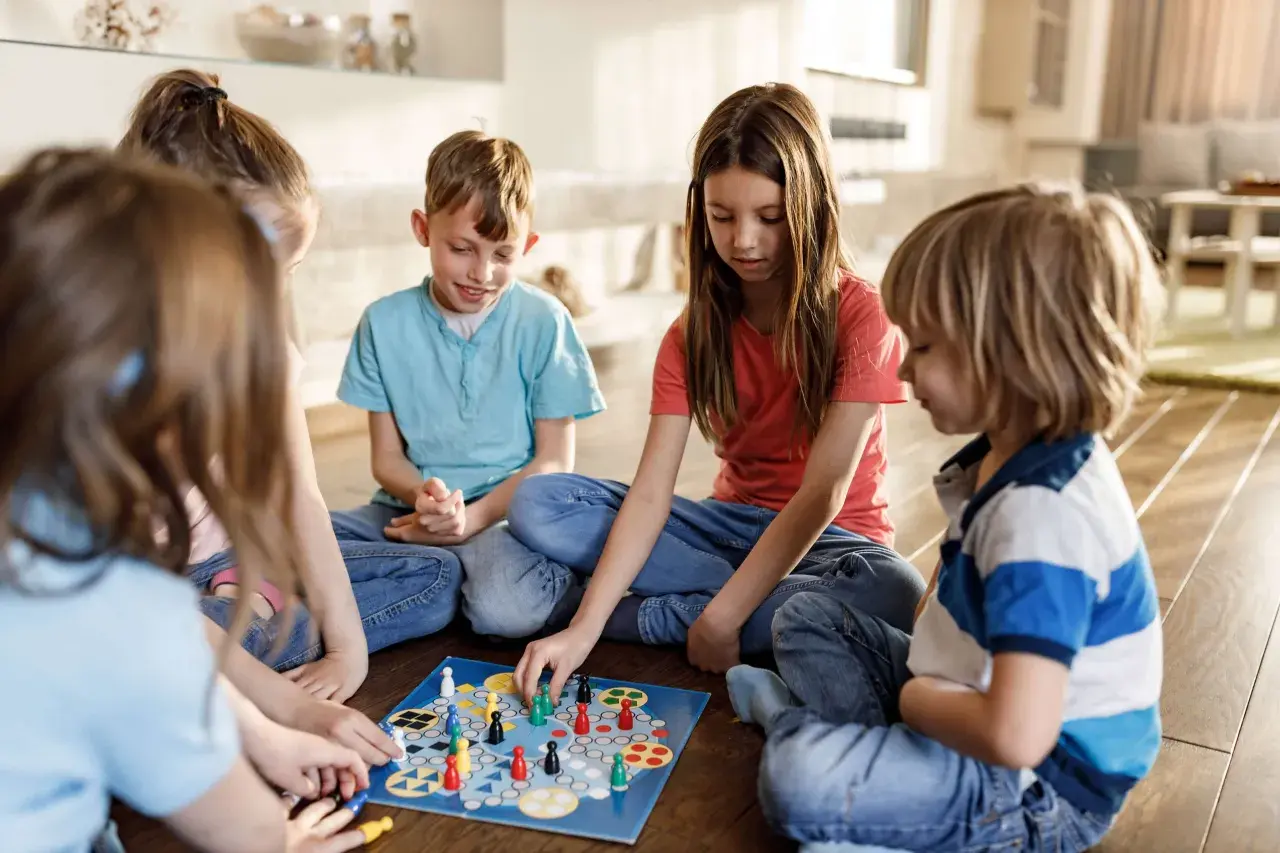
Shared play can be a lot more than a way to kill time. The right sibling activities help children cooperate, use language, manage frustration, and enjoy each other without turning every moment into a competition. In this guide, I focus on practical things to do with siblings at home and outdoors, plus the small adjustments that make mixed-age play actually work.
Quick sibling-play ideas that balance fun, cooperation, and low prep
- Choose shared goals over head-to-head games when the age gap is wide or rivalry is high.
- Keep a few low-prep activities ready so boredom does not turn into conflict.
- Use movement outside when siblings need to burn energy before they can play calmly.
- Match the task to the younger child’s skills and give the older child a useful role.
- Set a 10- to 15-minute timer for the first round of play and stop while it is still going well.
- Keep a simple play kit on hand so you do not lose momentum searching for supplies.

The activities that usually work best
When I look for sibling activities, I start with one question: does this create a shared goal? If the answer is yes, the odds of cooperation go up fast. If the activity simply creates a winner and a loser, it can still be fun, but it is usually a worse choice when kids are tired, unevenly matched, or already bickering.
| Activity type | Best for | Why it helps development | Setup level |
|---|---|---|---|
| Cooperative build | Mixed ages, kids who like blocks or magnets | Planning, language, shared problem-solving | Low to medium |
| Movement game | High-energy siblings who need space | Gross motor skills, self-control, following directions | Low |
| Pretend play | Imaginative kids with different ages | Storytelling, empathy, flexible thinking | Low |
| Creative project | Rainy days and quieter personalities | Fine motor skills, patience, sequencing | Medium |
| Timed challenge | Siblings who do better without scorekeeping | Teamwork, focus, emotional regulation | Low |
That pattern lines up with what the CDC keeps stressing in early development guidance: children learn a lot from taking turns, sharing attention, and playing with other kids. Once you know the right format, the actual activity becomes much easier to choose.
From here, the question is less “What should they do?” and more “Which version fits the day we are having?”
Easy things to do at home when you need a fast win
Home is where sibling play often falls apart first, so I like activities that need little setup and have a clear finish. The best ones give each child a job, keep materials simple, and make it obvious when the game is done.
- Indoor scavenger hunt - Use picture clues for younger kids or simple riddles for older ones. This works well because it keeps everyone moving toward the same target instead of competing directly.
- Fort and mission game - One child builds the fort, the other hides a stuffed animal, snack, or clue. Then they switch. The role swap matters because it keeps the power balanced.
- Story chain - Each sibling adds one sentence to a story. I like this one for mixed ages because the younger child can contribute without needing to “win” anything.
- Lego or block challenge - Give them one prompt, such as “build a zoo,” “build a toy shop,” or “build the tallest tower that can survive a fan test.” Shared constraints reduce arguments.
- Card or dice game with a twist - Classic games can work, but I usually prefer ones where siblings play against a task instead of each other. For example, see how many rounds they can complete in five minutes.
- Kitchen helper line - One sorts ingredients, one stirs, one counts scoops, and one sets the table. This is not just useful; it also teaches sequencing and turn-taking in a real-world setting.
- Mini movie or puppet show - Have one child direct, one act, and one manage props. Even if the script is messy, the collaboration itself is the point.
If I had to pick one rule for indoor play, it would be this: do not let the setup outgrow the children’s attention span. A 10-minute game that starts quickly usually beats a 45-minute project that collapses before anyone gets to the fun part. Next, it helps to move that same logic outside, where energy is easier to channel.
Outdoor play that uses movement instead of arguments
Outdoor play often works better when siblings are tense because it gives them space. There is less face-to-face friction, more room to move, and a natural excuse to focus on the activity instead of each other. I reach for outdoor ideas whenever I want to lower the temperature in the room.
- Backyard obstacle loop - Set up five stations: hop, crawl, throw, balance, and spin. Make it a team circuit instead of a race, so both kids try to beat the clock together.
- Sidewalk chalk course - One sibling draws a path, arrows, or jump spots; the other follows it. Then they switch. This is a simple way to combine creativity with movement.
- Nature scavenger hunt - Keep the list short: a leaf, a rock, something round, something soft, something yellow, something that smells interesting. Six items is enough for most ages.
- Bike or scooter parade - Instead of racing, have them complete a route together and practice stopping, turning, and signaling. That makes the activity calmer and safer.
- Water relay - Use a sponge, cup, or small bucket to move water from one container to another. It is simple, cheap, and surprisingly good for teamwork.
- Shadow tracing - One child makes a pose, the other traces the shadow with chalk. It is quiet, a little silly, and ideal when you want cooperation without a lot of noise.
Outdoor play is especially useful when the siblings are close in age but not equally patient. A moving game gives the more restless child an outlet while still keeping the pair connected. Once you have movement and space working for you, creativity becomes easier too.
Creative projects that build cooperation and imagination
Creative play is where sibling dynamics often show their best side. There is room for negotiation, role-switching, and shared decision-making, which is exactly why these activities do so much developmental work in the background.
- Make a comic together - One sibling draws, the other writes speech bubbles. The result is fun, but the real value is learning to build on someone else’s idea.
- Build a cardboard town - Use boxes, tape, markers, and toy figures to create a city, zoo, or rocket base. This is a strong fit for toy-loving kids because the project can include their favorite figures without turning into a possession fight.
- Create a toy store or museum - One child curates the display, the other designs signs or labels. I like this one because it quietly introduces sorting, naming, and presentation skills.
- Start a pretend business - A pet clinic, ice cream stand, repair shop, or library all work well. Pretend play helps kids practice perspective-taking, which is a big deal in sibling relationships.
- Record a family radio show - They can interview each other, review favorite toys, or act out a story. Audio projects are useful when one child likes to perform and the other prefers to stay off camera.
- Design a board game - Older siblings can help with the rules; younger siblings can help with the board, cards, or pieces. The finished game often becomes more interesting than a store-bought one because they helped invent it.
Creative projects work best when you let each child own one part of the process. If one child controls everything, cooperation disappears. If both children have visible jobs, the activity becomes a lesson in negotiation rather than a silent tug-of-war. That matters even more when the siblings are different ages.
How to match the activity to the age gap
The age gap matters, but not in the simplistic way people sometimes assume. A three-year gap is not automatically a problem. The real issue is whether the activity lets both children succeed without one of them dominating the whole thing.
| Sibling mix | Best formats | What to avoid | Useful tweak |
|---|---|---|---|
| Toddler and school-age child | Pretend play, picture scavenger hunts, building with large blocks | Small pieces, long rule explanations, fast scoring games | Give the older child the role of helper or clue giver |
| Close-in-age siblings | Relay races, shared crafts, timed challenges | Anything that turns into nonstop one-upmanship | Use a team timer instead of a score |
| Older child and tween | Build projects, card games, creative contests with shared rules | Activities that reward only speed or strength | Rotate roles every round so both get a turn to lead |
| Big age gap | Read-aloud games, museum-style play, storytelling, guided building | Strictly competitive games where the older child can win instantly | Make the task asymmetric, not equal |
My rule is simple: the younger child should have a real way to contribute within the first minute. If the older sibling gets all the interesting jobs, the younger one loses interest or starts acting out. If the younger sibling can make a visible choice right away, both kids stay engaged longer. That leads straight into the part most families need most: keeping the play from unraveling.
How to keep sibling play from turning competitive
Even a good activity can fall apart if the structure is wrong. In my experience, sibling fights usually come from one of four things: unclear rules, uneven skills, too much waiting, or a game that rewards one winner and one loser every single round.
- Use one shared objective - “Finish the obstacle course together” works better than “beat your sibling.”
- Keep rounds short - Ten to 15 minutes is usually enough for a first run. If it is going well, they can repeat it.
- Assign different jobs - One child can build, one can time, one can hide clues, and then they swap.
- Remove scorekeeping when needed - Some siblings handle points just fine; others become instantly rigid about winning.
- Keep duplicate supplies nearby - Two crayons, two markers, or two flashlights prevents a lot of unnecessary conflict.
- Use a reset phrase - I like something short: “Pause, switch, try again.” It is easier to hear than a long lecture.
- End on success - Stop while they are still cooperating, not after everyone is annoyed.
The biggest mistake I see is trying to rescue a bad dynamic with a more complicated game. That usually makes things worse. Simpler rules, clearer roles, and shorter rounds do more than fancy materials ever will. With that in mind, a small ready-to-go kit can save you a lot of setup time.
The small play kit I would keep ready
If siblings play together often, I would keep one compact bin or tote ready with the basics. The goal is not to buy more stuff; it is to make starting easier than arguing. A good kit reduces friction before the activity even begins.
- Painter’s tape for forts, floor games, and obstacle lines
- Markers, crayons, and plain paper for drawing or story games
- A deck of cards and a couple of dice
- Sidewalk chalk for outdoor courses and hop paths
- Sticky notes for clue hunts and labeling games
- Blocks, magnetic tiles, or other buildable toys
- A foam ball or soft beanbag for safe throwing games
- Scissors, glue sticks, and recycled cardboard for crafts
- Small containers or envelopes for treasure hunts and sorting
- A timer so you can keep play short and clean transitions simple
The best sibling activities are usually not the most elaborate ones. They are the ones that create a shared goal, leave room for different skill levels, and can be repeated tomorrow without a full reset. That is what makes play useful for development instead of just filling an afternoon.
