What matters most at a glance
- Parallel play is side-by-side play with little direct interaction.
- Associative play adds conversation, imitation, and loose interaction, but not yet a shared goal.
- The shift is gradual, not a switch, and many children move back and forth by setting.
- Parallel play often appears in the toddler years; associative play is more common in the preschool years, but age is only a guide.
- Both stages build important skills: observation, language, turn-taking, imitation, and early social confidence.
- Good support is usually simple: duplicate toys, open-ended materials, calm supervision, and low pressure.
How the two stages look in real life
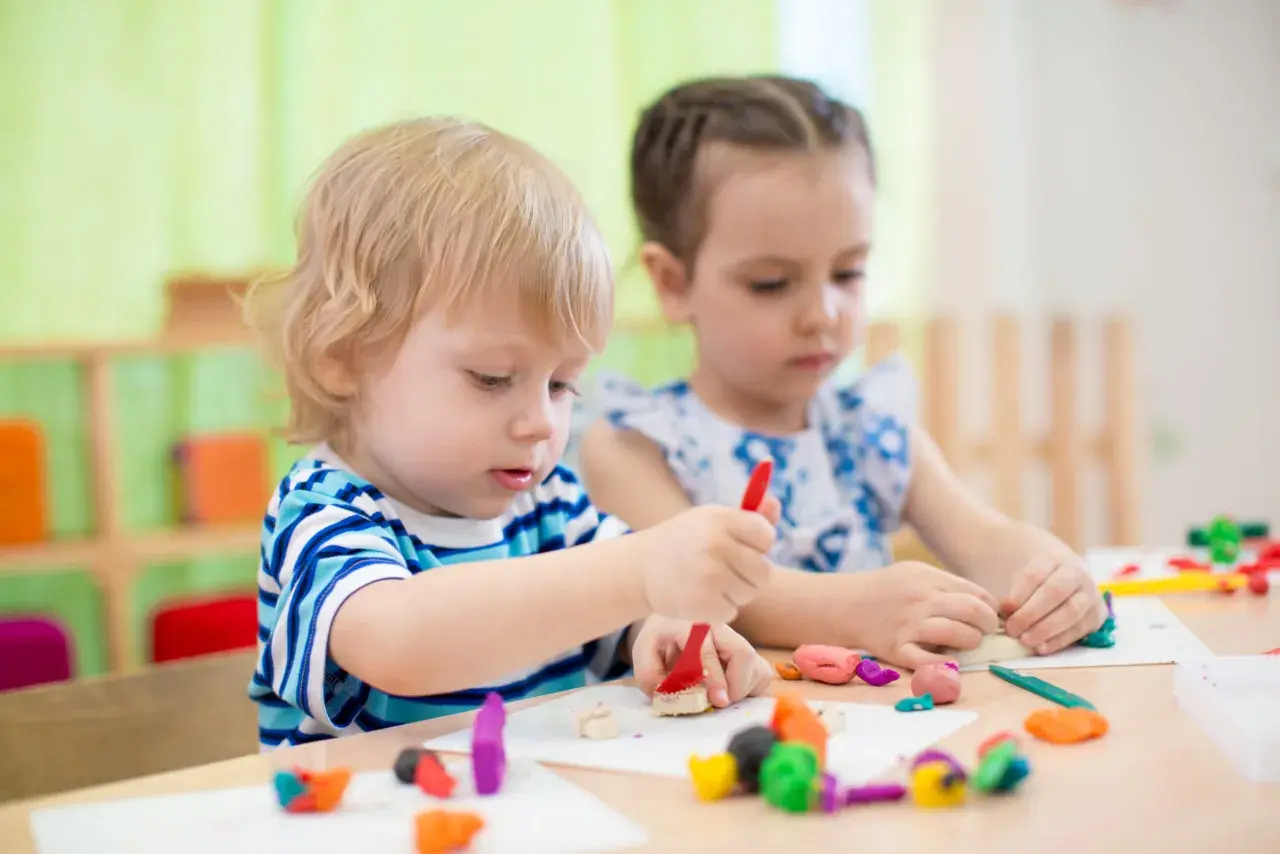
I find Pathways.org’s description useful here: in parallel play, children are beside each other, but each child is still running a separate little game. One child may be stacking blocks while another lines up cars on the same rug, and neither feels the need to join the other.
Associative play moves one step further. Children begin to notice and respond to one another. They may swap materials, comment on what they are building, imitate actions, or laugh at the same moment, but the play still lacks a single shared goal. That is why the same table, sandbox, or block corner can show very different social depth depending on what the children are doing with each other.
In practice, I think of parallel play as shared space without shared intention, while associative play is shared space with growing social interest. That difference in intention is what separates a child who is simply near peers from a child who is beginning to play into them, and it leads straight into the side-by-side comparison below.
The differences that actually matter
The cleanest way to compare these stages is to look at interaction, purpose, and the kind of support children usually need. The HSE treats both as normal parts of learning to play with others, and that is the right frame: they are steps, not problems to fix.
| Feature | Parallel play | Associative play | What to notice |
|---|---|---|---|
| Interaction | Children play next to each other. | Children begin to notice and respond to one another. | Look for eye contact, imitation, brief talk, or shared laughter. |
| Goal | Each child follows a separate plan. | The activity overlaps, but the goal is still loose. | Same materials do not always mean the same stage. |
| Communication | Minimal or none. | More talking, naming, and simple negotiation. | Short exchanges matter more than perfect cooperation. |
| Adult role | Set up space and stay nearby. | Model language and gentle turn-taking. | Support should match the child’s tolerance. |
| Developmental signal | Comfort with peers close by. | Growing interest in peer interaction. | Progress is usually gradual and uneven. |
Once you see that pattern, it becomes much easier to read what a child is practicing instead of guessing from appearance alone. A quiet room can still be socially rich, and a noisy room is not automatically more advanced.
Why these stages matter for development
I care about these stages because they do different developmental work. Parallel play gives children repeated exposure to peers without too much social pressure, which is especially useful for toddlers who are still learning to tolerate being near other children. Associative play adds a new layer: children have to track other people’s actions, respond to them, and make room for simple cooperation.
That shift supports several skills at once:
- Observation and imitation. Children watch what others do, then try it themselves.
- Language growth. Casual comments, requests, and naming objects start to appear more often.
- Emotional regulation. Children practice staying calm while another child uses the same space or toy.
- Flexibility. They begin to handle small changes in plan without falling apart immediately.
- Early peer awareness. Other children stop being background noise and start becoming part of the play environment.
That is why I do not treat these stages as a race toward “more social” behavior. They are the scaffolding that supports later cooperative play, when children finally start working toward the same goal. When I think about play and development in a nursery or preschool setting, this is the layer that matters most: the child is rehearsing how to be with others before they are ready to truly play with them.
That is also the reason I read a child’s play as a process, not a test, and that mindset makes the next practical question much easier to answer.
How to encourage the next step without forcing it
If you want to support movement from parallel play into more interactive play, the best strategy is usually to lower pressure and raise opportunity. I would start with the environment before I start with instructions.
- Use duplicate or near-duplicate toys. Two sets of blocks, crayons, cars, or animal figures reduce conflict and let children stay side by side long enough for interaction to emerge.
- Choose open-ended materials. Blocks, play dough, magnetic tiles, and sensory bins invite separate play first, then sharing and imitation later.
- Set up side-by-side spaces. A small art table, a floor mat with two building zones, or a water table with enough tools for both children works better than a single central toy.
- Model short, usable language. Phrases like “my turn,” “your turn,” “show me,” and “can I have that?” are more helpful than long explanations.
- Stay close, but do not over-direct. Children often need an adult nearby, not an adult running the whole interaction.
- Expect short bursts. A child may interact for 20 seconds, drift back into solo play, then rejoin. That still counts.
For toys and nursery setups, I usually prefer items that can be duplicated or divided easily. A play kitchen, a train set with enough tracks, or a large drawing surface is often more useful than a single toy that forces one child to wait. The goal is not to speed up the stage, but to make the next one easier to reach.
Common mistakes adults make when they read play too literally
Most confusion around these stages comes from expecting visible togetherness to mean social maturity. I see the opposite mistake too: adults sometimes assume that quiet side-by-side play is a warning sign when it is actually a healthy part of development.
- Forcing sharing too early. Young children often need help with turn-taking before they can truly share in a relaxed way.
- Assuming parallel play is antisocial. It is not. It is often the bridge that makes later interaction feel safe.
- Calling any noisy group play “social.” Children can be loud and still be doing separate things.
- Expecting one setting to tell the whole story. A child may play more independently at home and more socially at preschool, or the reverse.
- Rushing to the next stage. If a child is still comfortable in parallel play, that does not mean something is wrong.
Reading the behavior correctly matters, because the wrong interpretation leads to the wrong kind of help. A child who needs space will shut down if pushed, while a child who is ready for interaction may need a small nudge rather than a full intervention.
What I would watch for before worrying about the pace of play
Most children move through these stages unevenly, and that unevenness is normal. A child may be very social at the playground, but more solitary at home; another may happily play beside peers for months before suddenly starting to converse and coordinate.
If I were watching for a broader concern, I would look less at one play session and more at the pattern across settings. I would want extra attention if a child consistently showed none of the following:
- interest in nearby children over time
- imitation of peers or adults during play
- attempts to communicate, even with gestures or simple words
- flexibility when another child joins the space
- growth in play skills alongside language, hearing, or motor concerns
If those concerns show up across home, childcare, and playground settings, I would talk with a pediatrician or an early intervention team. Otherwise, I would treat the stage as information, not a verdict. The most useful question is not whether a child is ahead or behind, but what kind of social work the child is doing right now.
