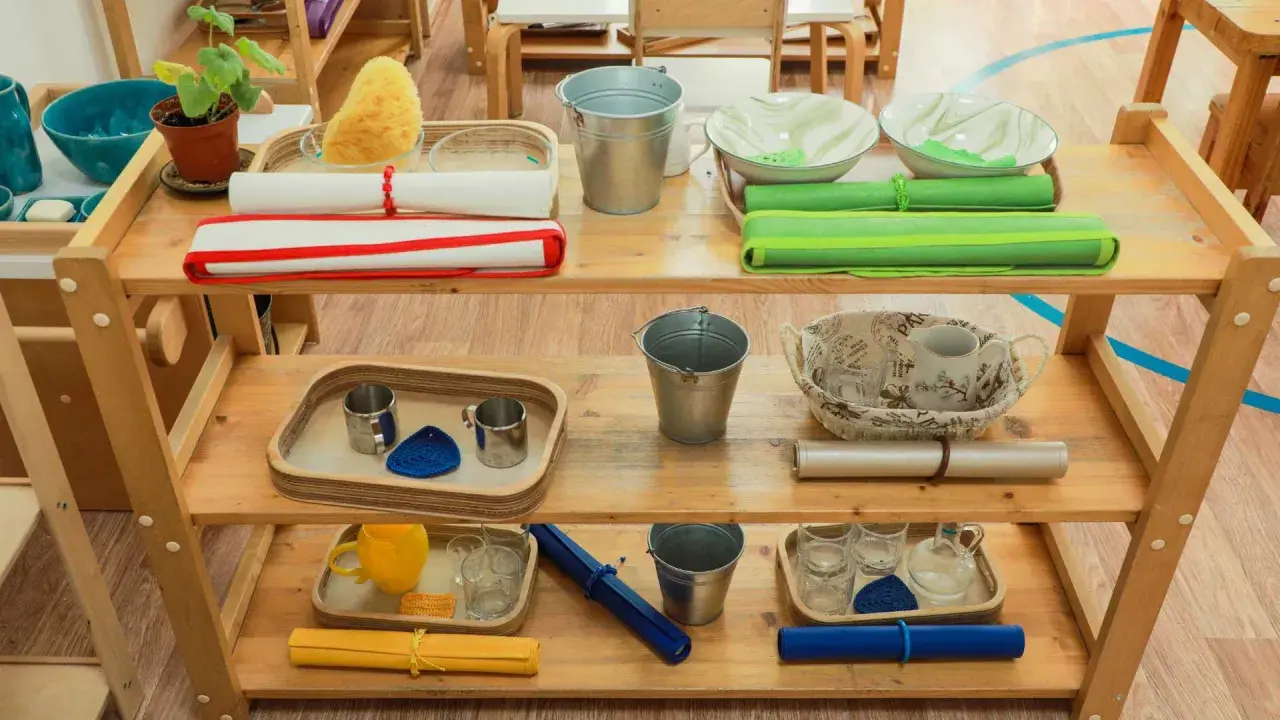
What matters most when you bring Montessori home
- Independence within limits is the goal: the child should be able to try, repeat, and finish real tasks.
- Practical life work matters more than fancy materials because it builds coordination, order, and concentration.
- The environment does the teaching: low shelves, simple choices, and reachable tools reduce friction.
- Less is usually better: a few well-chosen activities outperform a crowded room of toys.
- Age and readiness matter: the best activity is the one that matches the child’s current abilities and interest.
- Real-life participation beats themed pretend play when the goal is skill-building.
What Montessori is really trying to build
When I strip away the branding, Montessori is about helping a child become competent in everyday life. The method is built around freedom within limits, hands-on learning, and respect for the child’s pace, which is why it works best when adults stop treating every moment as a lesson and start treating the home as a place for real participation.
| Principle | What it means | What it looks like at home |
|---|---|---|
| Independence | The child does parts of a task alone, even if it is slower | Low hooks for coats, a small pitcher, a reachable snack shelf |
| Order | Objects and routines stay predictable | The same basket for shoes, the same tray for pouring, the same place for books |
| Concentration | Work is protected from constant interruption | One activity out at a time and a short, uninterrupted work cycle |
| Movement | The body is part of learning, not a problem to control | Carrying a tray, wiping a table, climbing safely, sorting objects by hand |
| Respect | The adult guides without taking over | Demonstrate once, then step back and let the child try |
Montessori also relies on what educators call isolation of difficulty, which means a material should challenge one skill at a time. A pouring tray teaches spill control and grip without also demanding reading, and a simple puzzle teaches spatial reasoning without extra noise. I think this is where many parents overcomplicate things: the best activity is often the one that removes distractions, not the one that adds more features. Once that foundation is clear, the next step is to turn it into daily life the child can actually enter.

Practical life ideas that children actually use
Practical life is the heart of early Montessori, and the American Montessori Society has long treated it as the foundation for order, coordination, and concentration. I agree with that emphasis because children are usually far more engaged by a real task than by a toy that only imitates one.
These are the kinds of Montessori-inspired activities that work well in ordinary homes:
- Pouring and spooning from one container to another, starting with dry beans or large pom-poms before moving to water.
- Washing and drying a small dish, a table, or a toy, which gives the child a visible beginning and end.
- Food prep such as peeling a banana, spreading cream cheese, tearing lettuce, or cutting soft fruit with a child-safe knife.
- Dressing practice like buttons, zippers, Velcro, socks, and jackets placed at child height.
- Cleaning work such as sweeping crumbs, using a sponge, or carrying laundry to a hamper.
- Plant and pet care such as watering a plant or helping with food and water bowls.
How to prepare the room without overbuying
You do not need a showroom to create a Montessori environment, and in a typical U.S. home I would rather see a few useful tools than a shelf full of expensive materials. A basic starter setup can often be built for roughly $40 to $120 if you reuse household items, while a more complete version with new baskets, trays, and child-sized tools can land around $150 to $300. The point is not to spend more; it is to remove barriers.
| Area | Simple adjustment | Why it helps |
|---|---|---|
| Play space | Use a low shelf with 6 to 10 visible activities, not a crowded bin | Children choose more calmly when they can see what is available |
| Kitchen | Add a small stool, a reachable cup, and one snack drawer | The child can join real routines instead of waiting to be served |
| Bathroom | Keep a hand towel, toothbrush, and step stool where the child can reach them | Self-care becomes part of the routine instead of a struggle |
| Entryway | Install low hooks or a basket for shoes | Coming and going becomes predictable and manageable |
| Cleaning tools | Store a child-sized broom, cloth, and small dustpan in one place | Cleanup becomes a natural part of the day, not a special event |
I also rotate items instead of exposing everything at once. A child who sees six interesting things often engages more deeply than a child who sees twenty. That is one of the quiet truths of Montessori: clarity beats abundance. If you are unsure where to begin, start with one shelf, one stool, and one task the child can do daily. From there, the question becomes which ideas fit which age.
Age-by-age Montessori ideas that fit real children
The best activity depends on readiness, not on the age listed on the box. Montessori teachers often talk about sensitive periods, which are windows when a child is especially drawn to a skill such as movement, order, language, or small objects. I use that idea as a guide, not a rule, because children develop at different speeds and the right challenge is the one they will return to willingly.
| Age range | Good activity examples | What the child is building |
|---|---|---|
| 0 to 12 months | Floor time, reaching for a mobile, grasping a ring, looking at a simple high-contrast book | Visual tracking, hand control, body awareness |
| 12 to 24 months | Placing blocks in a basket, pushing a toy vacuum, transferring objects by hand, putting socks in a hamper | Coordination, order, early independence |
| 2 to 3 years | Pouring water, spooning dry materials, wiping a surface, matching socks, simple snack prep | Precision, concentration, self-care |
| 3 to 6 years | Setting the table, flower arranging, peeling fruit, sweeping, simple sorting and puzzle work | Planning, responsibility, fine motor control |
What I like about this age-by-age approach is that it prevents two common mistakes: doing too much too soon, and waiting too long to offer meaningful work. A toddler does not need a complicated lesson plan, but a preschooler also does not need to be trapped in babyish toys. When the task matches the child’s current interest, the learning feels natural, which is exactly why the material choice matters so much.
How to choose toys and materials that actually support the method
Not every calm-looking toy is Montessori, and not every plastic object is off-limits. I care more about function than branding. A wooden toy can be useless if it does nothing, while a simple plastic pitcher can be perfect if it helps a child pour independently. The real test is whether the object invites action, repetition, and concentration.
| Good fit | Why it works | Less useful version |
|---|---|---|
| Open-ended blocks or stacking pieces | The child solves the problem in more than one way | Single-use toy with one obvious button or sound |
| Real tools in child size | The task has purpose and transfers to daily life | Plastic pretend kitchen tools that never leave the play corner |
| Simple puzzles and sorting trays | They isolate one skill and can be repeated | Busy puzzle boards with lights, noise, and unrelated features |
| Natural materials with clear function | They are often easy to see, carry, and arrange | Decorative toys that look beautiful but are hard to use |
One useful filter is to ask whether the child can finish the activity. Montessori materials usually have a beginning, middle, and end that make sense to the child’s hands. That is why a tray with two bowls and a spoon can be more valuable than an oversized toy chest. The child is not just looking at the material; the child is completing a cycle. But even good materials can be used badly, and that is where many families get tripped up.
Common mistakes that quietly break the method
The most common mistake I see is confusing Montessori with aesthetic minimalism. A room can be beautifully styled and still not support the child if nothing is reachable, nothing is real, and nothing can be used without adult intervention. Another trap is overloading the shelf. Too many choices create noise, not independence.- Buying before observing means you fill the house with materials the child is not ready for.
- Stepping in too quickly turns a child-led task into a parent-led performance.
- Expecting adult-level neatness leads to frustration because a two-year-old does not clean like a six-year-old.
- Using Montessori only for toys ignores the method’s bigger point, which is participation in daily life.
- Changing activities too often prevents repetition, and repetition is where mastery appears.
There are also real limits. Some children need more direct instruction than a highly open-ended environment provides, and some days even a Montessori-minded child wants more structure. Children with sensory, motor, or developmental differences may need adaptations, not a rigid version of the method. I think that honesty matters, because a philosophy becomes useful only when it can bend to the child instead of forcing the child to fit the philosophy. With that in mind, the most effective setup is usually the smallest one that still gives the child a real job.
The smallest setup that still feels like Montessori
If I had to start from zero, I would keep the plan almost embarrassingly simple: one low shelf, one child-sized cleaning tool, one accessible snack or dressing area, and one daily practical life task that the child can repeat. That is enough to change the feel of a home, because it shifts the child from spectator to participant.
- One place for materials so the child knows where things belong.
- One real task per routine such as pouring water, wiping a table, or putting shoes away.
- One rotation rule so the shelf stays clear and inviting.
- One adult habit of demonstrating once, then waiting before helping.
The best Montessori homes are not the ones that look perfect; they are the ones where a child can reach, try, fail safely, and try again. If you keep that standard in mind, the method becomes much easier to apply, and the whole house starts working as a learning environment instead of a place where the child is constantly being managed. That is the version of Montessori that actually holds up in everyday life.
