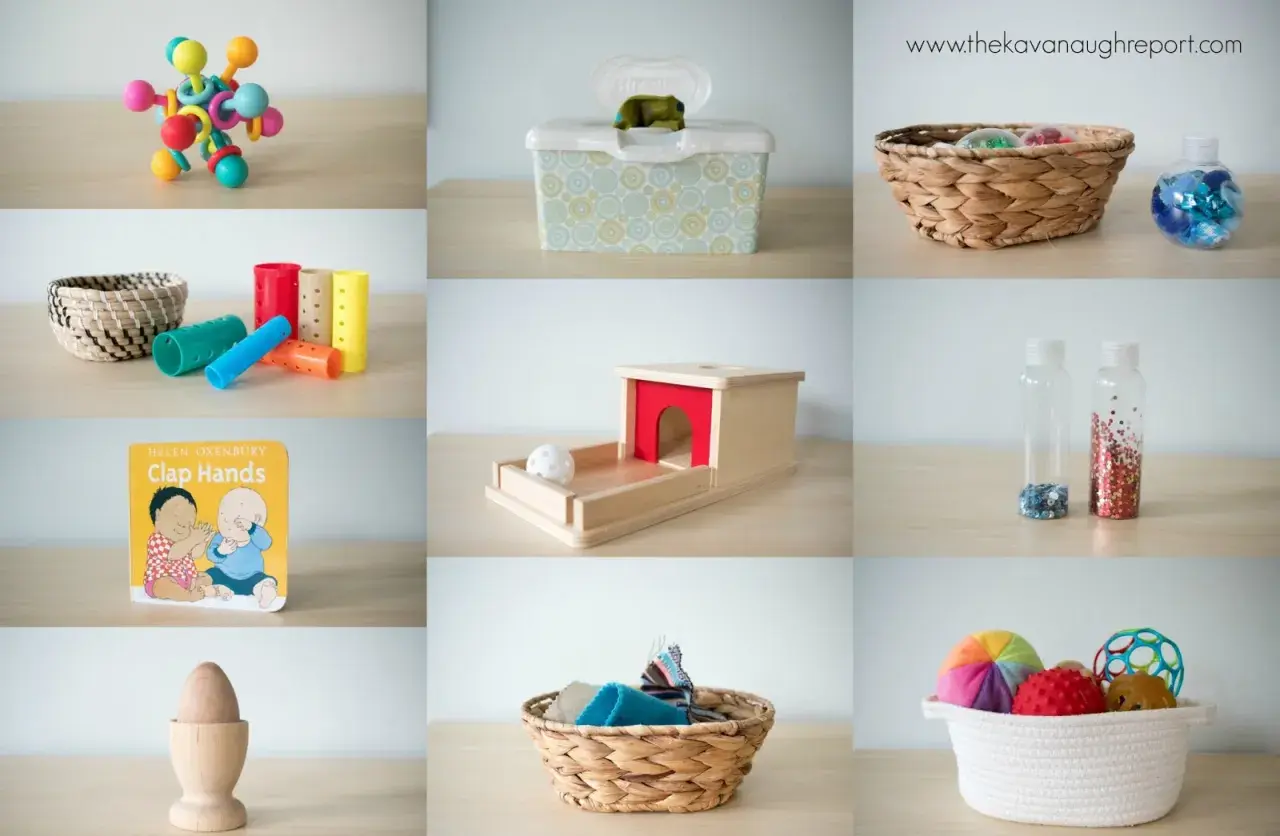
At eight months, Montessori is less about teaching a baby to "do school" and more about shaping the room so movement, repetition, and independent exploration can happen naturally. The right setup can help an infant who is sitting, rolling, reaching, or starting to crawl spend longer with one activity instead of bouncing from toy to toy. In this article I break down what Montessori really means at this age, which toys deserve shelf space, how I would set up the nursery, and what I would skip.
What matters most at eight months
- Keep the environment simple. Two to four toys on a low shelf is usually enough.
- Choose materials that support grasping, object permanence, visual tracking, and movement.
- A mirror, floor mat, and open shelf matter more than branded Montessori toys.
- For sleep, follow safe-sleep guidance with a crib, bassinet, or portable play yard.
- Rotate materials when interest drops. Do not flood the room with options.
What Montessori really looks like at eight months
At this age, Montessori is mostly a prepared environment. In many Montessori settings, the earliest infant stage is treated differently from the later mobile stage, because once a baby starts sitting, pivoting, crawling, and pulling up, the room has to change with that movement. That makes sense to me. An eight-month-old is not ready for lessons in the adult sense. The real work is motor control, repetition, and discovering how objects behave.
The CDC's 9-month checklist reflects that developmental shift: many babies around this stage sit without support, move objects from one hand to the other, look for dropped toys, and use their fingers to rake food. That is the level I plan around. I want the environment to support what the child is already trying to master, not overwhelm them with things they cannot use yet.
So when people ask about Montessori for an eight-month-old, I usually translate that into a simpler question: how do I build a room that makes it easy for my baby to move, focus, and repeat? Once that lens is clear, the toy shelf becomes much easier to edit.The best toys and activities for an eight-month-old
I think in categories here: things to grasp, things to hide and find, things to watch, and things to move toward. You do not need a lot of products. You need a few that match the baby’s current skills and invite repetition.
| Material | Why it works | What to look for | Typical US price |
|---|---|---|---|
| Low mirror with floor mat | Builds body awareness and encourages rolling, pivoting, sitting, and early crawling | Shatter-resistant mirror, stable backing, soft mat or rug underneath | $25 to $100 |
| Object permanence box or a simple hide-and-find game | Supports cause-and-effect and the idea that objects still exist when hidden | A simple drop box, cup, or scarf-and-ball setup with no tiny parts | $15 to $70 |
| Grasping ring, wooden rattle, or soft transfer toy | Helps with hand opening, hand-to-hand transfer, and mouth exploration | Lightweight, easy to hold, smooth edges, non-toxic finish | $10 to $30 |
| Soft ball or rolling ball activity | Encourages tracking, reaching, crawling toward a target, and early coordination | Quiet texture, easy to roll, large enough to avoid choking risk | $8 to $25 |
| Small basket of safe household objects | Creates a simple sensory and practical-life experience without flashing lights | One fabric square, one silicone spoon, one metal cup, one teether, one wooden spoon | $0 to $20 |
I keep the presentation short. One item at a time is usually enough, especially if the baby is still learning how to sit, rotate, and shift weight. If the child bangs two objects together, mouths a toy, or transfers it from hand to hand, that is not random play. That is concentration, and it is exactly what I want to see.
- Place your baby on a stable floor space.
- Offer one material within easy reach.
- Show the action slowly once, then stop.
- Wait and let the baby explore without interruption.
- Put the item away while interest is still alive, not after it has become a fight.
That approach works better than a crowded toy bin, and it leads naturally into how the room itself should be arranged.

How to set up a safe Montessori-inspired room
The room does not need to be expensive, but it does need to be deliberate. I want clear floor space, a low open shelf, a soft mat or rug, and a few carefully chosen objects that are easy to see and reach. The goal is not decoration. The goal is accessibility.
A practical starter setup often costs less than people expect. If you already have a rug and a shelf, the core space can usually be built for about $50 to $150. If you are buying everything new, a more realistic total is $120 to $300, depending on the mirror, shelf, and safety hardware you choose. The point is not to buy more. The point is to buy less, but better.
- Use a low, open shelf so the baby can eventually see the materials clearly.
- Anchor furniture, cover outlets, secure cords, and block stairs if needed.
- Keep breakables, tiny pieces, and decorative clutter out of reach.
- Use a mirror low enough for the baby to notice body movement.
- Limit the shelf to a few items so each one feels meaningful.
One place I draw a hard line is sleep. The AAP still recommends a crib, bassinet, or portable play yard with a firm, flat mattress and fitted sheet for infant sleep. I would not replace that with a loose floor mattress for an eight-month-old. Montessori can shape the play space now, but it should not override safe sleep.
Once the room is calm and usable, the next challenge is avoiding the traps that make a Montessori setup look good but work poorly.
What to skip at this age
At eight months, less really is more. Babies this age are building attention along with movement, so the room should support focus instead of competing with it.
- Skip flashing electronic toys that do the work for the child.
- Skip a crowded shelf with ten or more options.
- Skip toys with small parts or anything that can break into fragments.
- Skip loud, overstimulating toys that distract from movement and repetition.
- Skip the idea that Montessori means a floor bed for infant sleep.
I also skip toys that only entertain from one fixed position. An eight-month-old needs freedom to roll, pivot, crawl, and reach. If a toy traps the baby in one posture for too long, it works against the stage they are in. That is the subtle mistake many parents make: they buy something labeled educational, then accidentally remove the movement that makes learning possible.
When those distractions are gone, the signs of progress become much easier to see.
How to know the setup is working
You do not need a perfect checklist to see whether the environment is helping. I look for repetition first. If a baby returns to the same toy, works the same motion several times, or stays engaged on the floor a little longer, the setup is doing its job.
- Your baby returns to the same material instead of grabbing everything at once.
- Reaching, rolling, or pivoting looks more controlled over time.
- The child seems calmer in the room because the choices are simple.
- Objects are transferred more easily from hand to hand.
- Interest fades naturally, which tells you it is time to rotate rather than add more.
I usually rotate just one item at a time, and only when interest has clearly dropped for a few days. That keeps the room fresh without making it chaotic. If your baby is not sitting steadily, moving objects between hands, or showing interest in sounds and faces by around nine months, I would talk with your pediatrician before adding more toys. More stuff is rarely the answer.
That is why I keep the final version simple: one calm room, a few good materials, and enough patience to let repetition do the work.
The smallest Montessori setup that still works well
If I were building this from scratch, I would start with four things: a floor mat, a low mirror, one grasping toy, and one object permanence activity. Then I would add a small basket of safe household objects and stop there for a while. That is enough to support the real developmental work of an eight-month-old without turning the room into a toy showroom.
The strongest Montessori setups for this age are usually the quietest ones. They make movement easy, keep sleep separate, and give the baby room to repeat the same action until it feels familiar. If you get those basics right, you are already doing the important part well, and the rest can grow with your child.
